Falcon 9 Block 5 | Starlink Group 17-25
Falcon 9 • Falcon
A batch of 25 satellites for the Starlink mega-constellation - SpaceX's project for space-based Internet communication system.
Complete launch database from global space agencies
Falcon 9 • Falcon
A batch of 25 satellites for the Starlink mega-constellation - SpaceX's project for space-based Internet communication system.
Falcon 9 • Falcon
A batch of 28 satellites for the Starlink mega-constellation - SpaceX's project for space-based Internet communication system.
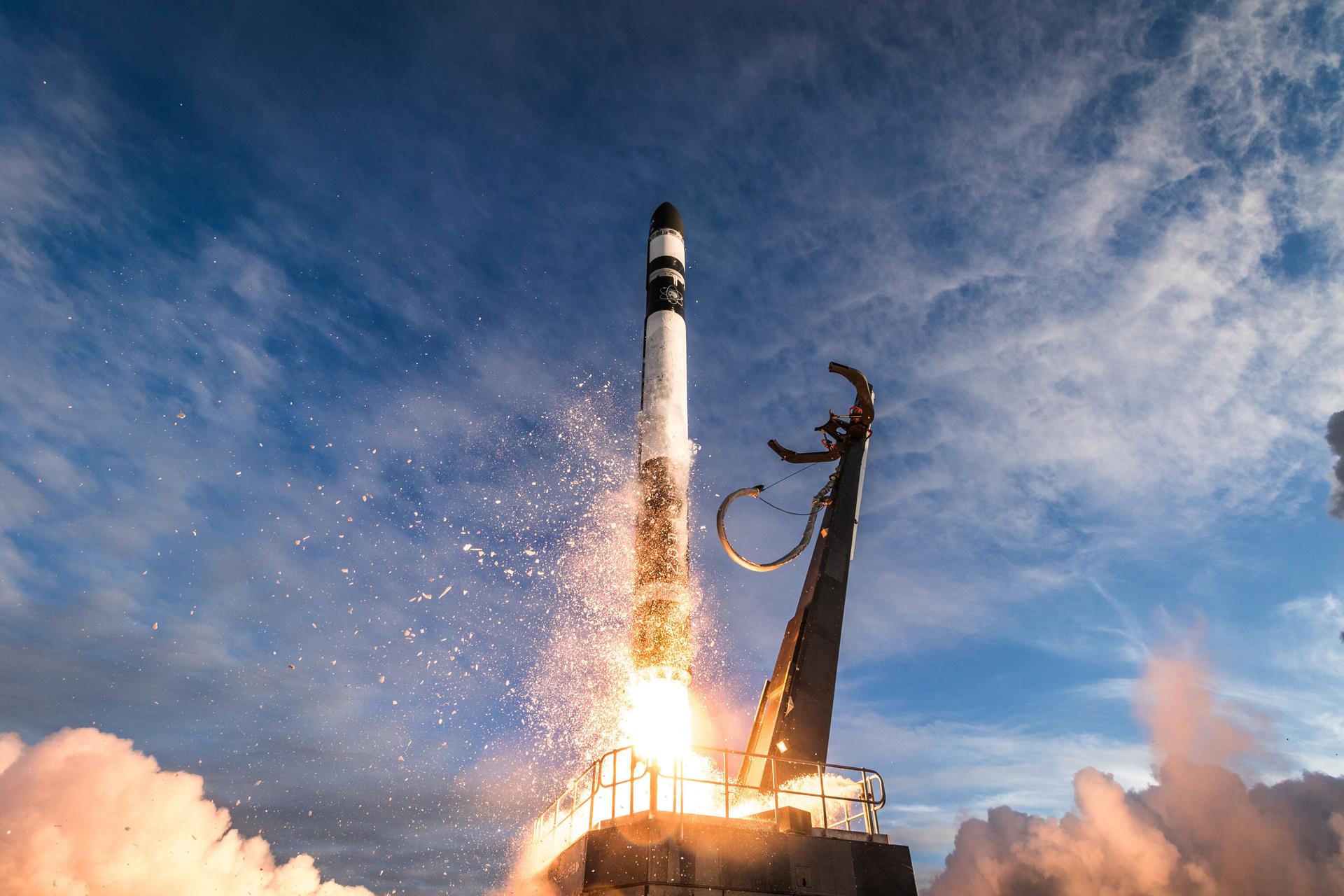
Electron •
Payload is a scramjet-powered hypersonic vehicle developed by by Australian company Hypersonix.
Falcon 9 • Falcon
A batch of 25 satellites for the Starlink mega-constellation - SpaceX's project for space-based Internet communication system.
Falcon 9 • Falcon
A batch of 29 satellites for the Starlink mega-constellation - SpaceX's project for space-based Internet communication system.
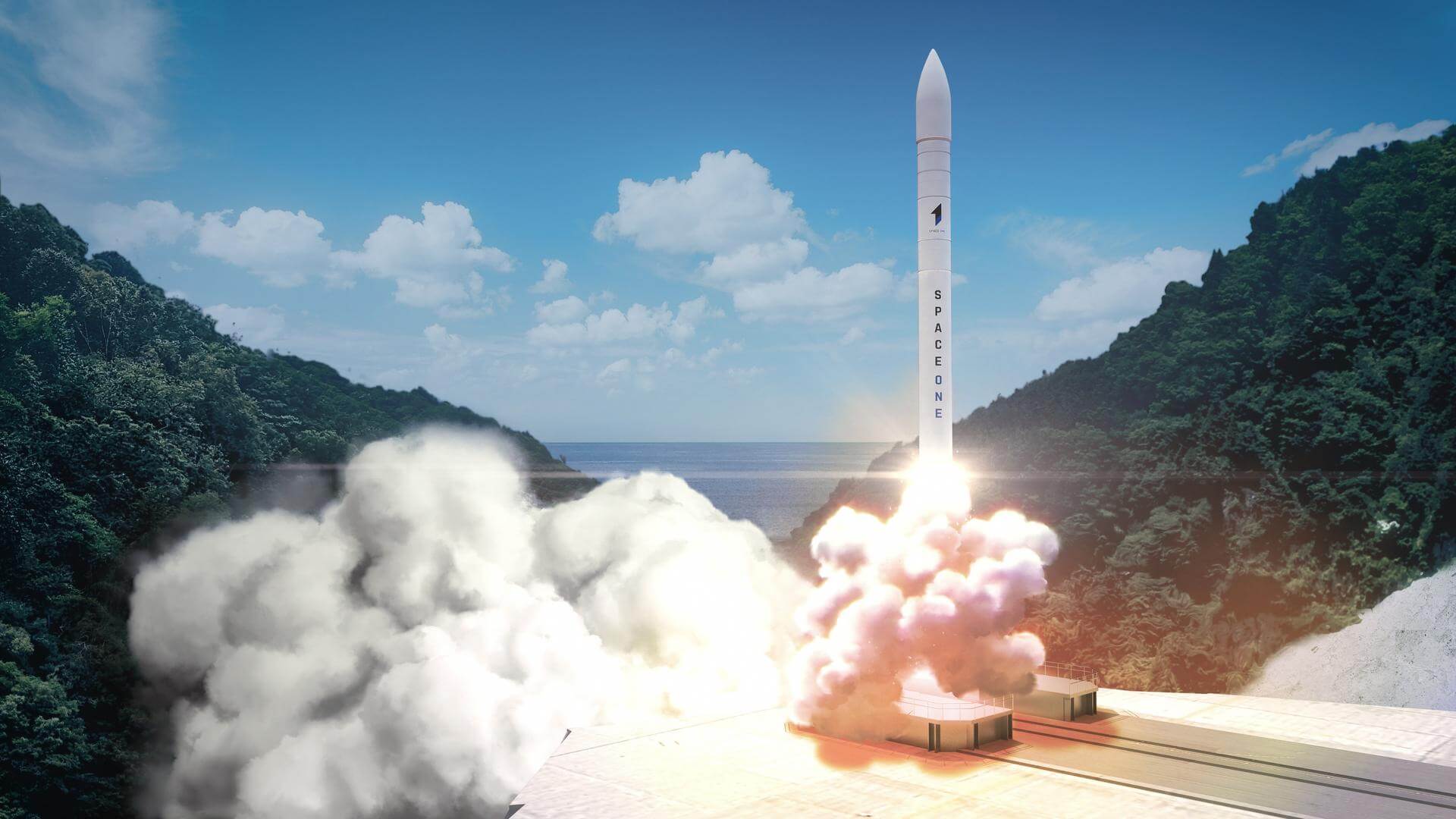
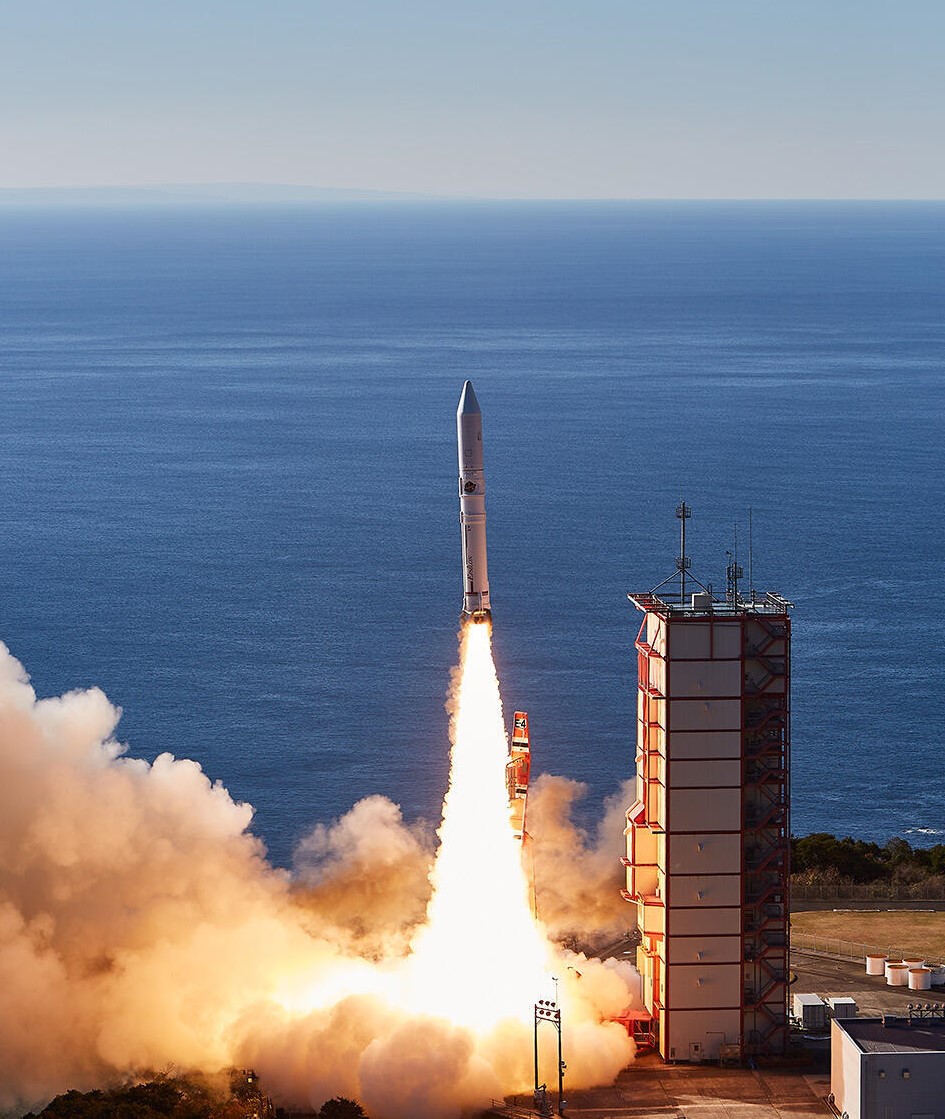
KAIROS •
Third flight of the KAIROS launch vehicle. 4 satellites will be on board: * TATARA-1R * SC-Sat1a * HErO * AETS-1
Falcon 9 • Falcon
A batch of 29 satellites for the Starlink mega-constellation - SpaceX's project for space-based Internet communication system.
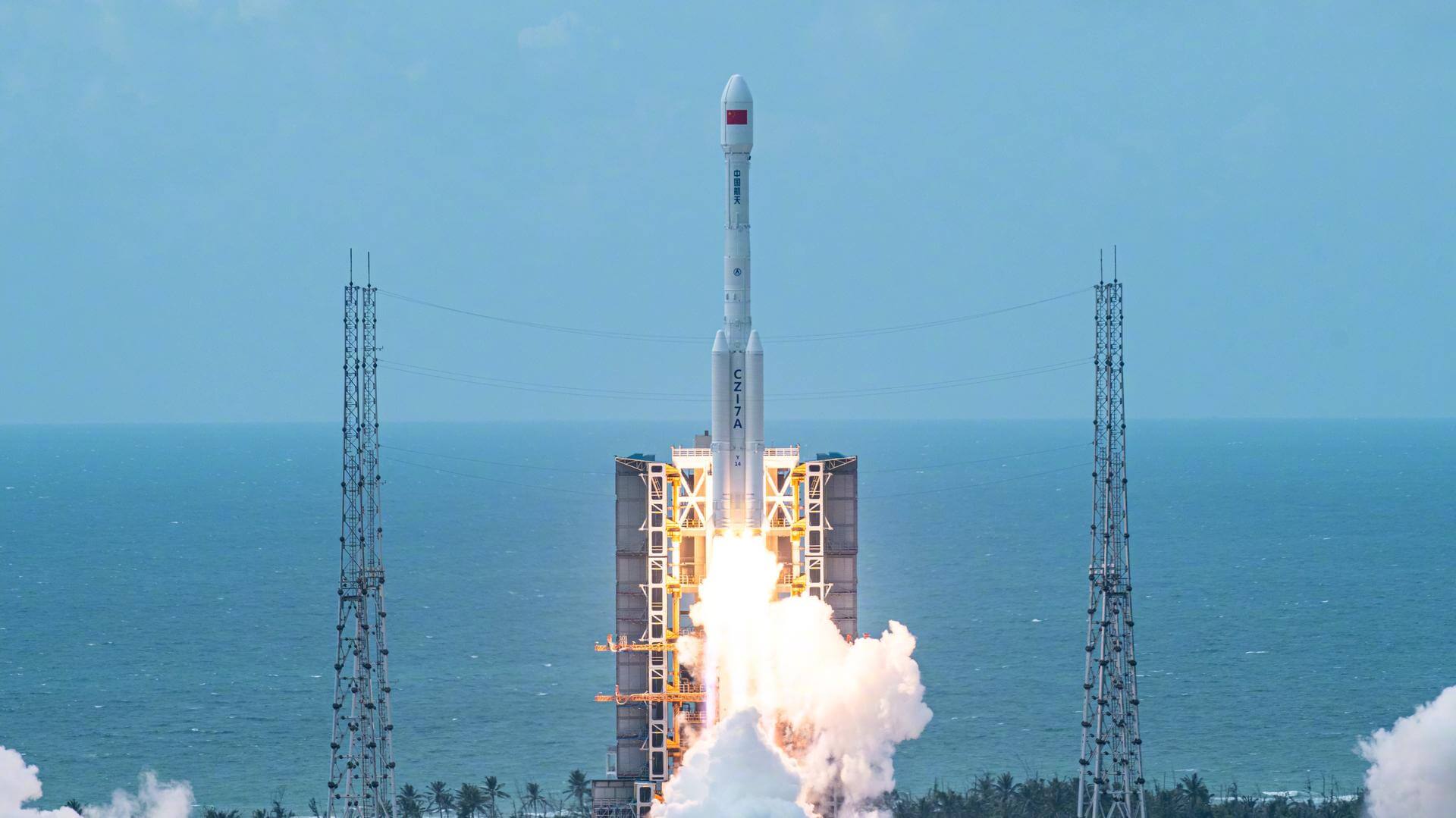
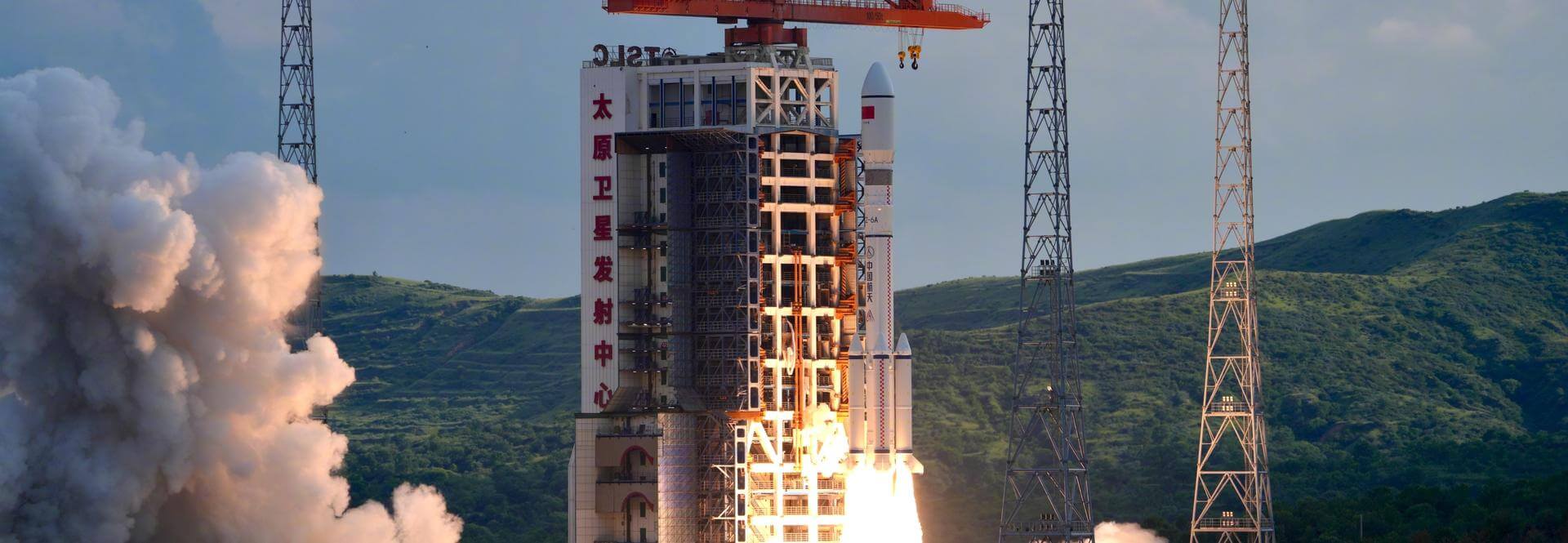
Long March 7A • Long March
Details TBD.
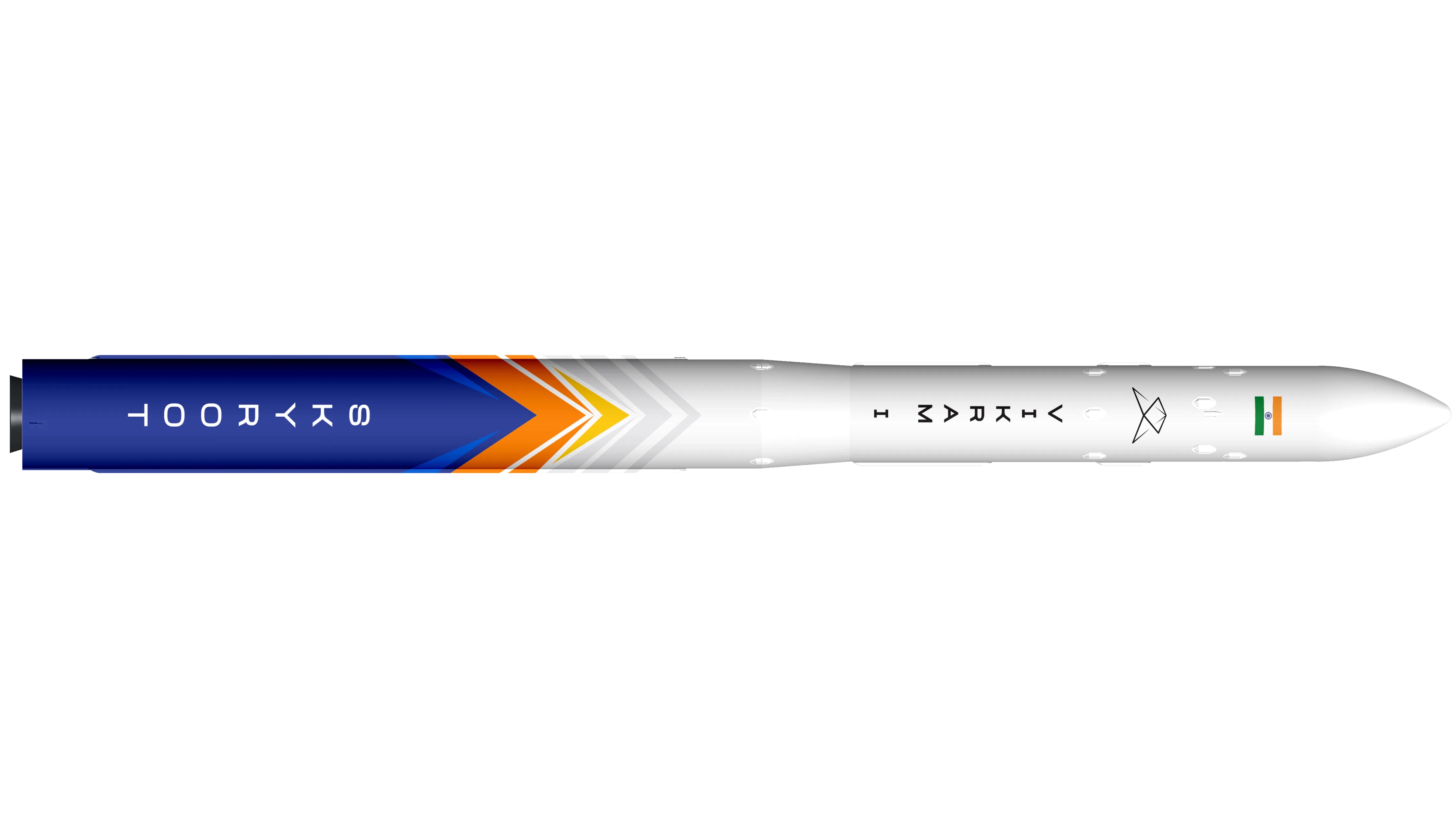
Vikram-I • Vikram
First launch of Skyroot Aerospace's Vikram-I launch vehicle, with several cubesats on board. Payload identities TBD.
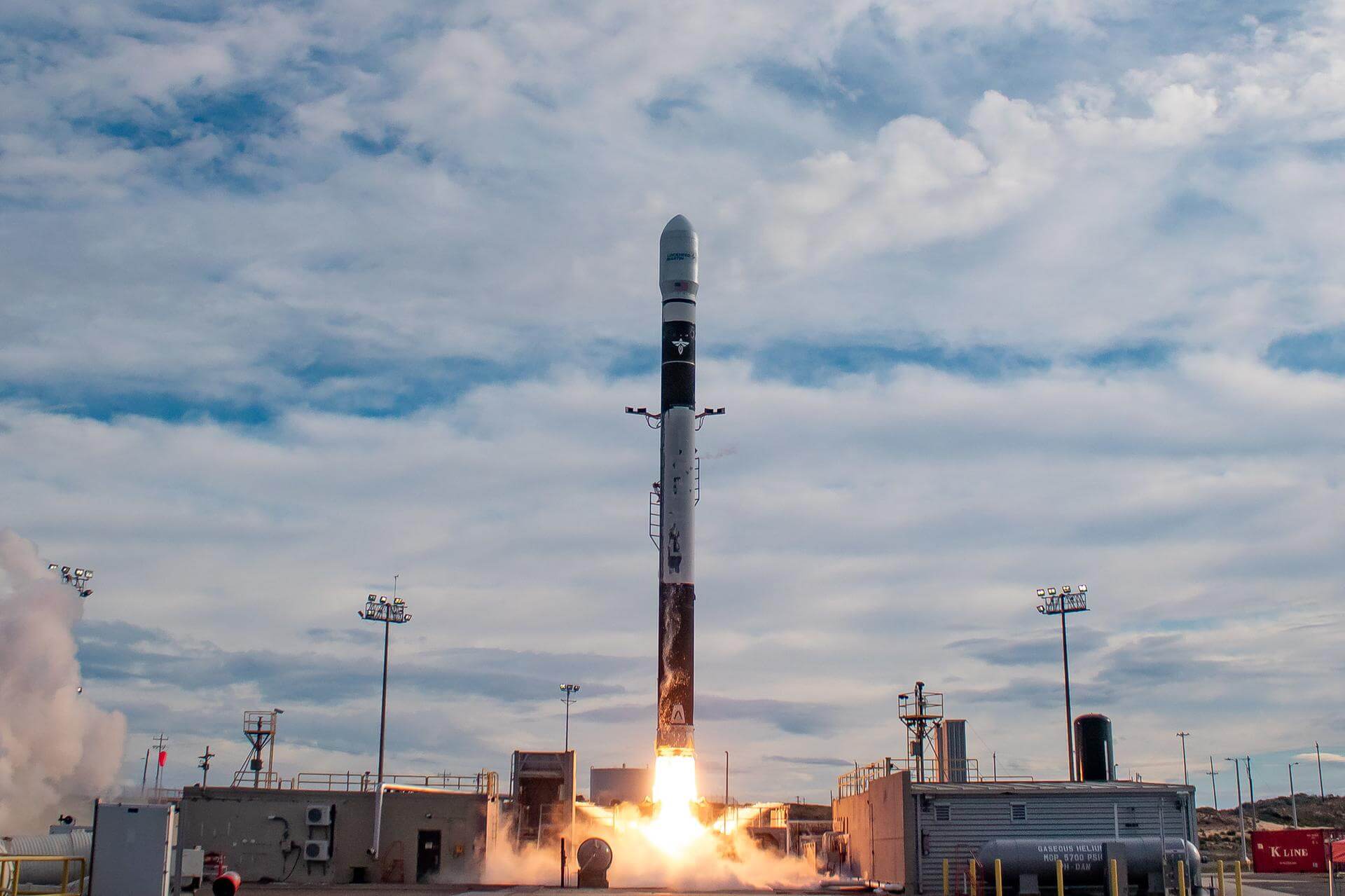
Firefly Alpha •
Firefly Alpha's Flight 7 will be a test flight and return-To-Flight for the launch vehicle after its April 2025 launch failure. It will test and validate key systems ahead of Firefly’s Block II configuration upgrade on Flight 8 that’s designed to enhance reliability and manufacturability across the vehicle. Flight 7 will be the last flown in Alpha’s current configuration and will test multiple Block II subsystems, including the in-house avionics and thermal improvements, to gain flight heritage and validate lessons learned ahead of the full configuration upgrade on Flight 8.
Falcon 9 • Falcon
A batch of 25 satellites for the Starlink mega-constellation - SpaceX's project for space-based Internet communication system.
Falcon 9 • Falcon
A batch of 29 satellites for the Starlink mega-constellation - SpaceX's project for space-based Internet communication system.
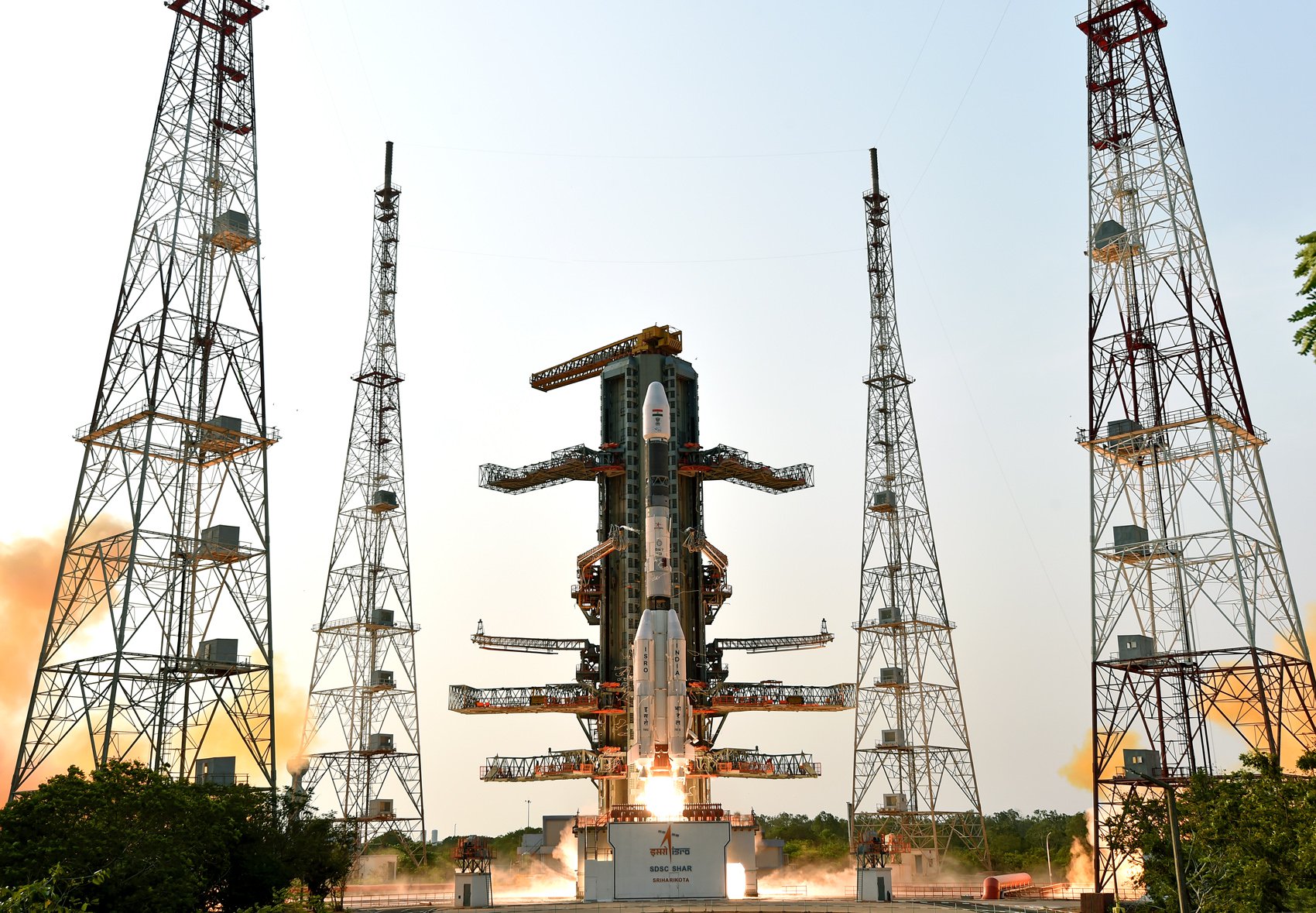
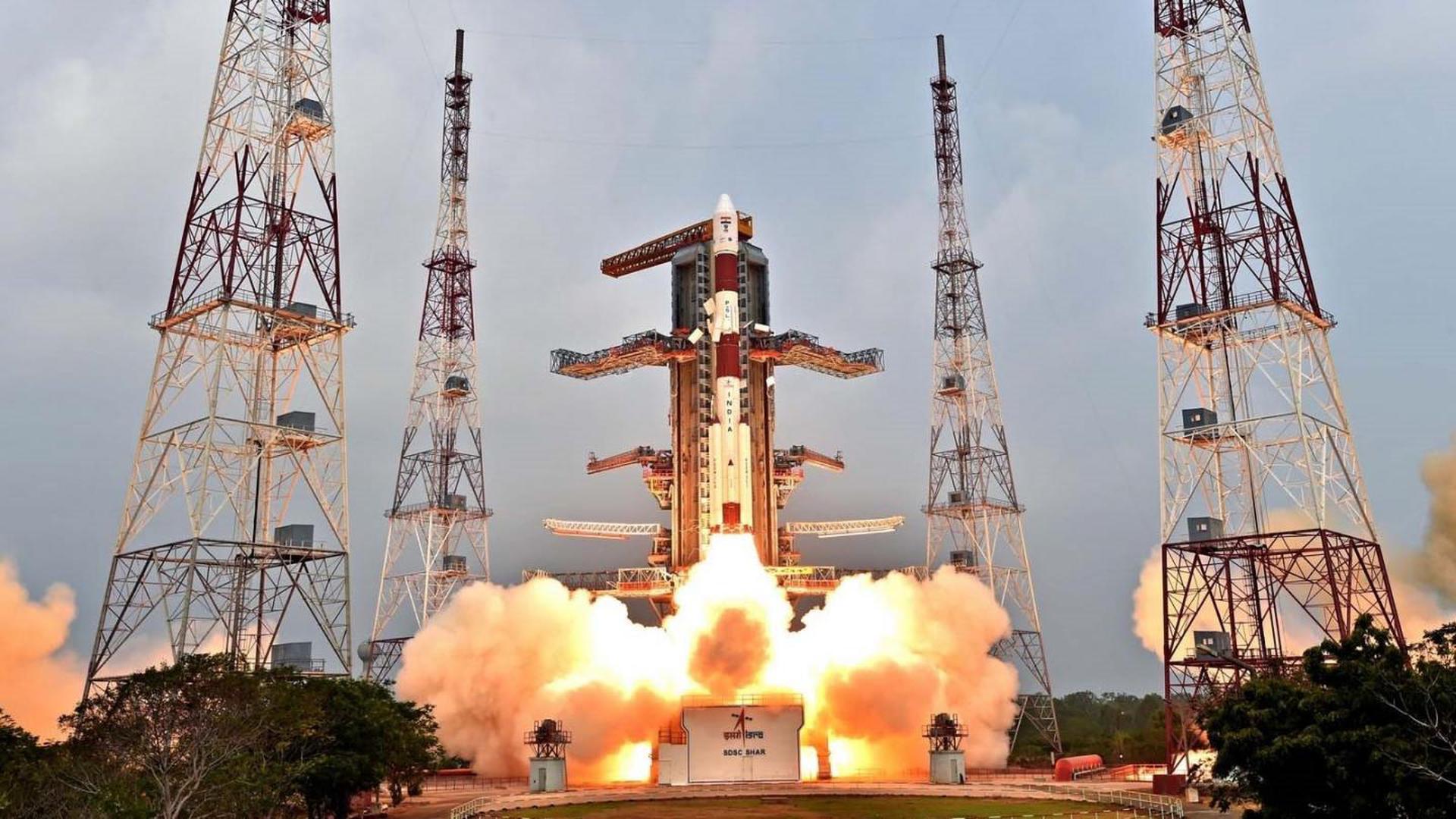
GSLV Mk II • GSLV
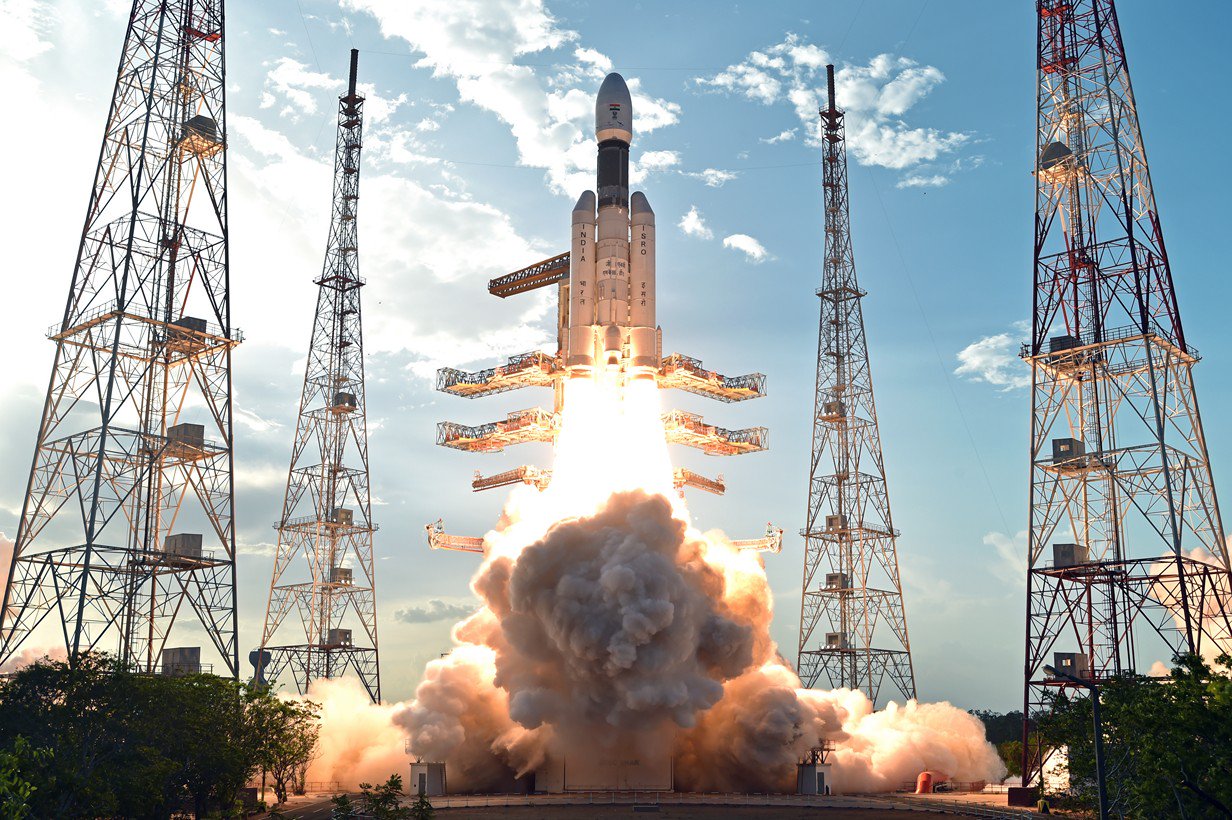
GISAT-1A (GEO Imaging Satellite) is an Indian earth observing satellite operating from geostationary orbit to facilitate continuous observation of Indian sub-continent, quick monitoring of natural hazards and disaster.
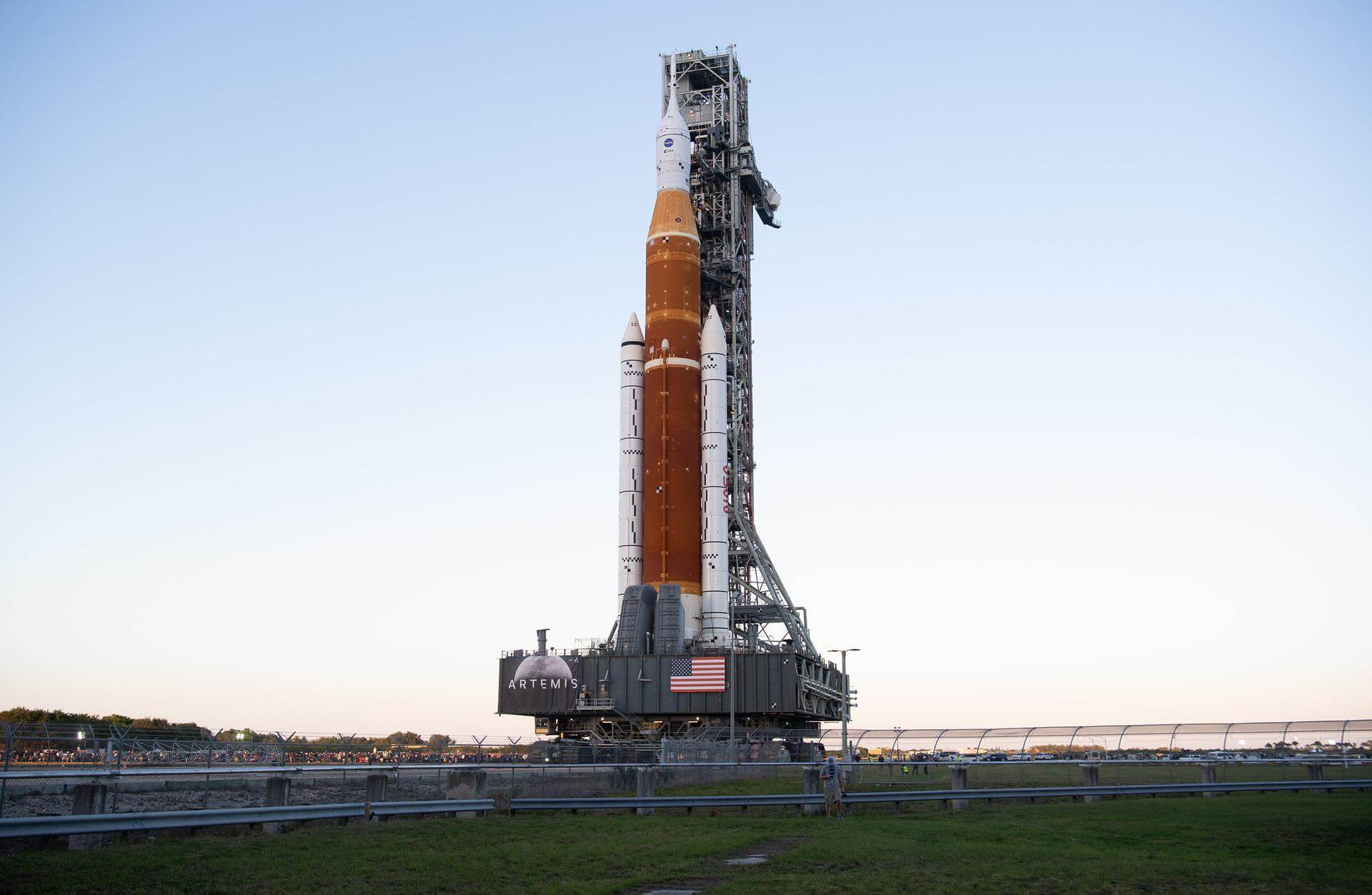
Space Launch System (SLS) • Space Launch System
Artemis II is the first crewed mission as part of the Artemis program. Artemis II will send a crew of 4 - 3 Americans and 1 Canadian around the moon and return them back to Earth. The mission will test the core systems of NASA's Orion spacecraft including the critical life support system, among other systems which could not be tested during Artemis I due to the lack of crew onboard.
Falcon 9 • Falcon
EchoStar 25 is a direct broadcast satellite, built on the proven Maxar 1300 series platform, which will deliver content across North America. It will be equipped with a high-power, multi-spot beam payload, allowing DISH to provide high-quality content to its customers.
Spectrum •
Second test flight of the Isar Spectrum launch vehicle. This launch will carry 5 cubesats and 1 non-separable experiment as part of European Space Agency (ESA)'s “Boost!” program: * CyBEEsat (TU Berlin) * TriSat-S (University of Maribor) * Platform 6 (EnduroSat) * FramSat-1 (NTNU) * SpaceTeamSat1 (TU Wien Space Team) * Let It Go (Dcubed, non-separable experiment)
Soyuz 2.1a • Soyuz
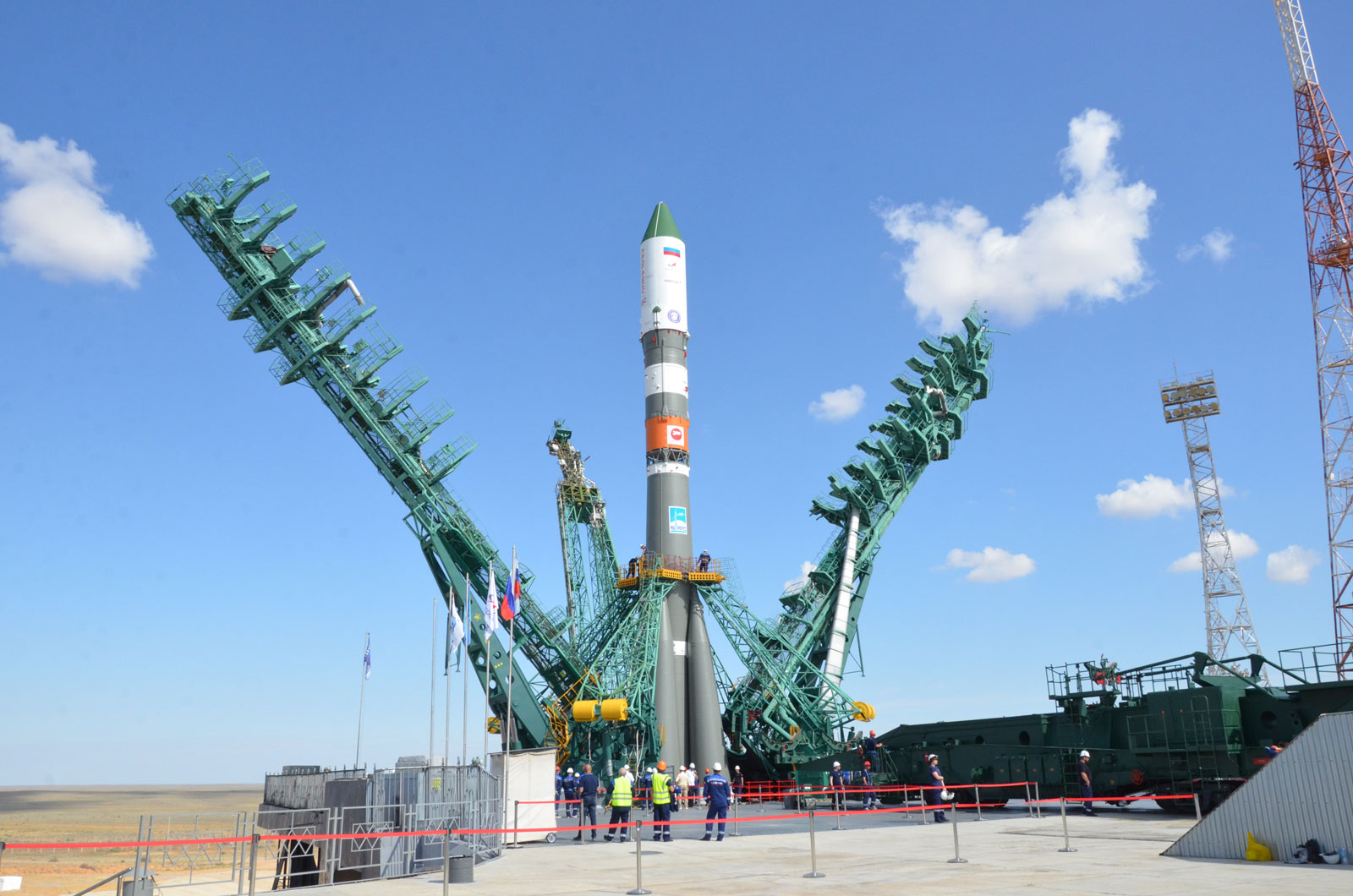
Progress resupply mission to the International Space Station.
Falcon 9 • Falcon
Dedicated rideshare flight to a sun-synchronous orbit with dozens of small microsatellites and nanosatellites for commercial and government customers.
Starship • Starship
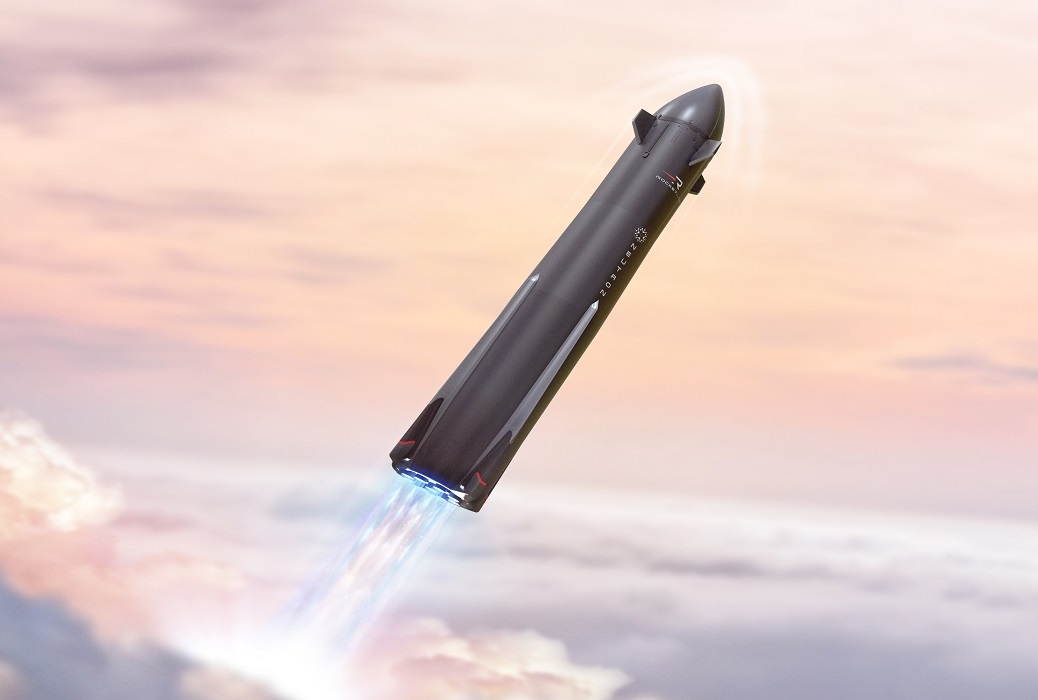
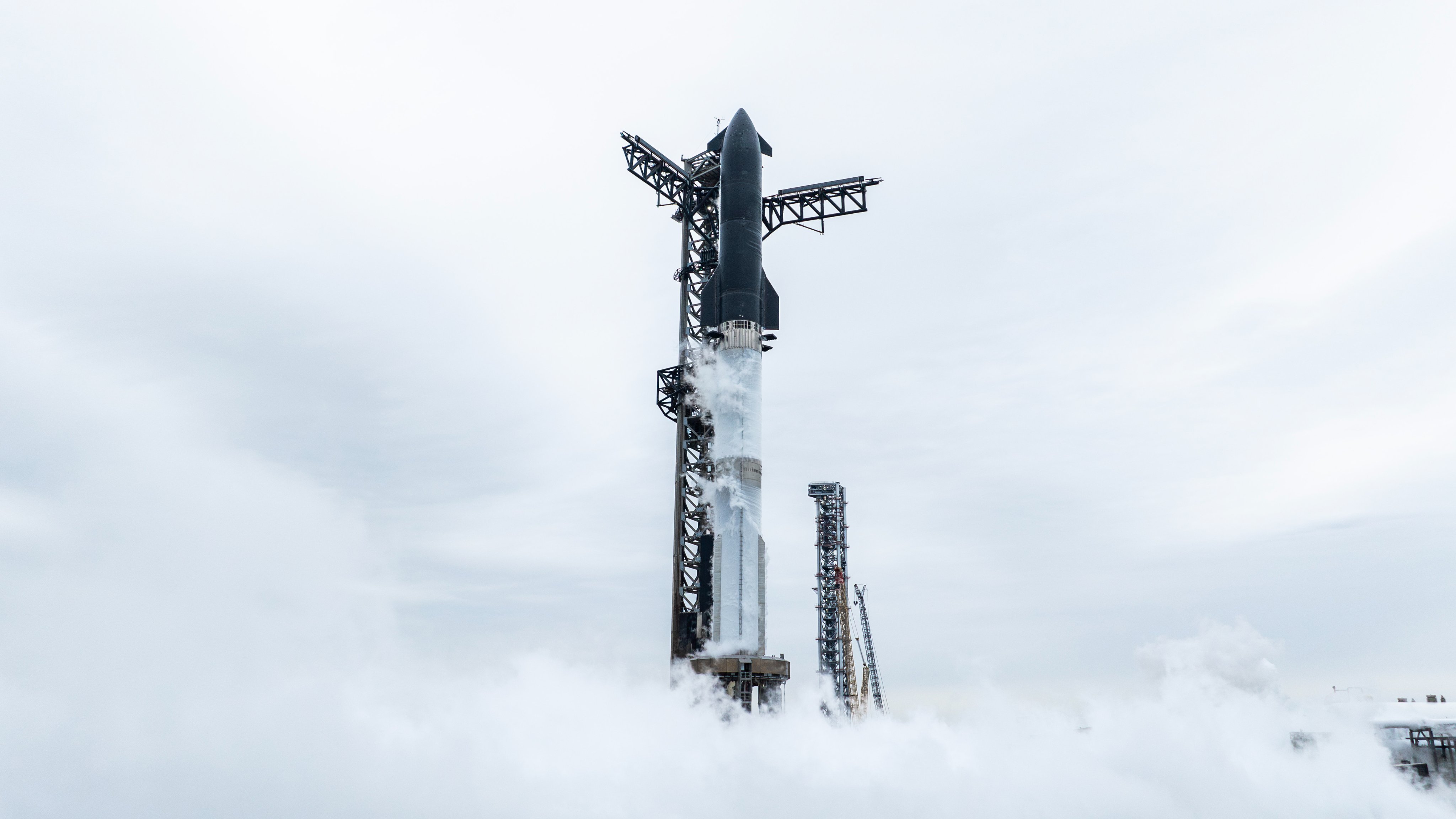
12th test flight of the two-stage Starship launch vehicle. Maiden Flight of Starship V3
Kinetica 2 •
First test launch of CAS Space’s Kinetica-2 rocket.
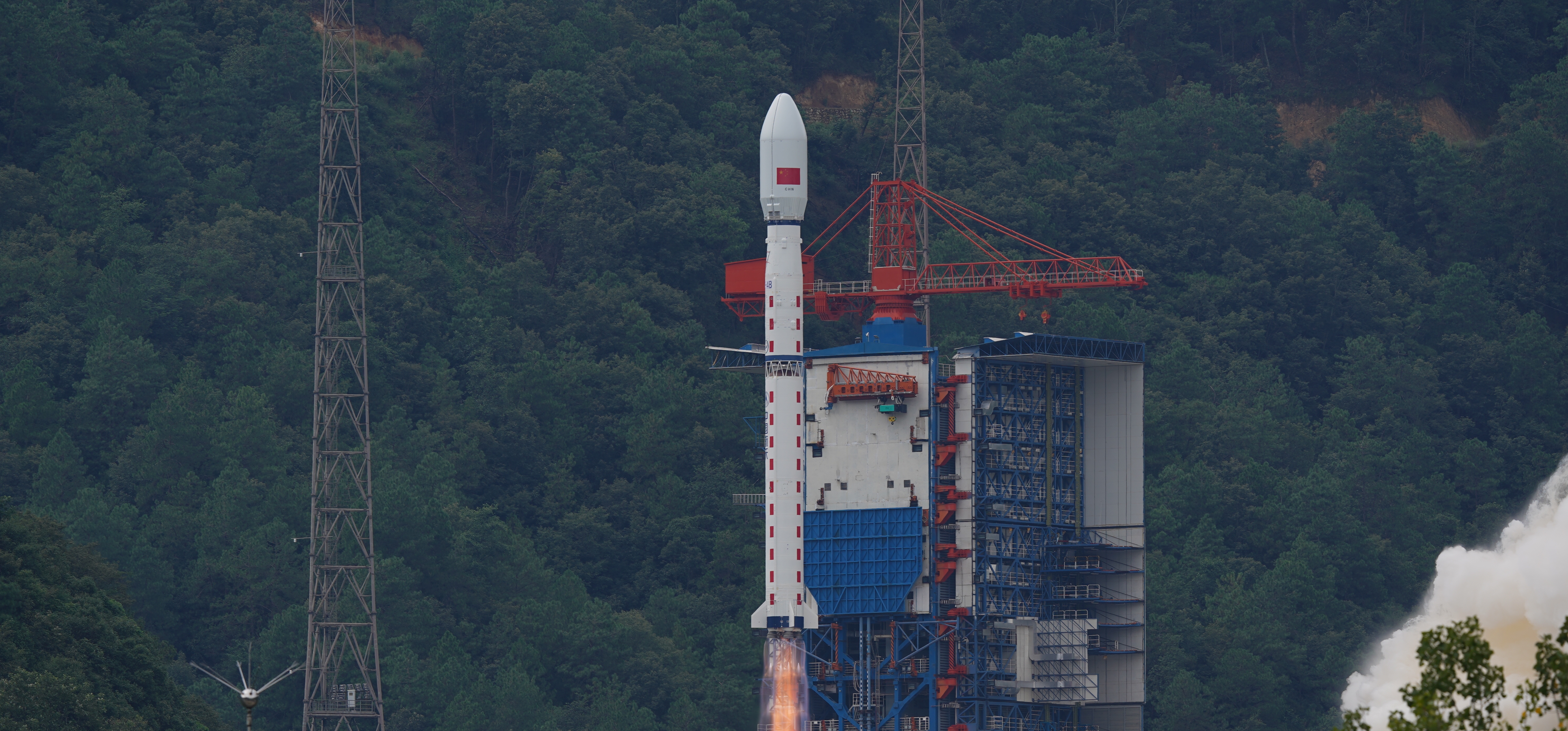
Long March 12B • Long March
First test launch of CASC’s Long March 12B rocket.
Tianlong-3 •
First test launch of Space Pioneer’s Tianlong-3 rocket.
Falcon 9 • Falcon
Tranche 1 Transport Layer E is one of six missions by the United States Space Force Space Development Agency (SDA) for the Proliferated Warfighter Space Architecture (PWSA) Tranche 1 Transport Layer constellation, which will provide assured, resilient, low-latency military data and connectivity worldwide to the full range of warfighter platforms from Low Earth Orbit satellites. The constellation will be interconnected with Optical Inter-Satellite Links (OISLs) which have significantly increased performance over existing radio frequency crosslinks. It is expected to operate over Ka band, have stereo coverage and be dynamically networked for simpler hand-offs, greater bandwidth and fault tolerance.
Neutron •
Maiden flight of the Neutron launch vehicle.
LVM-3 (GSLV Mk III) • GSLV
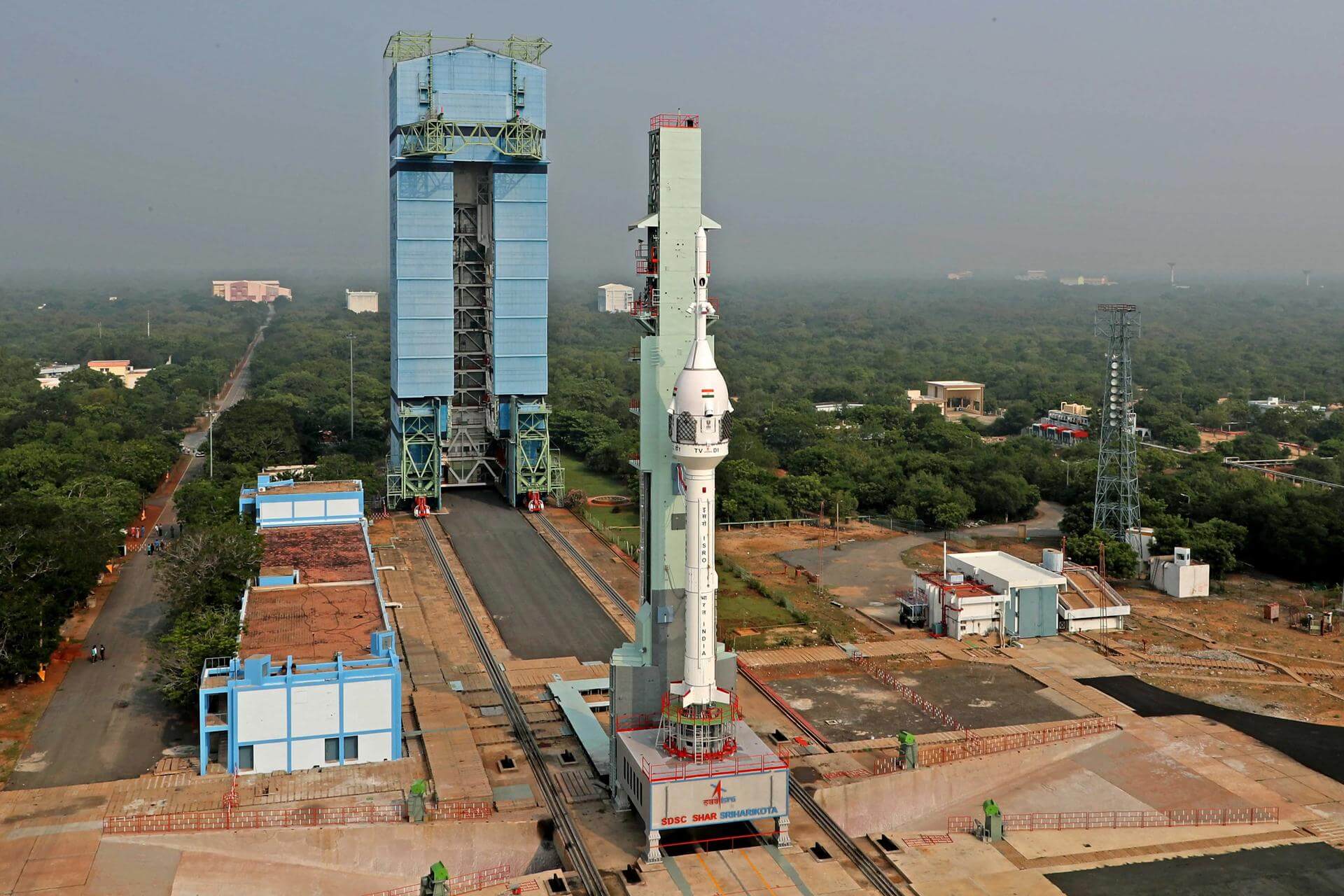
First uncrewed orbital test flight of the Gaganyaan capsule.
Vega-C • Vega
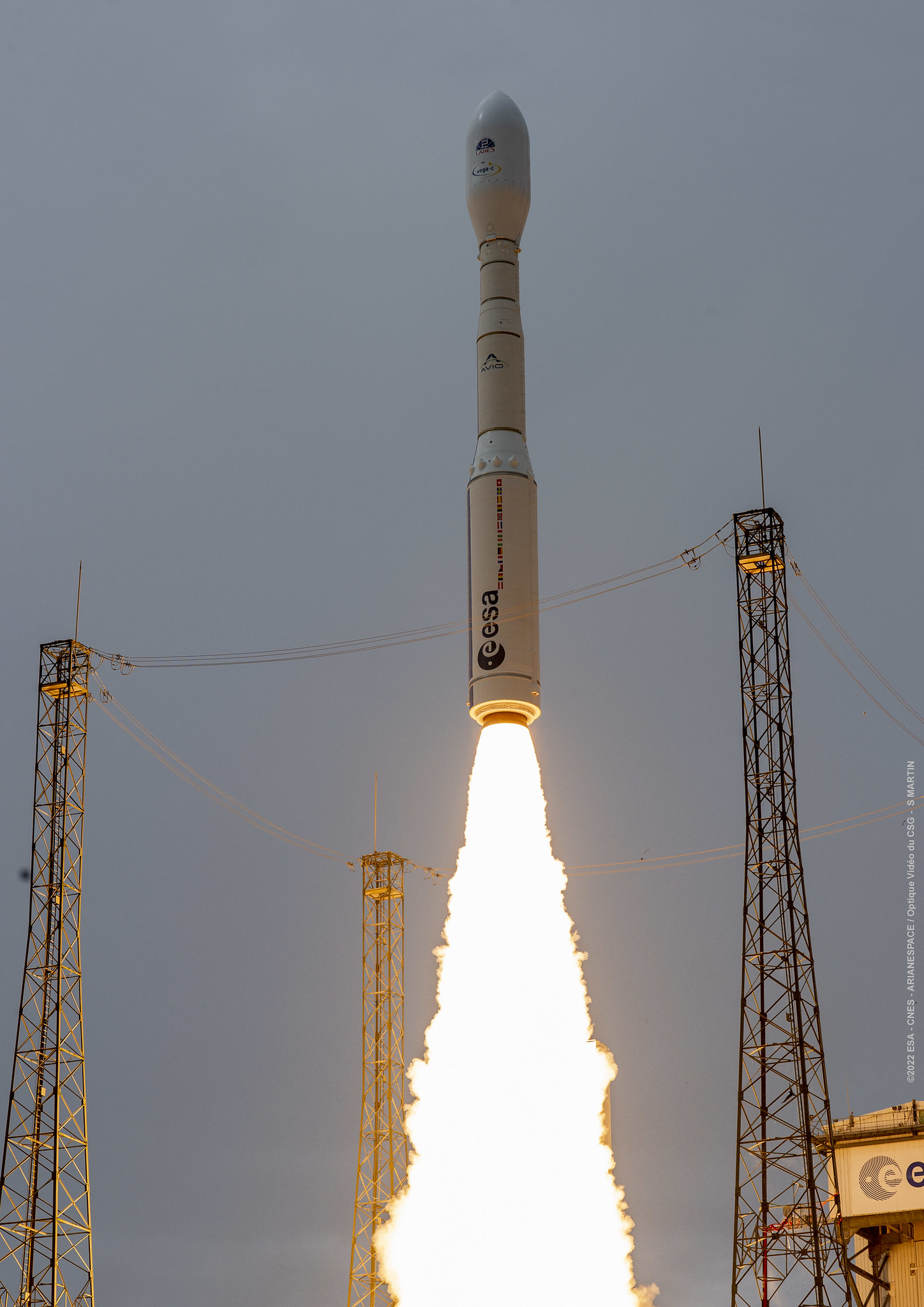
This Vega-C launch carries the Vega-C | PLATiNO 1 mission, scheduled for March 31, 2026. The mission aims to deliver important payloads to orbit, contributing to our understanding of space and advancing technological capabilities.
Electron •
Synthetic aperture radar satellite for Japanese Earth imaging company Synspective.
Gaganyaan Abort Test Booster •
The second inflight abort test of the Gaganyaan program.
GSLV Mk II • GSLV
This GSLV Mk II launch carries the GSLV Mk II | GSAT-32 mission, scheduled for March 31, 2026. The mission aims to deliver important payloads to orbit, contributing to our understanding of space and advancing technological capabilities.
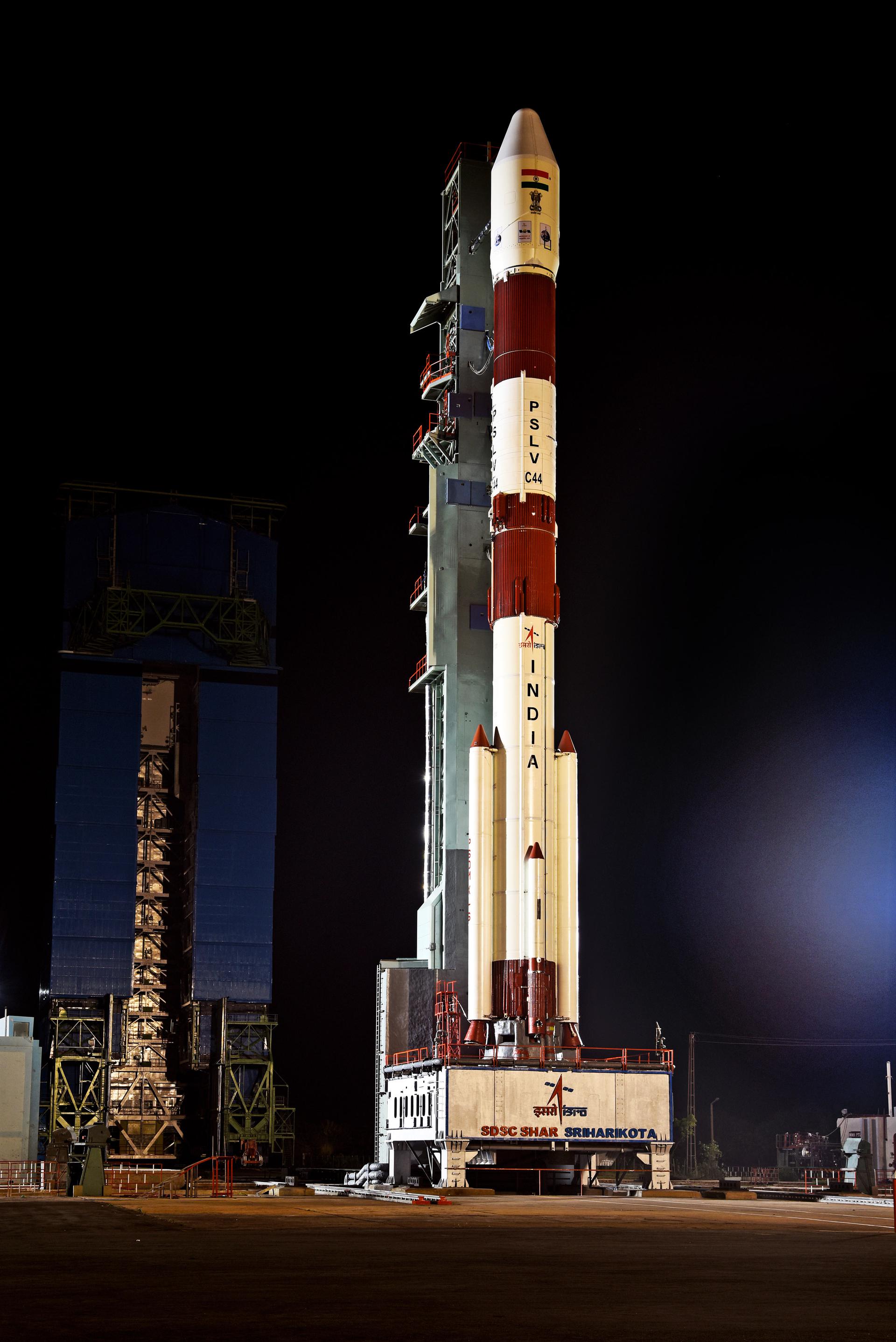
PSLV-XL • PSLV
Oceansat-3A is a part of ISRO's Oceansat program. Its main purpose is ocean observation, which includes gathering ocean color data, sea surface temperature measurements and wind vector data.
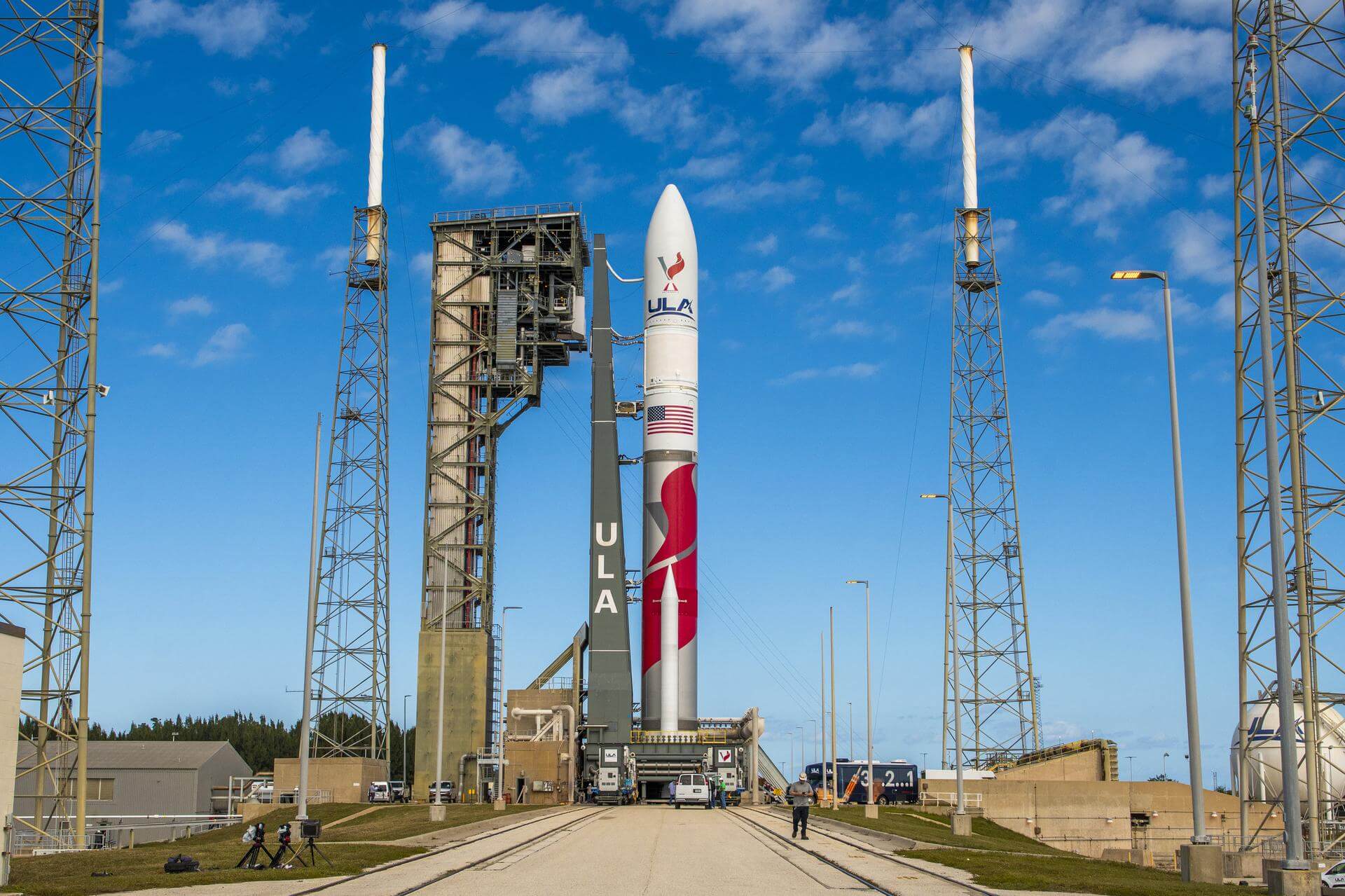
Vulcan • Vulcan
Last mission of the Wideband Global SatCom (WGS) series.
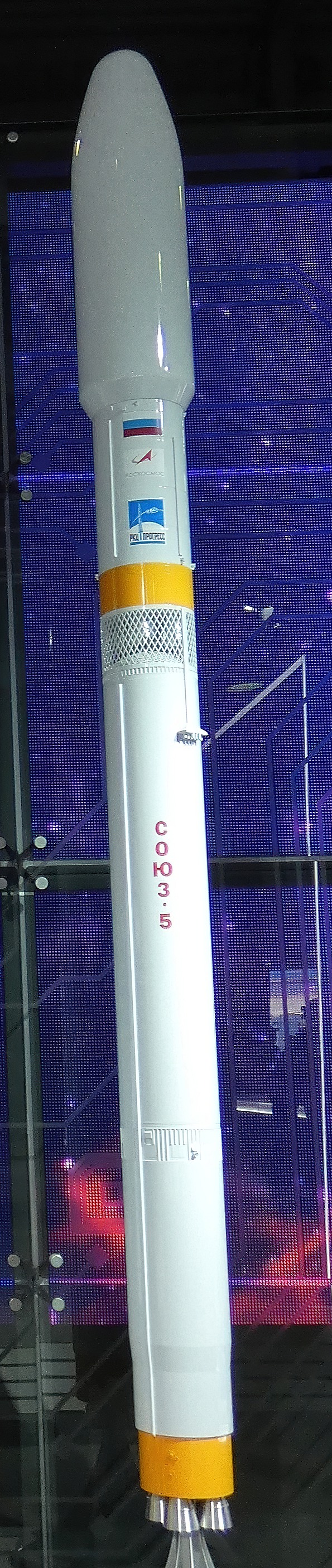
Soyuz-5 • Soyuz-5
Demonstration Flight for Russia's new Soyuz-5 launch vehicle. Details TBD.
Electron •
The European Space Agency (ESA)'s LEO-PNT (Low Earth Orbit Positioning, Navigation and Timing) demonstrator mission will feature a 10-satellite constellation demonstration mission that will assess how a low Earth orbit fleet of satellites can work in combination with the Galileo and EGNOS constellations in higher orbits that provide Europe’s own global navigation system. This launch will lift 2 “Pathfinder A” satellites built by Thales Alenia Space and GMV to a 510 km altitude Low Earth Orbit.
PSLV • PSLV
TDS-01 (Technology Demonstration Satellite-01) is an Indian geostationary orbit technology demonstration satellite carrying payloads for the Indian Space Research Organisation (ISRO)’s Institute of Plasma Research, Gandhinagar and the CSIR-CEERI, Pilani. Payloads to be tested included an internally developed 300 mN electric powered thrusters, atomic clocks, travelling wave tube amplifiers (TWTA) & a quantum communication suite (QuTDS).
New Glenn •
AST SpaceMobile’s Block 2 BlueBird satellites are designed to deliver up to 10 times the bandwidth capacity of the BlueBird Block 1 satellites, required to achieve 24/7 continuous cellular broadband service coverage in the United States, with beams designed to support a capacity of up to 40 MHz, enabling peak data transmission speeds up to 120 Mbps, supporting voice, full data and video applications. The Block 2 BlueBirds, featuring as large as 2400 square foot communications arrays, will be the largest satellites ever commercially deployed in Low Earth orbit once launched. This launch will feature 1 satellite, BlueBird 7/BlueBird Block 2 FM2.
Vulcan VC6L • Vulcan
Amazon Leo, formerly known as Project Kuiper, is a mega constellation of satellites in Low Earth Orbit that will offer broadband internet access, this constellation will be managed by Kuiper Systems LLC, a subsidiary of Amazon. This constellation is planned to be composed of 3,276 satellites. The satellites are projected to be placed in 98 orbital planes in three orbital layers, one at 590 km, 610 km and 630 km altitude. 45 satellites will be carried on each Vulcan launch.
Falcon 9 • Falcon
Tranche 1 Transport Layer D is one of six missions by the United States Space Force Space Development Agency (SDA) for the Proliferated Warfighter Space Architecture (PWSA) Tranche 1 Transport Layer constellation, which will provide assured, resilient, low-latency military data and connectivity worldwide to the full range of warfighter platforms from Low Earth Orbit satellites. The constellation will be interconnected with Optical Inter-Satellite Links (OISLs) which have significantly increased performance over existing radio frequency crosslinks. It is expected to operate over Ka band, have stereo coverage and be dynamically networked for simpler hand-offs, greater bandwidth and fault tolerance.
Electron •
JAXA-manifested rideshare of eight separate spacecraft that includes educational small sats, an ocean monitoring satellite, a demonstration satellite for ultra-small multispectral cameras, and a deployable antenna that can be packed tightly using origami folding techniques and unfurled to 25 times its size. The satellites were originally planned to launch with RAISE-4 on a Japanese Epsilon-S rocket, but the Epsilon-S was heavily delayed due to test firing failures. The 8 satellites are: * MAGNARO-II * KOSEN-2R * WASEDA-SAT-ZERO-II * FSI-SAT2 * OrigamiSat-2 * Mono-Nikko * ARICA-2 * PRELUDE
Falcon 9 • Falcon
Tranche 1 Transport Layer A is one of six missions by the United States Space Force Space Development Agency (SDA) for the Proliferated Warfighter Space Architecture (PWSA) Tranche 1 Transport Layer constellation, which will provide assured, resilient, low-latency military data and connectivity worldwide to the full range of warfighter platforms from Low Earth Orbit satellites. The constellation will be interconnected with Optical Inter-Satellite Links (OISLs) which have significantly increased performance over existing radio frequency crosslinks. It is expected to operate over Ka band, have stereo coverage and be dynamically networked for simpler hand-offs, greater bandwidth and fault tolerance. This launch carries 21 satellites manufactured by Northrop Grumman.
Vulcan • Vulcan
Tenth of ten GPS III missions.
Falcon 9 • Falcon
Tranche 1 Transport Layer F is one of six missions by the United States Space Force Space Development Agency (SDA) for the Proliferated Warfighter Space Architecture (PWSA) Tranche 1 Transport Layer constellation, which will provide assured, resilient, low-latency military data and connectivity worldwide to the full range of warfighter platforms from Low Earth Orbit satellites. The constellation will be interconnected with Optical Inter-Satellite Links (OISLs) which have significantly increased performance over existing radio frequency crosslinks. It is expected to operate over Ka band, have stereo coverage and be dynamically networked for simpler hand-offs, greater bandwidth and fault tolerance.
Falcon 9 • Falcon
This is the 24th flight of the Orbital ATK's uncrewed resupply spacecraft Cygnus and its 23rd flight to the International Space Station under the Commercial Resupply Services contract with NASA.
Minotaur IV • Minotaur
STP-S29A is a mission under the U.S. Department of Defense's Space Test Program (STP) that will deliver technology demonstrations to orbit and contribute to future space system development, with this launch delivering up to 200 kg of STP cubesats to Low Earth Orbit. The main payload will be STPSat-7, an ESPA class satellite based on the Aegis Aerospace M-1 satellite bus used on the STPSat-4 mission for hosting research and technology demonstration payloads for the Department of Defense (DoD). One of the payload is U.S. Naval Research Laboratory's (NRL) Lightsheet Anomaly Resolution and Debris Observation (LARADO) instrument, used to detect and characterize lethal non-trackable orbital debris with lasers in orbit.
Vega-C • Vega
Joint mission between the European Space Agency and the Chinese Academy of Sciences to investigate the interaction between Earth’s protective shield – the magnetosphere – and the supersonic solar wind.
Soyuz 2.1a • Soyuz
Progress resupply mission to the International Space Station.
Atlas V N22 • Atlas
Starliner-1 is the first operational flight of a Starliner spacecraft to the International Space Station as part of NASA's Commercial Crew Program. Due to problems with the Starliner spacecraft's RCS attitude control system during the Crew Flight Test mission in 2024, this mission has been re-scoped to not carry a crew by NASA. It will instead deliver necessary cargo to the orbital laboratory and allow in-flight validation of the system upgrades implemented following the Crew Flight Test mission last year.
Falcon 9 • Falcon
Commercial space station developed by Vast
Vulcan • Vulcan
First of three Next Generation Overhead Persistent Infrared geostationary satellites designed for missile warning.
Falcon 9 • Falcon
34th commercial resupply services mission to the International Space Station operated by SpaceX. The flight will be conducted under the second Commercial Resupply Services contract with NASA. Cargo Dragon 2 brings supplies and payloads, including critical materials to directly support science and research investigations that occur onboard the orbiting laboratory.
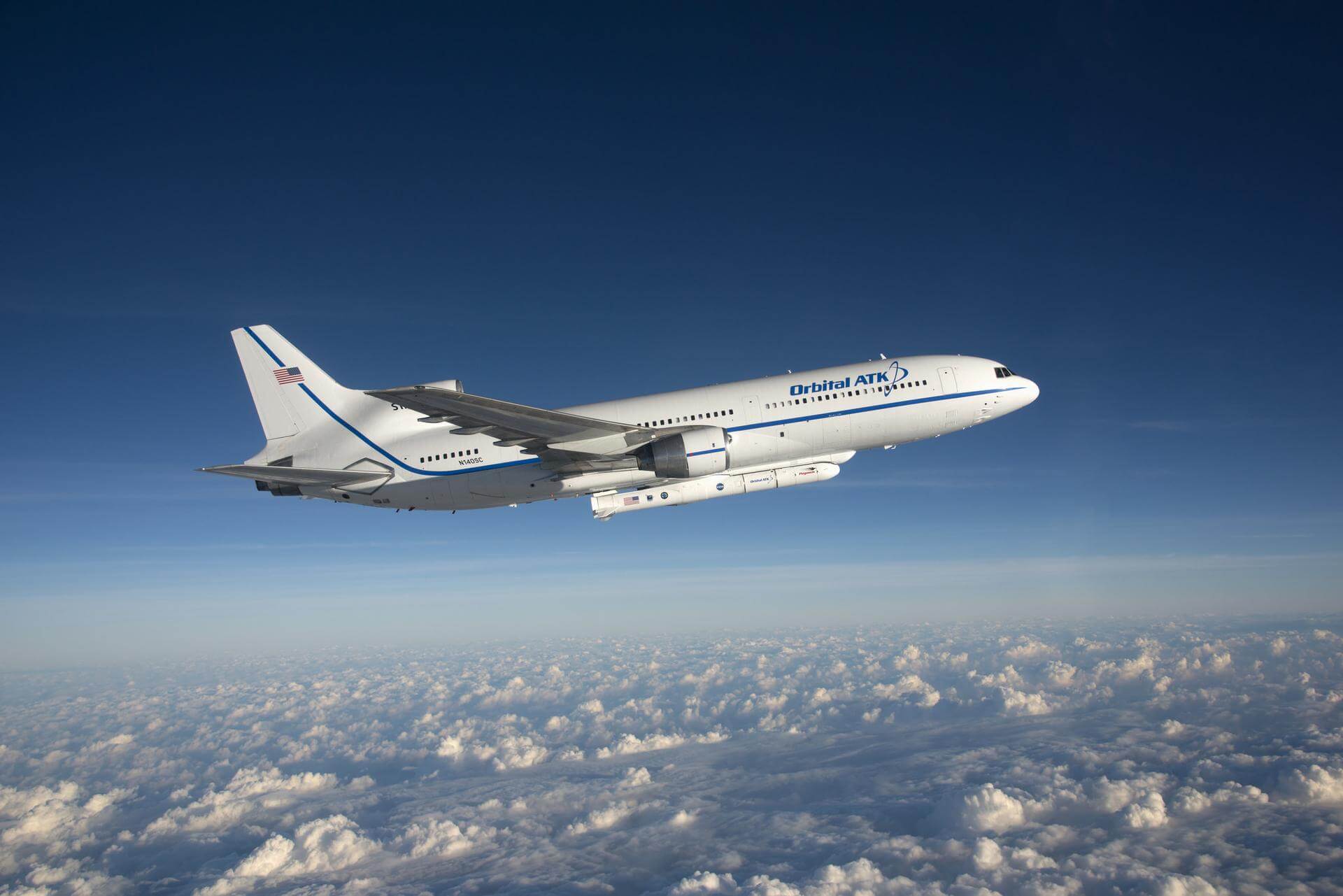
Pegasus XL • Pegasus
Contracted by NASA under the Small Business Innovation Research Phase 3 contract, Katalyst Space Technologies' LINK servicing spacecraft will rendezvous and attach to NASA’s Neil Gehrels Swift Observatory to re-boost its orbit. This aims to demonstrate a key capability for the future of space exploration and extending the Swift mission’s science lifetime in gamma ray astronomy.
Soyuz 2.1a • Soyuz
Progress resupply mission to the International Space Station.
Electron •
LOXSAT 1 is a demonstration satellite of a complete cryogenic oxygen fluid management system in orbit, developed by Eta Space and sponsored by NASA's Tipping Point program. The system will be integrated on a Rocket Lab Photon-LEO satellite bus and collect critical cryogenic fluid management data in orbit for 9 months, demonstrating capabilities of in-space cryogenic storage and transferal. Eta Space plans to use technology developed for this mission to develop a truly commercial depot intended to serve multiple customers in the future.
Firefly Alpha Block 2 • Firefly Alpha
True Anomaly’s Jackal Autonomous Orbital Vehicle (AOV) will support U.S. Space Force Space Systems Command’s VICTUS HAZE Tactically Responsive Space (TacRS) mission with operations in orbit proximity with another spacecraft built by Rocket Lab National Security. The spacecraft, once completed, will remain on call until the U.S. Space Force provides the notice to launch. The Firefly team will then have 24 hours to transport the payload fairing to the pad, mate the fairing to the Alpha rocket, fuel the rocket, and launch within the first available window.
Falcon 9 • Falcon
Dedicated rideshare flight to a sun-synchronous orbit with dozens of small microsatellites and nanosatellites for commercial and government customers.
Vega-C • Vega
This Vega-C launch carries the Vega-C | PLATiNO 2 mission, scheduled for June 30, 2026. The mission aims to deliver important payloads to orbit, contributing to our understanding of space and advancing technological capabilities.
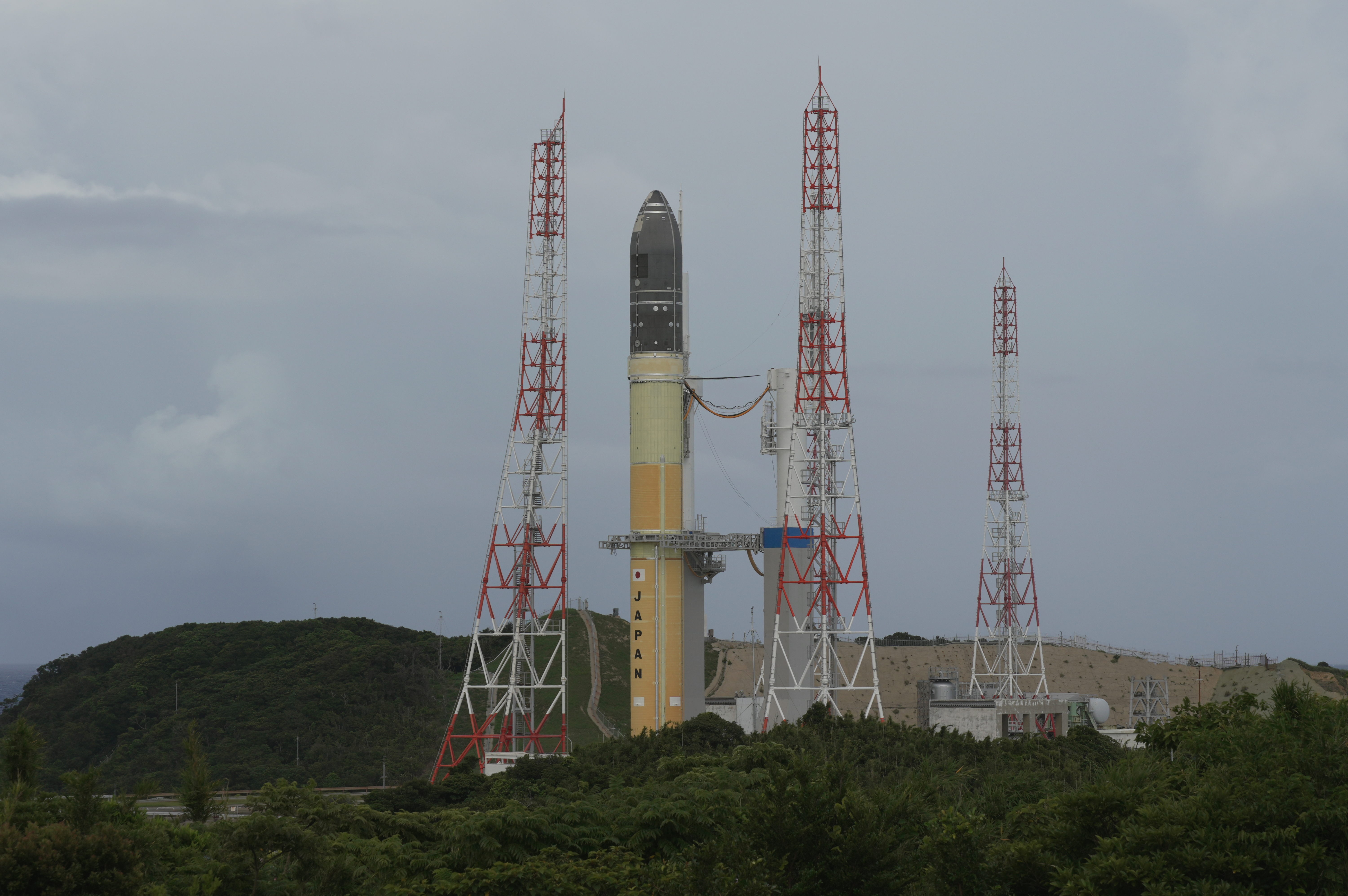
H3-30 • H3
Test flight of the H3-30 variant of the H3 launch vehicle with 3 LE-9 engines in the first stage and no SRBs. The flight will carry a dummy main payload (Vehicle Evaluation Payload 5, VEP-5) and several hitchhiking small satellites: * PETREL * STARS-X * BRO-19 * VERTECS * HORN-L/R
Atlas V N22 • Atlas
Starliner-2 is the second crewed operational flight of a Starliner spacecraft to the International Space Station as part of NASA's Commercial Crew Program.
Falcon 9 • Falcon
The Globalstar global mobile communications network offers global, digital real time voice, data and fax services via its Low Earth Orbit satellite constellation. The constellation operates in a 1410 km orbit inclined at 52 degrees. In early 2022, Globalstar contracted with MDA for the construction of 17 new 3rd generation satellites to replenish the existing constellation. Rocket Lab is sub-contracted to build the satellites' buses and the launch dispensers.
Falcon 9 • Falcon
24 satellites for Rivada's internet constellation.
Falcon 9 • Falcon
24 satellites for Rivada's internet constellation.
Falcon 9 • Falcon
24 satellites for Rivada's internet constellation.
Falcon 9 • Falcon
24 satellites for Rivada's internet constellation.
Falcon 9 • Falcon
24 satellites for Rivada's internet constellation.
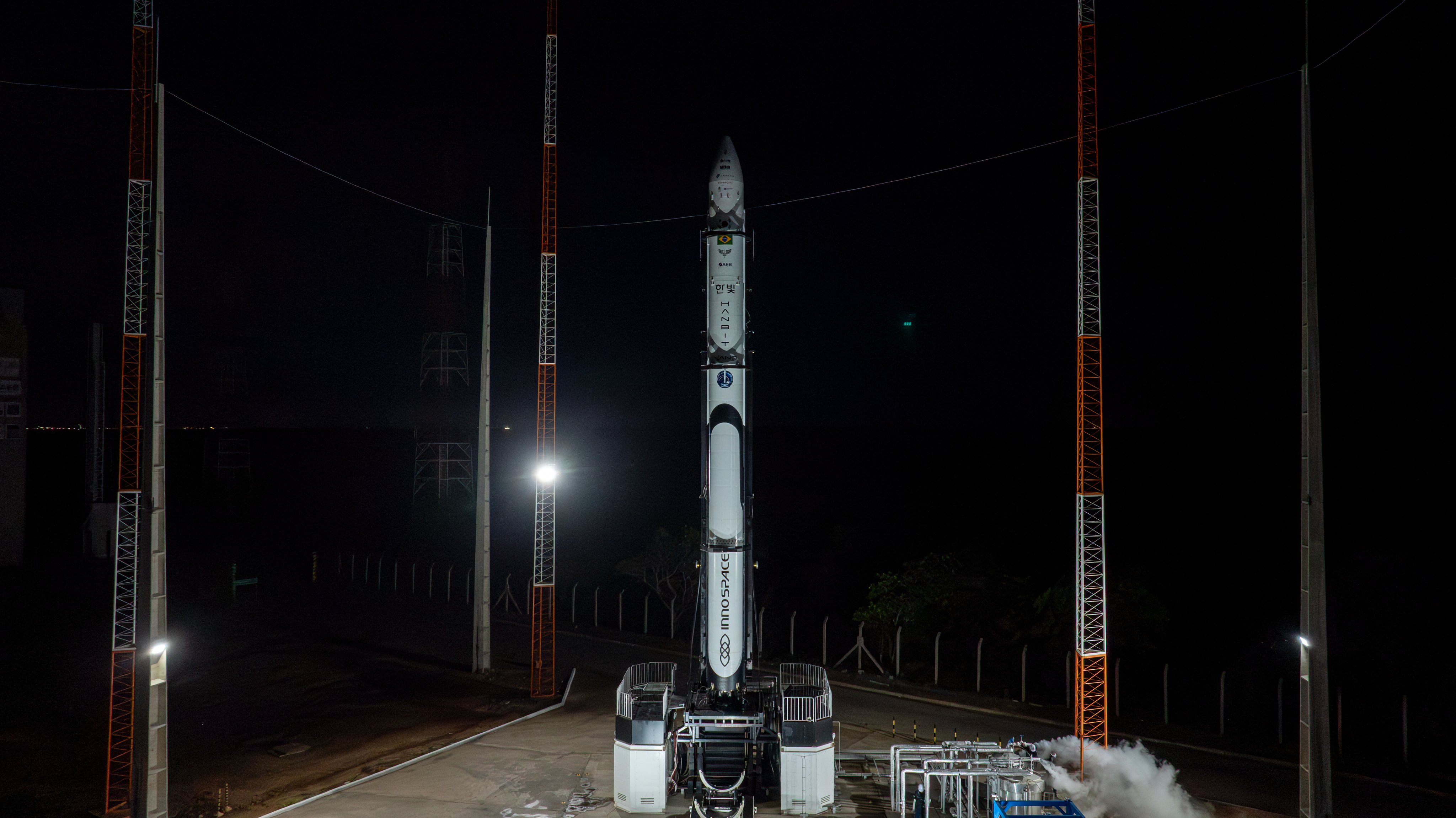
HANBIT-Nano • HANBIT
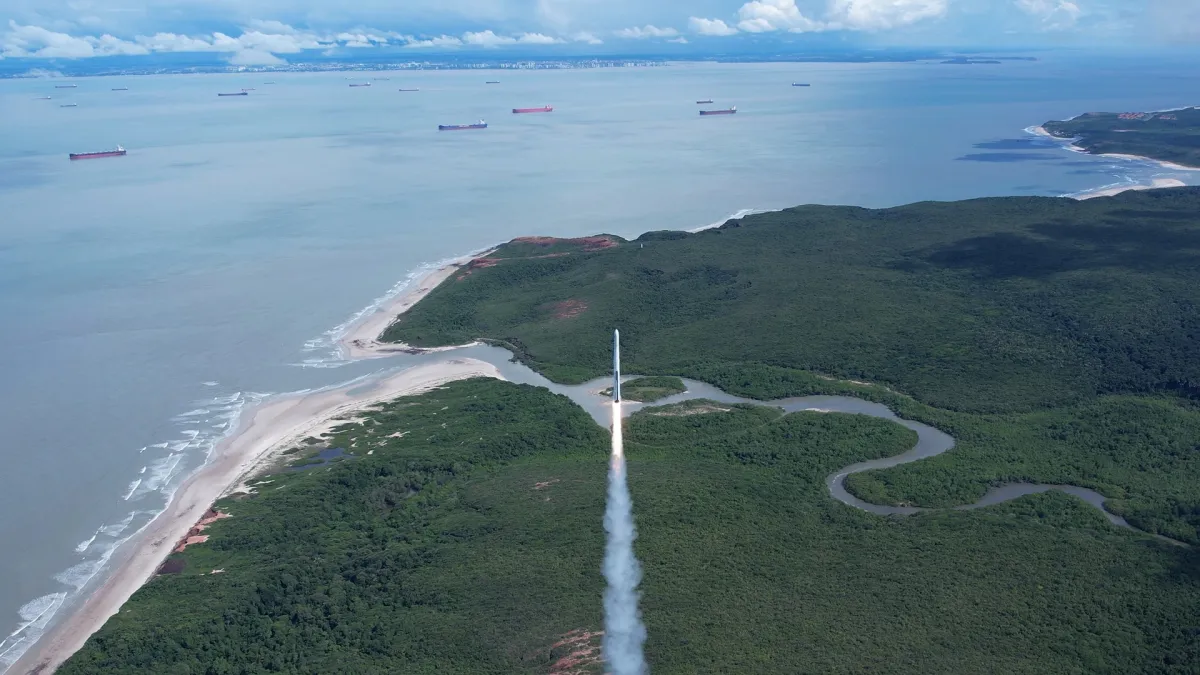
Second orbital launch attempt for the South Korean start-up Innospace and its HANBIT-Nano small launch vehicle.
Falcon 9 • Falcon
Tranche 1 Tracking Layer A is one of five missions by the United States Space Force Space Development Agency (SDA) for the Proliferated Warfighter Space Architecture (PWSA) Tranche 1 Tracking Layer constellation, which will provide global indications, warning, tracking, and targeting of advanced missile threats, including hypersonic missile systems.
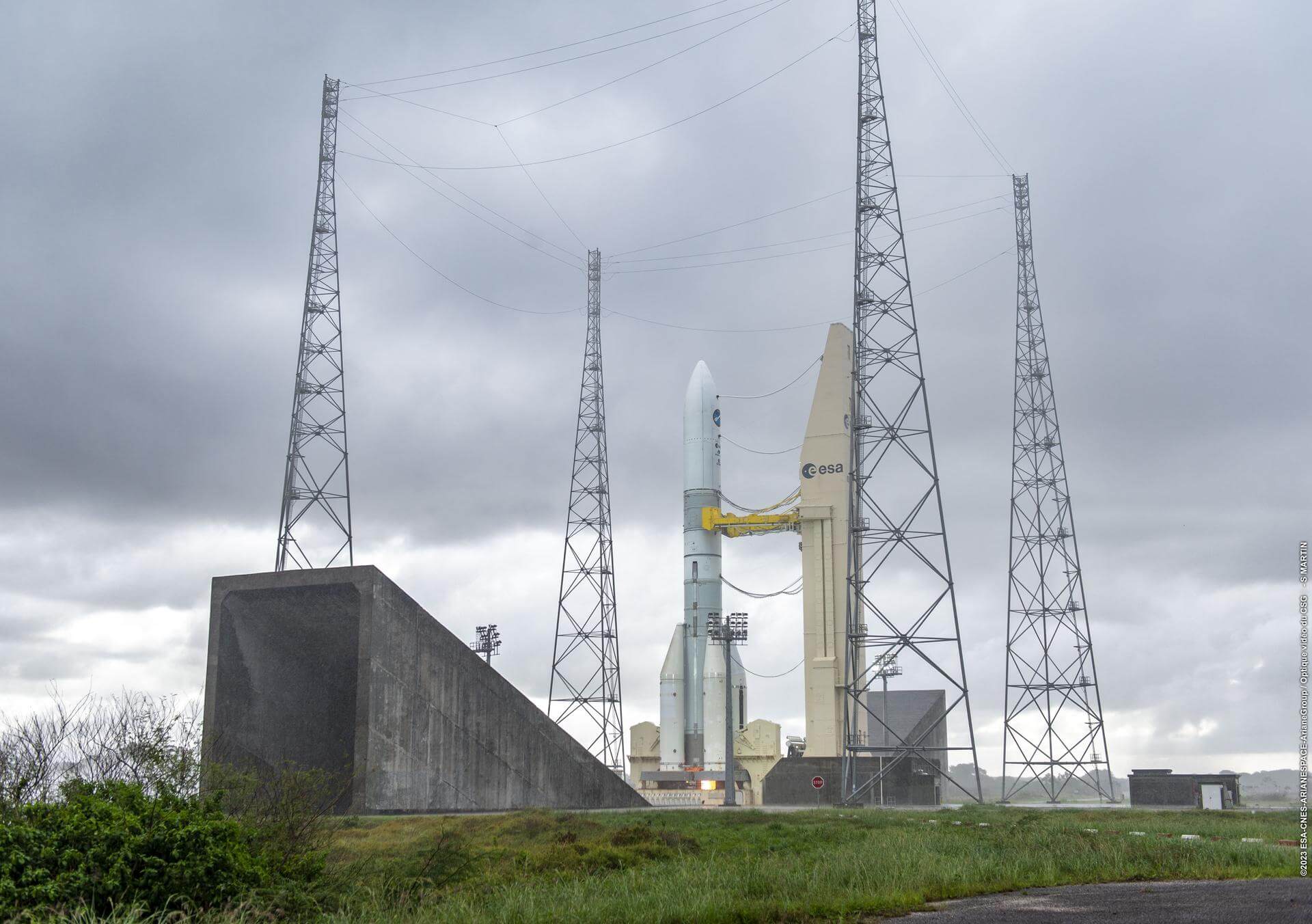
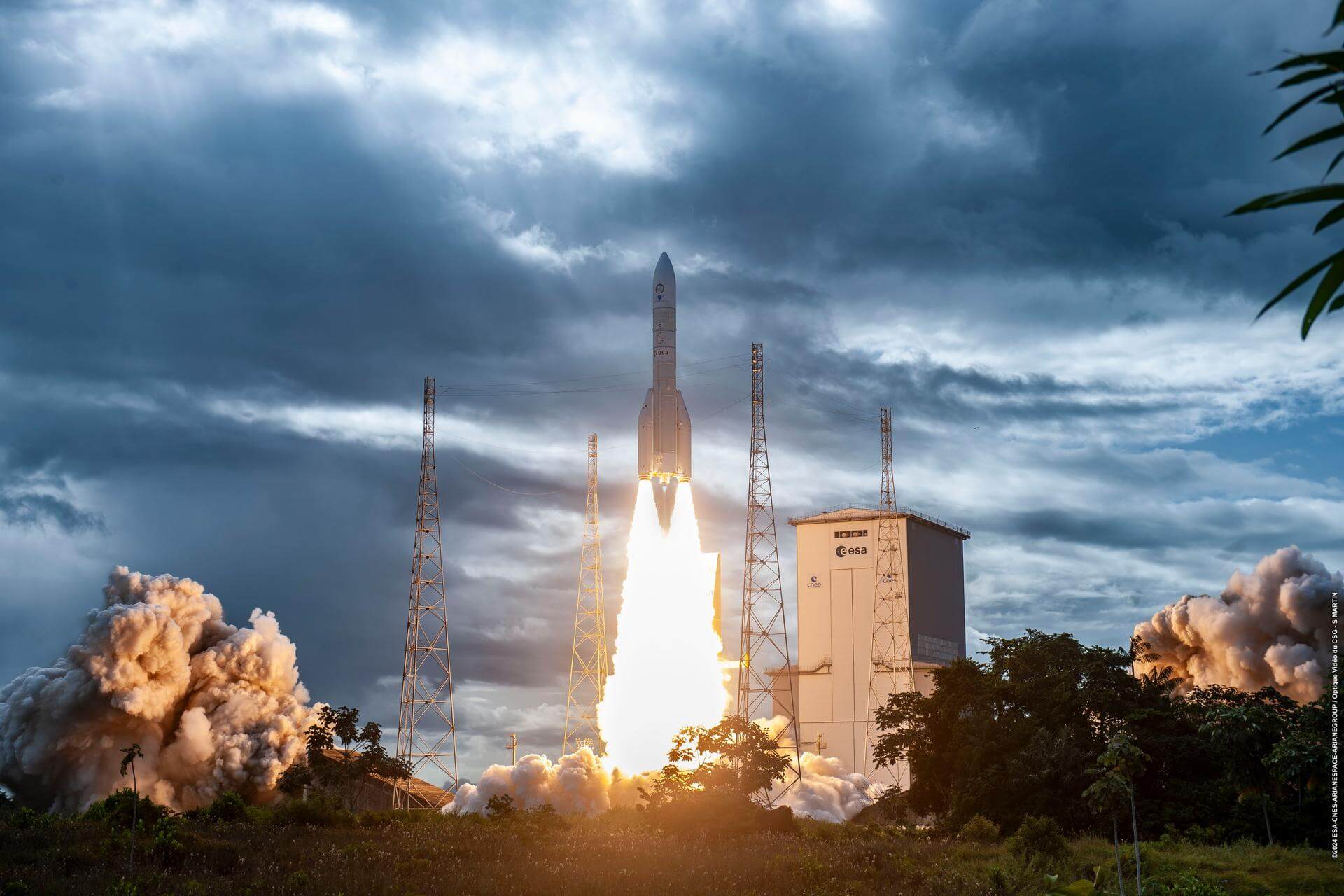
Ariane 64 • Ariane
Amazon Leo, formerly known as Project Kuiper, is a mega constellation of satellites in Low Earth Orbit that will offer broadband internet access, this constellation will be managed by Kuiper Systems LLC, a subsidiary of Amazon. This constellation is planned to be composed of 3,276 satellites. The satellites are projected to be placed in 98 orbital planes in three orbital layers, one at 590 km, 610 km and 630 km altitude. 35-40 satellites will be carried on each Ariane 6 launch.
Falcon 9 • Falcon
24 satellites for Rivada's internet constellation.
Falcon 9 • Falcon
Tranche 1 Tracking Layer C is one of five missions by the United States Space Force Space Development Agency (SDA) for the Proliferated Warfighter Space Architecture (PWSA) Tranche 1 Tracking Layer constellation, which will provide global indications, warning, tracking, and targeting of advanced missile threats, including hypersonic missile systems.
Falcon 9 • Falcon
Tranche 1 Tracking Layer E is one of five missions by the United States Space Force Space Development Agency (SDA) for the Proliferated Warfighter Space Architecture (PWSA) Tranche 1 Tracking Layer constellation, which will provide global indications, warning, tracking, and targeting of advanced missile threats, including hypersonic missile systems.
Falcon 9 • Falcon
First crewed mission to the Haven-1 commercial space station.
Vulcan • Vulcan
Tranche 1 Tracking Layer B is one of five missions by the United States Space Force Space Development Agency (SDA) for the Proliferated Warfighter Space Architecture (PWSA) Tranche 1 Tracking Layer constellation, which will provide global indications, warning, tracking, and targeting of advanced missile threats, including hypersonic missile systems.
Themis Demonstrator •
First low-altitude hop test of a Themis demonstrator, with a targeted altitude up to 100 m.
Vulcan • Vulcan
Tranche 1 Tracking Layer D is one of five missions by the United States Space Force Space Development Agency (SDA) for the Proliferated Warfighter Space Architecture (PWSA) Tranche 1 Tracking Layer constellation, which will provide global indications, warning, tracking, and targeting of advanced missile threats, including hypersonic missile systems.
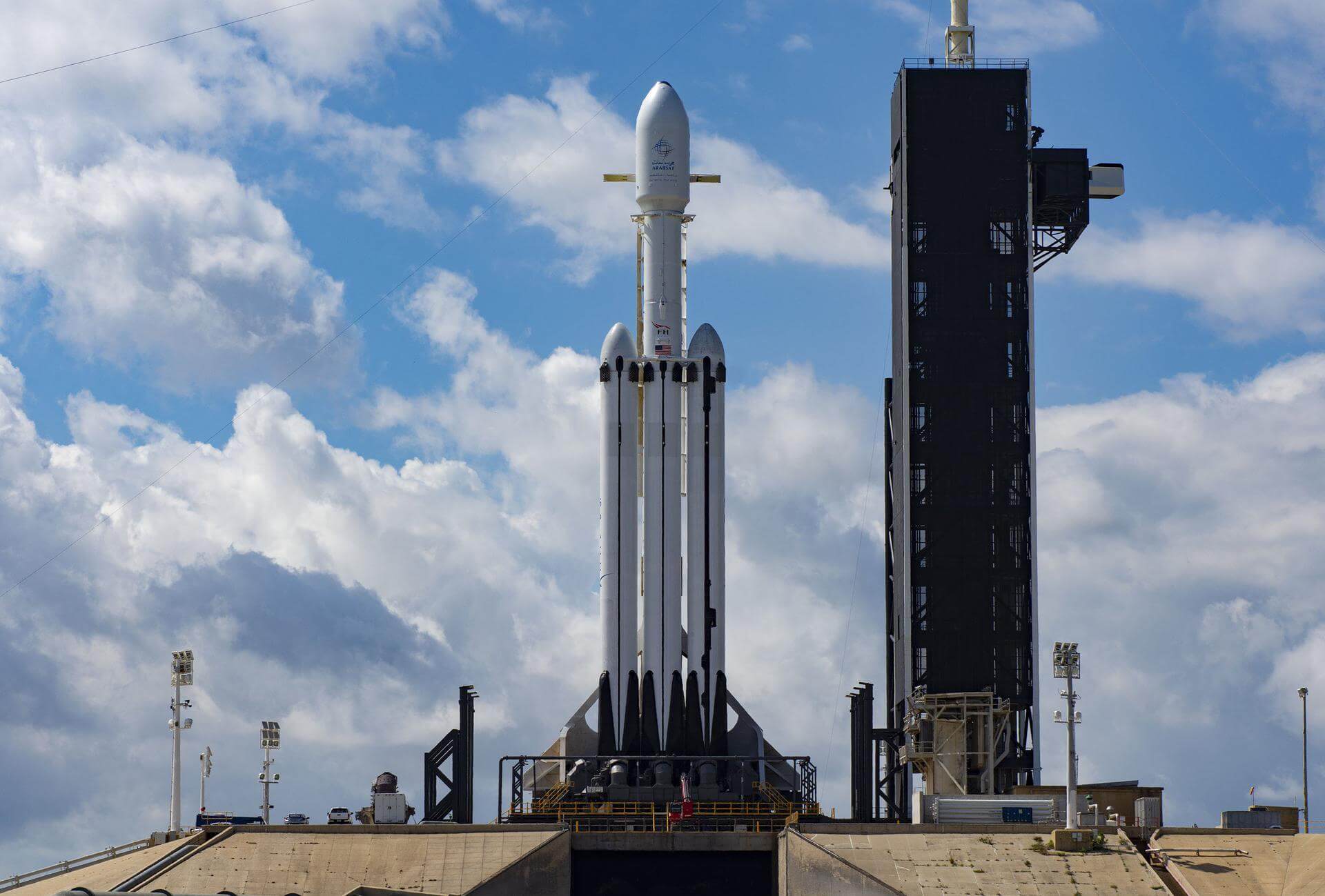
Falcon Heavy • Falcon
The ViaSat-3 is a series of three Ka-band satellites is expected to provide vastly superior capabilities in terms of service speed and flexibility for a satellite platform. Each ViaSat-3 class satellite is expected to deliver more than 1-Terabit per second of network capacity, and to leverage high levels of flexibility to dynamically direct capacity to where customers are located.
Electron •
VICTUS HAZE will see Rocket Lab design, build, launch, and operate a rendezvous proximity operation (RPO) capable spacecraft. U.S. Space Force Space Systems Command (SSC)’s Space Safari’s VICTUS HAZE mission will be an exercise of a realistic threat-response scenario and on-orbit space domain awareness (SDA) demonstration. Once the spacecraft build is complete, Rocket Lab will be entered into a Hot Standby Phase awaiting further direction. Once the exercise begins, Rocket Lab will be given notice to launch the spacecraft into a target orbit. After reaching orbit, the spacecraft will be rapidly commissioned and readied for operations. Rocket Lab will configure a Pioneer class spacecraft bus to meet the unique requirements of the VICTUS HAZE mission. The mission will improve Tactically Responsive Space (TacRS) processes and timelines, demonstrating the ability to respond to on-orbit threats on very short timelines and validating techniques for space domain awareness (SDA) and on-orbit characterization. Rocket Lab’s constellation-class production capability and discriminating technical capabilities in the areas of in-space propulsion, precision attitude control, low latency communications, and autonomous operations are key enablers for this mission.
Ariane 64 • Ariane
Amazon Leo, formerly known as Project Kuiper, is a mega constellation of satellites in Low Earth Orbit that will offer broadband internet access, this constellation will be managed by Kuiper Systems LLC, a subsidiary of Amazon. This constellation is planned to be composed of 3,276 satellites. The satellites are projected to be placed in 98 orbital planes in three orbital layers, one at 590 km, 610 km and 630 km altitude. 35-40 satellites will be carried on each Ariane 6 launch.
Vulcan • Vulcan
Classified payload for the US National Reconnaissance Office
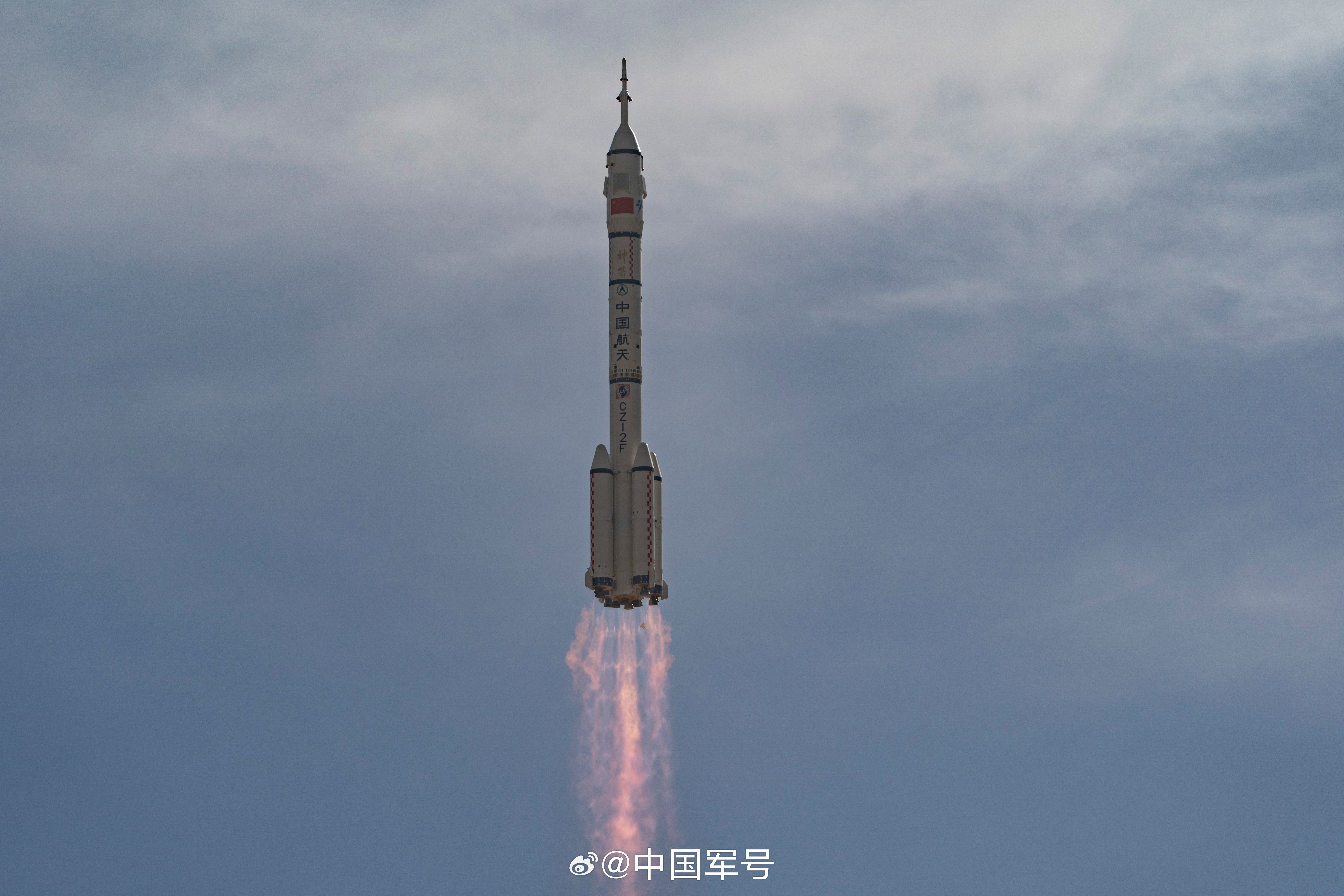
Long March 2F/G • Long March
Shenzhou 23 will be the 23rd flight of the Shenzhou program.
Falcon 9 • Falcon
The SpaceLogistics MRV-1 is a mission extension payload including a mission robotic vehicle (MRV) and multiple mission extension pods (MEPs).
Starship • Starship
13th test flight of the two-stage Starship launch vehicle. Second flight of Starship V3
Soyuz 2.1a • Soyuz
Soyuz MS-29 will carry three cosmonauts and one astronaut to the International Space Station aboard the Soyuz spacecraft from the Baikonur Cosmodrome in Kazakhstan. The crew consists of Roscosmos cosmonauts Pyotr Dubrov and Anna Kikina, as well as NASA astronaut Anil Menon.
Falcon Heavy • Falcon
Demonstration flight of the Astrobotic Griffin lander and its engines, initially contracted for the cancelled NASA VIPER (Volatiles Investigating Polar Exploration Rover) mission. The vacated payload spot will now host the FLIP (FLEX Lunar Innovation Platform) lunar rover from Astrolab.
Electron •
Aspera houses an ultraviolet telescope and will examine hot gas in the intergalactic medium, thought to be contributing to the birth of stars and planets. Aspera will be the first NASA astrophysics mission to gather and map these ultraviolet light signatures, potentially unlocking a deeper understanding of the origins of stars, planets, and life in the universe.
Falcon 9 • Falcon
35th commercial resupply services mission to the International Space Station operated by SpaceX. The flight will be conducted under the second Commercial Resupply Services contract with NASA. Cargo Dragon 2 brings supplies and payloads, including critical materials to directly support science and research investigations that occur onboard the orbiting laboratory.
Falcon 9 • Falcon
Classified mission launched by the Space Development Agency (SDA) for Tranche 2 Transport Layer.
Vega-C • Vega
Sentinel-3C is the third satellite in the Sentinel-3 constellation, which provides high-accuracy optical, radar and altimetry data for marine and land services. The Fluorescence Explorer (FLEX) satellite is a part of ESA's Earth Explorer program. The satellite will map vegetation fluorescence to quantify photosynthetic activity.
Falcon Heavy • Falcon
The Nancy Grace Roman Space Telescope is a NASA infrared space telescope with a 2.4 m (7.9 ft) wide field of view primary mirror and two scientific instruments. The Wide-Field Instrument (WFI) is a 300.8-megapixel multi-band visible and near-infrared camera, providing a sharpness of images comparable to that achieved by the Hubble Space Telescope over a 0.28 square degree field of view, 100 times larger than imaging cameras on the Hubble. The Coronagraphic Instrument (CGI) is a high-contrast, small field of view camera and spectrometer covering visible and near-infrared wavelengths using novel starlight-suppression technology. Roman objectives include a search for extra-solar planets using gravitational microlensing, and probing the expansion history of the Universe and the growth of cosmic structure, with the goal of measuring the effects of dark energy, the consistency of general relativity, and the curvature of spacetime.
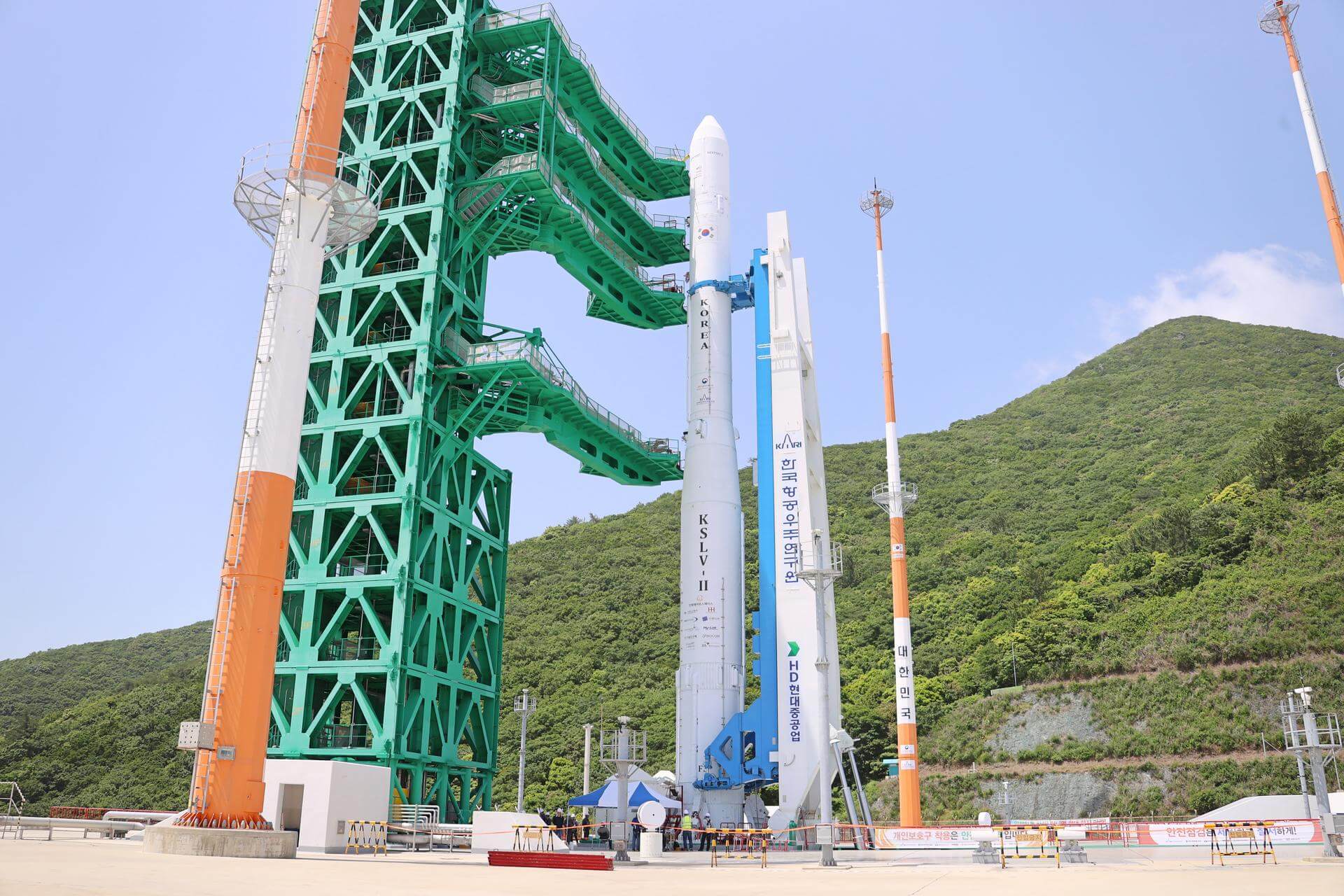
Nuri • KSLV
NeonSat-2 to 6 are part of the South Korean government's Earth observation micro-satellite constellation NeonSat (New-space Earth Observation Satellite). The NeonSat constellation is the first satellite system developed by the government using a mass-production approach for precise monitoring of the Korean Peninsula.
Ariane 62 • Ariane
Second of EUMETSAT's second generation of Metop weather satellites.
Falcon 9 • Falcon
Five Astranis MicroGEO communications satellite to be inserted in a custom geostationary orbit, from where they conduct on-orbit maneuvers to reach their individual slots. The 5 satellites include: * Apco 1 & Apco 2 (Mexico) * Thaicom-9 (Thailand) * 1x for Chunghwa Telecom (Taiwan) * 1x for MB Group (Oman)
Vulcan • Vulcan
Classified mission launched by the Space Development Agency (SDA) for Tranche 2 Transport Layer.
Falcon 9 • Falcon
Classified mission launched by the Space Development Agency (SDA) for Tranche 2 Tracking Layer.
Ariane 64 • Ariane
Third of EUMETSAT's third generation of weather satellite.
Firefly Alpha Block 2 • Firefly Alpha
QuickSounder is the first satellite mission of the Near Earth Orbit Network (NEON) program of the National Oceanic and Atmospheric Administration (NOAA), which aims to replace the current Joint Polar Satellite System (JPSS) series of polar orbit weather satellites. This pathfinder mission will demonstrate NOAA's ability to launch a small satellite within 3 years, flying a refurbished Advanced Technology Microwave Sounder (ATMS) instrument to polar orbit.
Falcon 9 • Falcon
Classified mission launched by the Space Development Agency (SDA) for Tranche 2 Tracking Layer.
Firefly Alpha Block 2 • Firefly Alpha
The Investigation of Convective Updrafts (INCUS) is a NASA Earth science mission led by Colorado State University that will investigate the behavior of tropical storms in order to better represent these storms in weather and climate models. It consists of 3 SmallSats flying in tight coordination to study why convective storms, heavy precipitation, and clouds occur exactly when and where they form. Each satellite will have a high frequency precipitation radar that observes rapid changes in convective cloud depth and intensities. 1 of the 3 satellites also will carry a microwave radiometer to provide the spatial content of the larger scale weather observed by the radars. By flying so closely together, the satellites will use the slight differences in when they make observations to apply a novel time-differencing approach to estimate the vertical transport of convective mass.
Falcon 9 • Falcon
Classified mission launched by the Space Development Agency (SDA) for Tranche 2 Transport Layer.
Falcon 9 • Falcon
Dedicated rideshare flight to a sun-synchronous orbit with dozens of small microsatellites and nanosatellites for commercial and government customers.
Falcon 9 • Falcon
Classified mission launched by the Space Development Agency (SDA) for Tranche 2 Transport Layer.
H3-24 • H3
MMX is a Japanese scientific mission to land on Phobos, one of the two moons of Mars, to collect samples before bringing them back to Earth. The mission includes a small French/German rover to explore the surface of Phobos.
Falcon 9 • Falcon
KOMPSAT-7 and 7A are the follow-up satellites of KOMPSAT-3A, whose mission is to provide high-resolution satellite images to satisfy South-Korea's governmental and institutional needs.
Vega-C • Vega
Korean Multi-purpose Satellite 6 (KOMPSAT-6) is the sixth South Korean Earth observation satellite of the KOMPSAT series. It is equipped with a synthetic aperture radar with a ground resolution between 0.5 and 20 meters. PLATiNO 1 is an experimental X-band SAR earth observation satellite project by the Italian Space Agency (ASI), with a radar payload from Thales Alenia Space Italia. The X-band SAR will first operate in passive mode at 619 km altitude, then in active mode after the satellites moves lower to a 410 km orbit.
Falcon 9 • Falcon
2nd lunar lander developed by Firefly Aerospace. The Blue Ghost lander will be of a new two-stage version utilizing an Elytra Dark transfer vehicle to place it and the European Space Agency's Lunar Pathfinder experimental communication satellite into Lunar orbit. The lander will land on the far side of the Moon with 2 NASA payloads: * Lunar Surface Electromagnetics Experiment (LuSEE-Night) * User Terminal (UT)
Atlas V N22 • Atlas
Starliner-3 is the third crewed operational flight of a Starliner spacecraft to the International Space Station as part of NASA's Commercial Crew Program.
SSLV •
Space Machines Company (SMC)'s second Optimus Orbital Transfer Vehicle (OTV), will launch on a mission designated Space MAITRI (Mission for Australia-India’s Technology, Research and Innovation). The mission will focus on debris management and sustainability, and will significantly advance Australia’s domestic space industry by combining Australian spacecraft capabilities with India's launch expertise. After separation, Optimus will perform a series of propulsive on-orbit maneuvers to inspect a space object in close proximity. It will then spend several months on orbit examining space debris to demonstrate affordable and accessible space sustainability technologies.
Vulcan VC4L • Vulcan
First flight of the Dream Chaser Spaceplane, on a free-flying mission in Low Earth Orbit.
Falcon 9 • Falcon
Classified mission launched by the Space Development Agency (SDA) for Tranche 2 Transport Layer.
Falcon 9 • Falcon
Up to 18 satellites manufactured by MDA for Canadian satellite operator Telesat's Lightspeed constellation.
Ariane 62 • Ariane
Payload consists of two satellites for Europe's Galileo navigation system.
Ariane 62 • Ariane
Plato, for PLAnetary Transits and Oscillations of stars, is a European Space Agency (ESA) mission with 26 cameras to study terrestrial exoplanets in orbits up to the habitable zone of Sun-like stars. Its goal is to measure the sizes of exoplanets and discover exomoons and rings around them, as well as characterise planets' host stars by studying tiny light variations in the starlight it receives.
Spectrum •
ΣYNDEO-3 is a satellite built by Redwire Corporation for the European Union/European Space Agency (ESA)’s In-Orbit Demonstration and In-Orbit Validation Programme (IOD/IOV), which will carry 10 different technological demonstration payload from institutions of Spain, France, Germany, Italy, Luxembourg and the European Commission. The satellite is built on Redwire's Hammerhead spacecraft platform.
Falcon 9 • Falcon
CHORUS is MDA's next generation Earth observation constellation, consisting of 2 radar satellites (C-band SAR and X-band SAR), in a 53.5 degree 600 km altitude LEO, with the X-band trailing the C-band by 60 minutes. A collaborative multi-sensor constellation, CHORUS will bring together diverse and unique imagery and data sources and provide a new level of near real-time insight and innovative Earth observation services. Operating in a unique mid-inclination orbit, CHORUS will be able to image day or night, regardless of weather conditions, with daily access of up to 95% of the coverage area. From an industry-leading 700km-wide imaging swath down to sub-metre high resolution, CHORUS will provide the most extensive and unrivalled Earth observation radar imaging capacity available on the market in a single mission.
Falcon 9 • Falcon
A batch of 29 satellites for the Starlink mega-constellation - SpaceX's project for space-based Internet communication system. First Starlink launch to feature a Falcon 9 booster landing within The Bahamas waters operationally, after the trajectory was tested during launch of Starlink Group 10-12 in February 2025.
Falcon 9 • Falcon
A batch of 29 satellites for the Starlink mega-constellation - SpaceX's project for space-based Internet communication system.
Falcon 9 • Falcon
A batch of 24 satellites for the Starlink mega-constellation - SpaceX's project for space-based Internet communication system.
Falcon 9 • Falcon
SpaceX Crew-12 is the twelfth crewed operational flight of a Crew Dragon spacecraft to the International Space Station as part of NASA's Commercial Crew Program.
Ariane 64 • Ariane
Amazon Leo, formerly known as Project Kuiper, is a mega constellation of satellites in Low Earth Orbit that will offer broadband internet access, this constellation will be managed by Kuiper Systems LLC, a subsidiary of Amazon. This constellation is planned to be composed of 3,276 satellites. The satellites are projected to be placed in 98 orbital planes in three orbital layers, one at 590 km, 610 km and 630 km altitude. 32 satellites will be carried on this launch.
Vulcan VC4S • Vulcan
USSF-87 will launch two identical Geosynchronous Space Situational Awareness Program (GSSAP) satellites GSSAP-7 and GSSAP-8 directly to a near-geosynchronous orbit approximately 36,000 km above the equator. Data from the GSSAP will uniquely contribute to timely and accurate orbital predictions, further enabling space flight safety including satellite collision avoidance.
Proton-M • Proton / UR-500
Elektro-L is a series of meteorological satellites developed for the Russian Federal Space Agency by NPO Lavochkin. They are designed to capture real-time images of clouds and the Earth's underlying surface, heliogeophysical measurements, collection and translating hydrometeorological and service data.
Smart Dragon 3 • Smart Dragon
Carried 7 satellites to sun-synchronous orbit, including PRSC-EO2 (Earth observation satellite for the Pakistan government's SUPARCO) & CUHK-1. Details on other payloads to be confirmed.
Falcon 9 • Falcon
A batch of 24 satellites for the Starlink mega-constellation - SpaceX's project for space-based Internet communication system.
Falcon 9 • Falcon
A batch of 25 satellites for the Starlink mega-constellation - SpaceX's project for space-based Internet communication system.
Long March 2F/G • Long March
4th flight of the Chinese spaceplane capable of returning to Earth.
Soyuz 2.1b/Fregat-M • Soyuz
Unknown classified payload(s) for the Russian military.
Falcon 9 • Falcon
A batch of 25 satellites for the Starlink mega-constellation - SpaceX's project for space-based Internet communication system.
H3-22 • H3
QZSS (Quasi Zenith Satellite System) is a Japanese satellite navigation system operating from inclined, elliptical geosynchronous orbits to achieve optimal high-elevation visibility in urban canyons and mountainous areas. The navigation system objective is to broadcast GPS-interoperable and augmentation signals as well as original Japanese (QZSS) signals from a three-spacecraft constellation. The navigation system objective is to broadcast GPS-interoperable and augmentation signals as well as original Japanese (QZSS) signals from a three-spacecraft constellation in inclined, elliptical geosynchronous orbits.
Long March 2C • Long March
Earth observation satellite built by China's CAST for the Algerian Space Agency.
GSLV Mk II • GSLV
This is a replacement satellite for the Indian Regional Navigation Satellite System. The constellation will provide India with an alternative to GPS and will be used for military and civilian use. Located at a geosynchronous orbit, the system will be operated by the Indian government.
New Glenn •
First flight of Blue Origin's Blue Moon MK1 lunar lander.
Falcon 9 • Falcon
A batch of 29 satellites for the Starlink mega-constellation - SpaceX's project for space-based Internet communication system.
Electron •
The NeonSat-1A, carrying a high-resolution optical camera, is designed to test the constellation capabilities of the South Korean government's Earth observation micro-satellite constellation NeonSat (New-space Earth Observation Satellite), in particular technology improvements identified from operations of NeonSat-1 after its launch in April 2024. These technologies will in turn be incorporated into the next 10 NeonSat under construction, as well as providing more site re-visiting capabilities along with NeonSat-1. The NeonSat constellation is the first satellite system developed by the government using a mass-production approach for precise monitoring of the Korean Peninsula, lead by the Satellite Technology Research Center (SaTReC) at the Korea Advanced Institute of Science and Technology (KAIST), Korea’s leading university dedicated to science and technology. Designed to capture near-real time natural disaster monitoring for the Korean peninsula, KAIST’s NEONSAT constellation is a collaboration across multiple Korean academic, industry, and research institutions, including SaTReC, which is leading the program’s system design and engineering. The NEONSAT program is funded by the Korean government’s Ministry of Science and ICT (MSIT).
Falcon 9 • Falcon
A batch of 25 satellites for the Starlink mega-constellation - SpaceX's project for space-based Internet communication system.
Falcon 9 • Falcon
Ninth of ten GPS III missions.
Falcon 9 • Falcon
A batch of 25 satellites for the Starlink mega-constellation - SpaceX's project for space-based Internet communication system.
New Shepard •
NS-38 is the 17th crewed flight for the New Shepard program and the 38th in the New Shepard program's history.
Electron •
First 2 satellites (named MR-1 and MR-2) of UK-based Open Cosmos' secure LEO broadband constellation designed to provide independent and resilient connectivity infrastructure for Europe and the world, using high-priority Ka-band spectrum filings by the Principality of Liechtenstein.
Falcon 9 • Falcon
A batch of 25 satellites for the Starlink mega-constellation - SpaceX's project for space-based Internet communication system.
Long March 12 • Long March
A batch of 9 Low Earth Orbit communication satellites for the Chinese state owned SatNet constellation operated by the China Satellite Network Group. The constellation will eventually consists of 13000 satellites.
Falcon 9 • Falcon
A batch of 29 satellites for the Starlink mega-constellation - SpaceX's project for space-based Internet communication system.
Falcon 9 • Falcon
Twelfth batch of satellites for a reconnaissance satellite constellation built by SpaceX and Northrop Grumman for the National Reconnaissance Office to provide imaging and other reconnaissance capabilities.
Ceres-2 •
First test launch of Galactic Energy’s Ceres-2 rocket.
Long March 3B/E • Long March
Chinese experimental spacecraft of unknown purposes.
Ceres-1S • Ceres-1
4 small satellites for LEO Internet of Things (IoT) communication purposes.
Long March 2C • Long March
Earth observation satellite built by China's CAST for the Algerian Space Agency.
Falcon 9 • Falcon
A batch of 29 satellites for the Starlink mega-constellation - SpaceX's project for space-based Internet communication system.
Long March 8A • Long March
A batch of 9 Low Earth Orbit communication satellites for the Chinese state owned SatNet constellation operated by the China Satellite Network Group. The constellation will eventually consists of 13000 satellites.
Long March 6A • Long March
The Yaogan 50-01 is a Chinese military “remote sensing” satellite of unknown purposes.
Falcon 9 • Falcon
A batch of 29 satellites for the Starlink mega-constellation - SpaceX's project for space-based Internet communication system.
PSLV-DL • PSLV
Small Earth observation satellite from NewSpace India Limited (NSIL) for an "Indian strategic user", details TBD. This launch will also carry 18 other ride-share payloads.
Falcon 9 • Falcon
The Pandora small satellite was selected in 2021 as an inaugural mission in NASA’s Astrophysics Pioneers Program. It includes a 0.45-meter telescope that will improve our understanding of exoplanet atmospheres by disentangling exoplanet signals from their host stars, as well as studying host star variability with long-duration observations of 20 unique planets through visible-light photometry and near-infrared spectroscopy. Also launching on this launch are 39 other ride-share payloads under the "Falcon 9 Twilight mission" manifested by Exolaunch, including satellites from Spire Global and Kepler Communications.
Falcon 9 • Falcon
### SpaceX's Starlink Mission: A Leap Forward in Orbital Connectivity On January 10, 2026, SpaceX successfully executed another Starlink mission using its reliable Falcon 9 rocket, marking a pivotal step in the company's ambitious plan to blanket the Earth with high-speed internet. This launch from Cape Canaveral Space Force Station deployed a batch of 60 next-generation Starlink satellites into low Earth orbit (LEO), further expanding the constellation that already exceeds 5,000 operational units. The mission underscores SpaceX's dominance in reusable rocketry and its role in democratizing global connectivity. At the heart of this mission are the objectives to enhance broadband access in underserved regions and support emerging applications like remote sensing and disaster response. Each Starlink satellite weighs approximately 300 kilograms and features advanced laser inter-satellite links for seamless data relay, enabling latencies as low as 20 milliseconds. The payload capabilities of this deployment allow for a total mass of up to 18,000 kilograms to LEO, with the satellites equipped with ion thrusters for precise orbital maneuvering and eventual deorbiting to mitigate space debris. This batch incorporates upgrades for higher bandwidth and improved signal strength, aiming to serve over 2 million users worldwide by year's end. Such capabilities not only address digital divides but also pave the way for integrated services with terrestrial networks, potentially revolutionizing industries from agriculture to telemedicine. The Falcon 9 rocket, a two-stage vehicle standing 70 meters tall with a diameter of 3.7 meters, exemplifies innovative engineering. Powered by nine Merlin engines in the first stage and a single vacuum-optimized Merlin in the second, it generates over 7.6 million Newtons of thrust at liftoff. Its reusable design allows the first stage to land vertically on drone ships or ground pads, a feature that has slashed launch costs from $62 million per flight in earlier models to under $30 million today. Technical specs include a payload fairing of 5.2 meters in diameter, accommodating bulky satellite stacks, and advanced avionics for autonomous flight control. This iteration of Falcon 9 Block 5, with its strengthened structure and improved heat shielding, ensures reliability even in adverse weather. Falcon 9's performance history is a testament to iterative success. Since its debut in 2010, it has completed over 300 launches with a success rate exceeding 98%, including more than 100 consecutive successes since 2020. Reusability milestones, such as a single booster flying 15 times
Falcon 9 • Falcon
A batch of 29 satellites for the Starlink mega-constellation - SpaceX's project for space-based Internet communication system.
Falcon 9 • Falcon
### SpaceX's Starlink Mission: A Leap Forward in Global Connectivity On January 7, 2026, SpaceX successfully executed another Starlink mission from Cape Canaveral Space Force Station in Florida, deploying a batch of 60 next-generation satellites into low Earth orbit (LEO). This launch, carried out aboard the reliable Falcon 9 rocket, underscores the company's relentless push to build a comprehensive satellite constellation aimed at delivering high-speed internet worldwide. As the 150th Starlink mission in the program's history, it highlights the maturation of reusable rocket technology and its role in democratizing access to space. The primary objective of this Starlink mission was to expand the constellation's coverage, focusing on underserved regions in Africa and Southeast Asia. Each satellite in the payload weighs approximately 300 kilograms and is equipped with advanced laser inter-satellite links, enabling data transfer at speeds up to 100 Gbps without relying on ground stations. These Version 2.0 satellites boast enhanced phased-array antennas and solar arrays that generate over 2.5 kilowatts of power, allowing for greater bandwidth and lower latency—down to 20 milliseconds in optimal conditions. The payload's capabilities extend beyond broadband; they include provisions for direct-to-cell connectivity, partnering with telecom providers to beam signals to unmodified smartphones. This mission aimed to boost the total active satellites to over 7,000, inching closer to SpaceX's goal of 12,000 by 2027, which could provide seamless global coverage and compete with traditional fiber optics in remote areas. At the heart of the operation is the Falcon 9 rocket, a two-stage vehicle standing 70 meters tall with a diameter of 3.7 meters. Its first stage is powered by nine Merlin 1D engines, producing 7.6 meganewtons of thrust at sea level, while the second stage uses a single vacuum-optimized Merlin engine for orbital insertion. The rocket's hallmark is its reusability: the first stage, capable of withstanding up to 20 flights with minimal refurbishment, performed a textbook landing on the autonomous drone ship "Of Course I Still Love You" just eight minutes after liftoff. Technical specifications include a payload capacity of 22,800 kilograms to LEO in reusable mode, making it ideal for dense satellite deployments. Innovations like grid fins for controlled descent and cold gas thrusters for precise maneuvering have reduced costs to under $3,000 per kilogram, a fraction of traditional launch expenses. Falcon 9
Falcon 9 • Falcon
A batch of 29 satellites for the Starlink mega-constellation - SpaceX's project for space-based Internet communication system.
Falcon 9 • Falcon
### SpaceX's Starlink Mission: A Leap Toward Global Connectivity On January 4, 2026, SpaceX executed another milestone in its ambitious Starlink project with the launch of a Falcon 9 rocket from Cape Canaveral Space Force Station in Florida. This mission, part of an ongoing series to expand the Starlink satellite constellation, deployed a batch of advanced satellites into low Earth orbit (LEO), furthering the goal of providing high-speed, low-latency internet to underserved regions worldwide. The primary objective of this Starlink mission was to bolster the constellation's coverage and capacity. Each Falcon 9 launch in the Starlink series typically carries around 20 to 60 satellites, depending on the variant. For this flight, the payload consisted of 23 next-generation Starlink V2 Mini satellites, each weighing approximately 800 kilograms and equipped with enhanced laser inter-satellite links for improved data routing. These satellites are designed to operate at altitudes between 500 and 550 kilometers, enabling global broadband services with download speeds up to 220 Mbps and upload speeds around 20 Mbps. The mission's success contributes to SpaceX's target of deploying over 12,000 satellites by the mid-2020s, with plans for expansion to 42,000, aiming to bridge the digital divide in remote areas, maritime environments, and aviation. At the heart of the operation is the Falcon 9 rocket, a reusable two-stage vehicle engineered for reliability and cost-efficiency. Standing 70 meters tall with a diameter of 3.7 meters, the Falcon 9 is powered by nine Merlin 1D engines in its first stage, generating over 7.6 million Newtons of thrust at liftoff. The second stage features a single vacuum-optimized Merlin engine for orbital insertion. A hallmark of its design is reusability: the first stage, constructed from aluminum-lithium alloy, is capable of vertical landing and refurbishment, significantly reducing launch costs to around $67 million per flight. This mission marked another reuse of a booster that had previously flown 15 times, showcasing the rocket's robust thermal protection systems and autonomous landing capabilities on drone ships or ground pads. The Falcon 9's performance history underscores its dominance in the commercial launch sector. Since its debut in 2010, the rocket has completed over 300 successful missions by early 2026, with a success rate exceeding 98%. Notable achievements include the first orbital-class rocket reuse in 2017 and routine crewed flights to
Falcon 9 • Falcon
CSG-3 is an Earth observation satellite for the Italian Space Agency, part of a reconnaissance constellation using synthetic aperture radars operating in the X-band.
Falcon 9 • Falcon
### Falcon 9 Powers COSMO-SkyMed Second Generation Mission into Orbit On January 3, 2026, a SpaceX Falcon 9 rocket lifted off from Cape Canaveral Space Force Station in Florida, carrying the latest addition to Italy's COSMO-SkyMed constellation. This mission, part of the COSMO-SkyMed Second Generation (CSG) program, deployed an advanced radar imaging satellite designed to enhance global Earth observation capabilities. The launch marked another milestone in international space collaboration, underscoring the growing reliance on reusable launch vehicles for sophisticated payloads. At the heart of the mission are its objectives: to bolster environmental monitoring, disaster management, and defense applications through high-resolution synthetic aperture radar (SAR) imagery. The CSG satellite, built by Thales Alenia Space for the Italian Space Agency (ASI) and the Italian Ministry of Defense, features improved imaging resolution down to 0.3 meters in spotlight mode, enabling detailed analysis of urban areas, agricultural fields, and maritime zones. Unlike optical satellites, SAR technology penetrates clouds and operates in darkness, making it invaluable for real-time crisis response, such as tracking oil spills or assessing earthquake damage. Payload capabilities include dual-polarization imaging and interferometric modes, which allow for precise measurements of ground deformation—critical for monitoring subsidence in vulnerable regions like Venice or California's Central Valley. With a mass of approximately 2,200 kilograms and an operational lifespan of seven years in sun-synchronous orbit at 620 kilometers altitude, this satellite expands the constellation's capacity to revisit sites every few hours, supporting both civilian and military users. The Falcon 9 rocket, SpaceX's workhorse, exemplifies modern reusable launch technology. Standing 70 meters tall with a diameter of 3.7 meters, it consists of two stages: the first powered by nine Merlin 1D engines generating 7,607 kN of thrust at sea level, and the second by a single vacuum-optimized Merlin engine. The vehicle can deliver up to 22,800 kilograms to low Earth orbit in expendable mode, though reusability reduces this to about 16,700 kilograms. Key innovations include grid fins for atmospheric reentry control and landing legs for vertical touchdown, enabling booster recovery. For this mission, the first stage successfully landed on a droneship in the Atlantic, demonstrating the rocket's efficiency in reducing launch costs from tens of millions to around $67 million per flight. Falcon 9's performance history is a testament to its reliability. Since
Electron •
This Electron launch carries the HASTE | Leidos-3 mission, scheduled for December 31, 2025. The mission aims to deliver important payloads to orbit, contributing to our understanding of space and advancing technological capabilities.
Soyuz 2.1b/Fregat • Soyuz
Glonass-K are the third generation of satellite design for GLONASS satellite navigation system. GLONASS is a Russian space-based navigation system comparable to the similar GPS and Galileo systems. This generation improves on accuracy, power consumption and design life. Each satellite is unpressurized and weighs 935 kg, and has an operational lifetime of 10 years.
Pallas-1 •
First test launch of Galactic Energy’s Pallas-1 rocket.
Electron •
This Electron launch carries the HASTE | Leidos-4 mission, scheduled for December 31, 2025. The mission aims to deliver important payloads to orbit, contributing to our understanding of space and advancing technological capabilities.
Electron •
This Electron launch carries the HASTE | Leidos-5 mission, scheduled for December 31, 2025. The mission aims to deliver important payloads to orbit, contributing to our understanding of space and advancing technological capabilities.
Electron •
HawkEye 360 is a a space-based civil global intelligence satellite network using radio frequency (RF) technology to help monitor transportation across air, land and sea and assist with emergencies, and to provide civil SIGINT (Signal Intelligence) mission. The constellation of small satellites (named Hawk ) will collect information on specific radio signals worldwide to provide high-precision radio frequency mapping and analytics from Low Earth orbit (LEO).
Falcon 9 • Falcon
Classified US Space Force carrying two payloads directly to geostationary orbit.
Electron •
BlackSky Gen-3 Earth-imaging satellites
Electron •
BlackSky Gen-3 Earth-imaging satellites
Long March 7A • Long March
2 satellites officially described as for "demonstration of new technologies for spatial targets detection" purposes.
Long March 4B • Long March
A satellite officially described as for cartography purposes, details TBD.
Soyuz 2.1b/Fregat-M • Soyuz
A pair of Russian optical Earth observation satellites built by the Progress Rocket Space Centre for obtaining stereo images of the Earth's surface, with maximum resolution of 1.2 m in panchromatic mode and a swath width of 32 km. 50 small satellites will also be launched as ride-share payloads, including 3 from Iran.
Long March 3B/E • Long March
China's geostationary meteorological satellite program FY-4 (Feng Yun 4) is the second generation of chinese geostationary meteorological satellites.
Long March 8A • Long March
A batch of 9 Low Earth Orbit communication satellites for the Chinese state owned SatNet constellation operated by the China Satellite Network Group. The constellation will eventually consists of 13000 satellites.
Soyuz 2.1a • Soyuz
The Russian Obzor-R satellite is a planned X-band radar earth observation satellite designed by TsSKB-Progress. In 2012, the development of the Arkon-2M radar satellite was stopped and instead the development of the Obzor-R was initiated. The satellite features the BRLK X-band Synthetic Aperture Radar as the imaging instrument with a ground resolution of 500 m.
LVM-3 (GSLV Mk III) • GSLV
AST SpaceMobile’s Block 2 BlueBird satellites are designed to deliver up to 10 times the bandwidth capacity of the BlueBird Block 1 satellites, required to achieve 24/7 continuous cellular broadband service coverage in the United States, with beams designed to support a capacity of up to 40 MHz, enabling peak data transmission speeds up to 120 Mbps, supporting voice, full data and video applications. The Block 2 BlueBirds, featuring as large as 2400 square foot communications arrays, will be the largest satellites ever commercially deployed in Low Earth orbit once launched. This launch will feature a single satellite.
Long March 12A • Long March
First test launch of CASC/SAST’s Long March 12A rocket, with a dummy payload. The rocket’s 1st stage attempted to land on a landing pad about 300 km downrange of the launch site.
HANBIT-Nano • HANBIT
Maiden orbital launch attempt for the South Korean start-up Innospace and its HANBIT-Nano small launch vehicle. Onboard this flight are five small satellites from the Brazilian space agency AEB, Brazilian university Universidade Federal do Maranhão and Indian startup Grahaa Space, as well as three payloads from AEB and Brazilian company Castro Leite Consultoria that will remain attached to the rocket, and an empty aluminium can from the South Korean beverage company Brewguru.
H3-22 • H3
QZSS (Quasi Zenith Satellite System) is a Japanese satellite navigation system operating from inclined, elliptical geosynchronous orbits to achieve optimal high-elevation visibility in urban canyons and mountainous areas. The navigation system objective is to broadcast GPS-interoperable and augmentation signals as well as original Japanese (QZSS) signals from a three-spacecraft constellation. The navigation system objective is to broadcast GPS-interoperable and augmentation signals as well as original Japanese (QZSS) signals from a three-spacecraft constellation in inclined, elliptical geosynchronous orbits.
Electron •
Synthetic aperture radar Earth observation satellite for Japanese Earth imaging company iQPS.
New Shepard •
NS-37 is the 16th crewed flight for the New Shepard program and the 37th in the New Shepard program's history.
Long March 5 • Long March
Chinese classified satellite claimed to be for communication technology test purposes. Actual mission not known.
Electron •
STP-S30 is a complex mission that will deliver research experiments and technology demonstrations to orbit for the DoD and contribute to future space systems development. The projected primary payload, DISKSat, will demonstrate sustained very low earth orbit (VLEO) flight and test a unique, 1-meter diameter, disk-shaped satellite bus that is designed to increase on-orbit persistence.
Falcon 9 • Falcon
A batch of 27 satellites for the Starlink mega-constellation - SpaceX's project for space-based Internet communication system.
Falcon 9 • Falcon
A batch of 29 satellites for the Starlink mega-constellation - SpaceX's project for space-based Internet communication system.
Ariane 62 • Ariane
Payload consists of two satellites for Europe's Galileo navigation system.
Atlas V 551 • Atlas
Amazon Leo, formerly known as Project Kuiper, is a mega constellation of satellites in Low Earth Orbit that will offer broadband internet access, this constellation will be managed by Kuiper Systems LLC, a subsidiary of Amazon. This constellation is planned to be composed of 3,276 satellites. The satellites are projected to be placed in 98 orbital planes in three orbital layers, one at 590 km, 610 km and 630 km altitude.
Long March 4B • Long March
The ZY-3 (Ziyuan-3, 'Resource-3') series represents China's first high-resolution, stereoscopic mapping satellites for civilian use. The second satellite is managed by the Satellite Surveying and Mapping Application Center (SASMAC). The imaging payload consists of a three-line camera array and a multispectral imager. The three-line panchromatic camera array to acquire stereoscopic imagery consists of three telescopic cameras with one oriented to the nadir and the other two each offset by 22° forward and backward in flight direction. The stereo mapping camera of ZY-3 has a resolution of 2.1 m for the nadir camera, and 2.6 m for the offset cameras. The swath width is 51 km. The multispectral imager for environmental and vegetation monitoring consists of a three-mirror telescope and a cooled detector system sensitive to four wavelength bands to capture full-color imagery as well as near-infrared data. The ground resolution of this system is 5.8 m.
Falcon 9 • Falcon
A batch of 29 satellites for the Starlink mega-constellation - SpaceX's project for space-based Internet communication system.
Falcon 9 • Falcon
A batch of 27 satellites for the Starlink mega-constellation - SpaceX's project for space-based Internet communication system.
Electron •
RAISE-4 (RApid Innovative payload demonstration Satellite-4) is a Japan Aerospace Exploration Agency (JAXA) satellite for on-orbit demonstrations of 15 demonstration components and equipment selected by public solicitation. The satellite will be operated in response to requests from the demonstration theme proposers, and will provide experimental data of the demonstration devices and environmental data during the experiments. 6 of the demonstration payload, as well as as well as 4 cubesats originally planned to ride on the same launch vehicle, are re-flight of those planned for RAISE-3, which failed to reach orbit in October 2022. The launch vehicle was switched from Epsilon-S to Rocket Lab's Electron due to continuous testing problems with the Epsilon-S' 2nd stage motor. The original 8 hitch-hiking cubesats will be launched on another Electron rocket later.
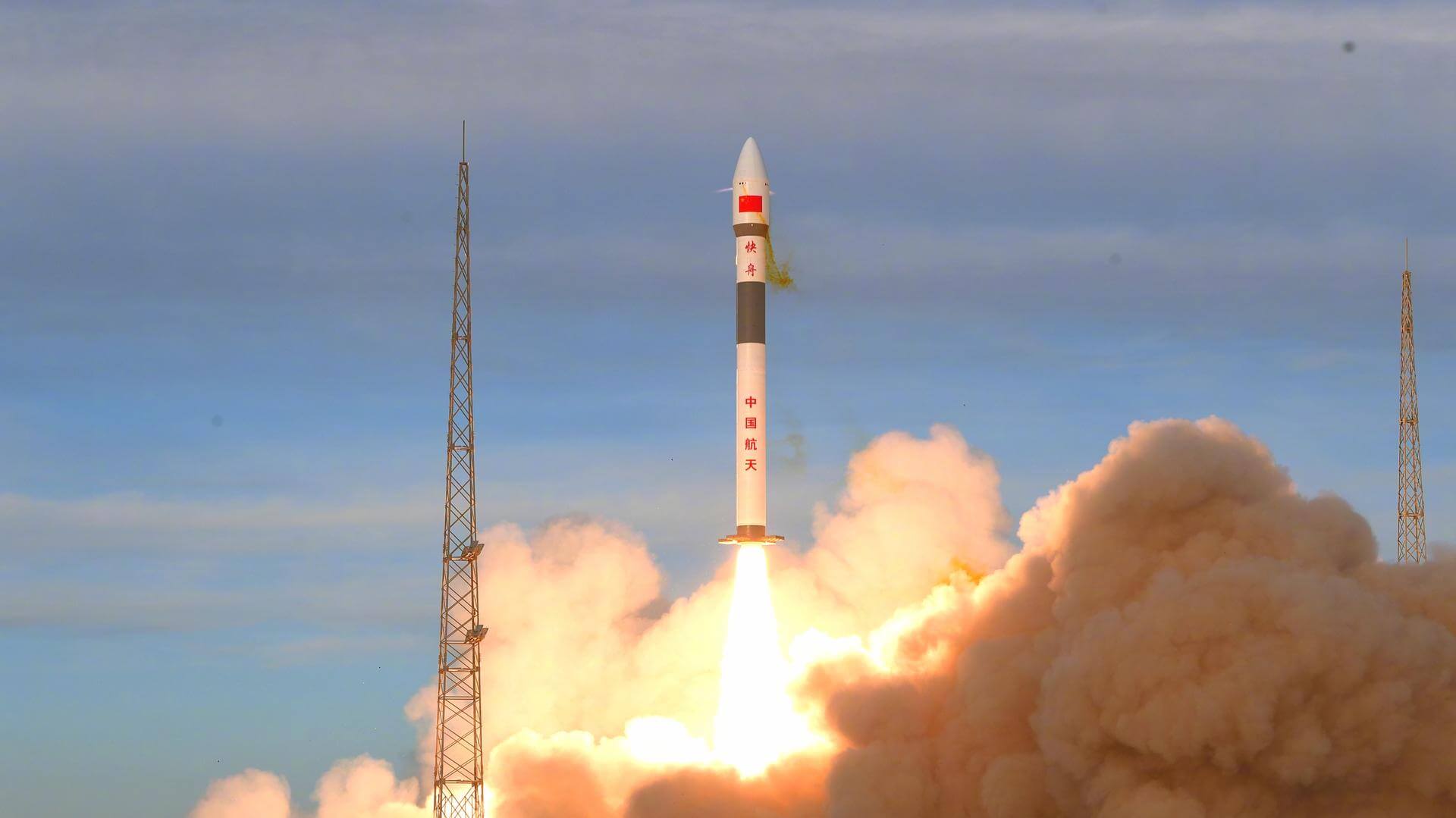
Kuaizhou 11 • Kuaizhou
DEAR-5 is a commercial in-orbit payload and micro-gravity experiments hosting spacecraft developed by Chinese commercial company AZSPACE for various civilian customers, with capability to carry a maximum of 300 kg of payload for up to 1 year in orbit.
Long March 12 • Long March
A batch of 9 Low Earth Orbit communication satellites for the Chinese state owned SatNet constellation operated by the China Satellite Network Group. The constellation will eventually consists of 13000 satellites.
Falcon 9 • Falcon
A batch of 29 satellites for the Starlink mega-constellation - SpaceX's project for space-based Internet communication system.
Falcon 9 • Falcon
A batch of 27 satellites for the Starlink mega-constellation - SpaceX's project for space-based Internet communication system.
Kinetica 1 •
Share ride of 9 satellites to sun-synchronous orbit: * Satellite 813 (United Arab Emirates) * Jilin-1 Gaofen 07B-01/07C-01/07D-01 * Dongpo-15 * Yixing-2 09 * Yixian-A * SPNEX (Egypt) * Slipper2Sat (Nepal)
Falcon 9 • Falcon
Classified payload for the US National Reconnaissance Office.
Long March 3B/E • Long March
Chinese classified satellite claimed to be for communication technology test purposes. Actual mission not known.
Long March 4B • Long March
The Yaogan 47 is a Chinese military “remote sensing” satellite of unknown purposes.
Falcon 9 • Falcon
A batch of 29 satellites for the Starlink mega-constellation - SpaceX's project for space-based Internet communication system.
Long March 6A • Long March
A batch of 5 Low Earth Orbit communication satellites for the Chinese state owned SatNet constellation operated by the China Satellite Network Group. The constellation will eventually consists of 13000 satellites.
Falcon 9 • Falcon
A batch of 28 satellites for the Starlink mega-constellation - SpaceX's project for space-based Internet communication system.
Long March 8A • Long March
A batch of 9 Low Earth Orbit communication satellites for the Chinese state owned SatNet constellation operated by the China Satellite Network Group. The constellation will eventually consists of 13000 satellites.
Kuaizhou 1A • Kuaizhou
Two technology demonstration satellites for satellite transmissions of signals for the VHF Data Exchange System (VDES), a successor to the current Automatic Identification System (AIS) on ships and maritime vessels for traffic management at sea with higher bandwidth on new frequencies for secure communications and e-navigation. This project is a joint effort by the China Ministry of Transport's China Transport Telecommunications Information Center and SpaceSail, operator of the Qianfan/G60 constellation.
Falcon 9 • Falcon
A batch of 28 satellites for the Starlink mega-constellation - SpaceX's project for space-based Internet communication system.
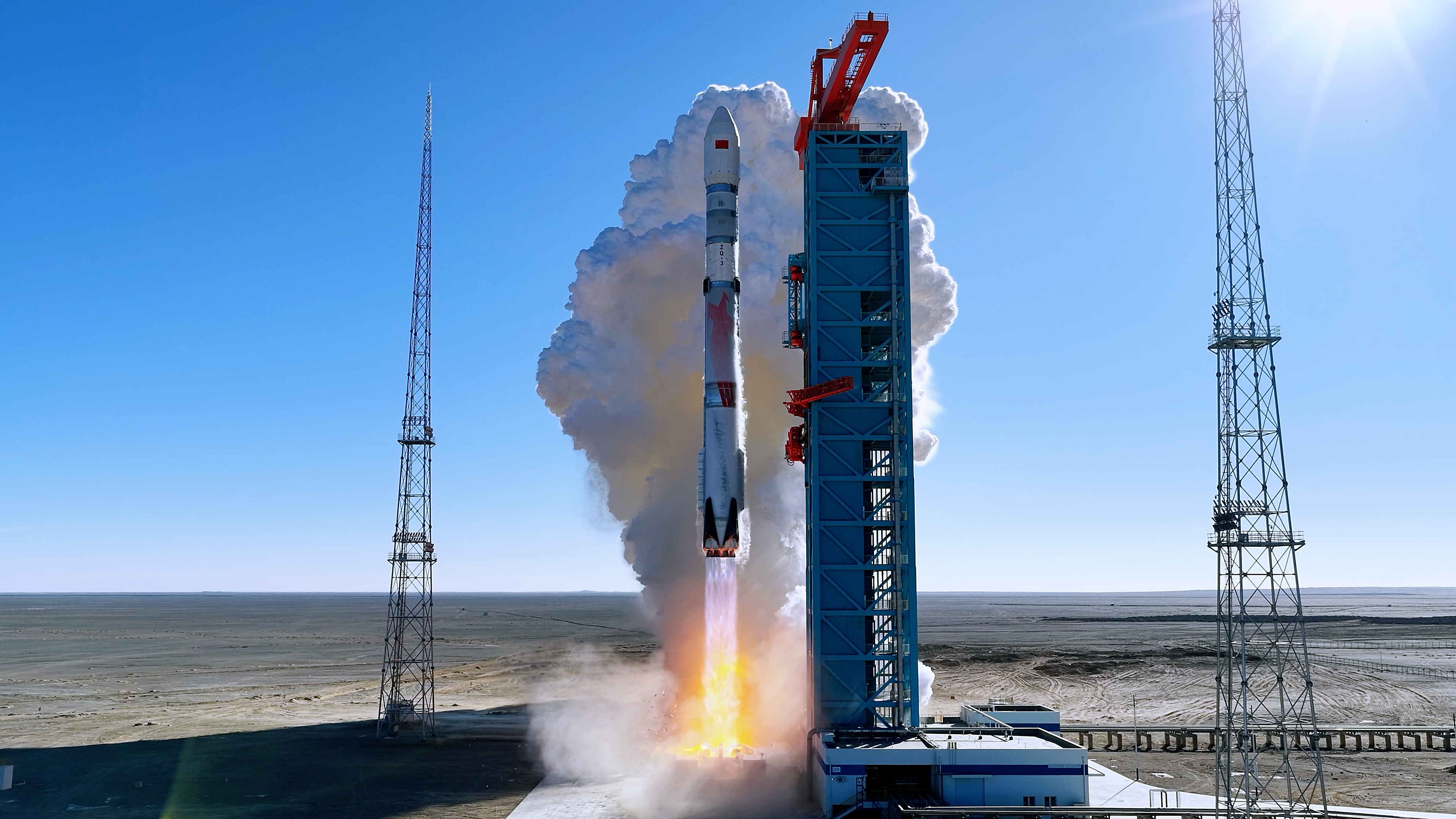
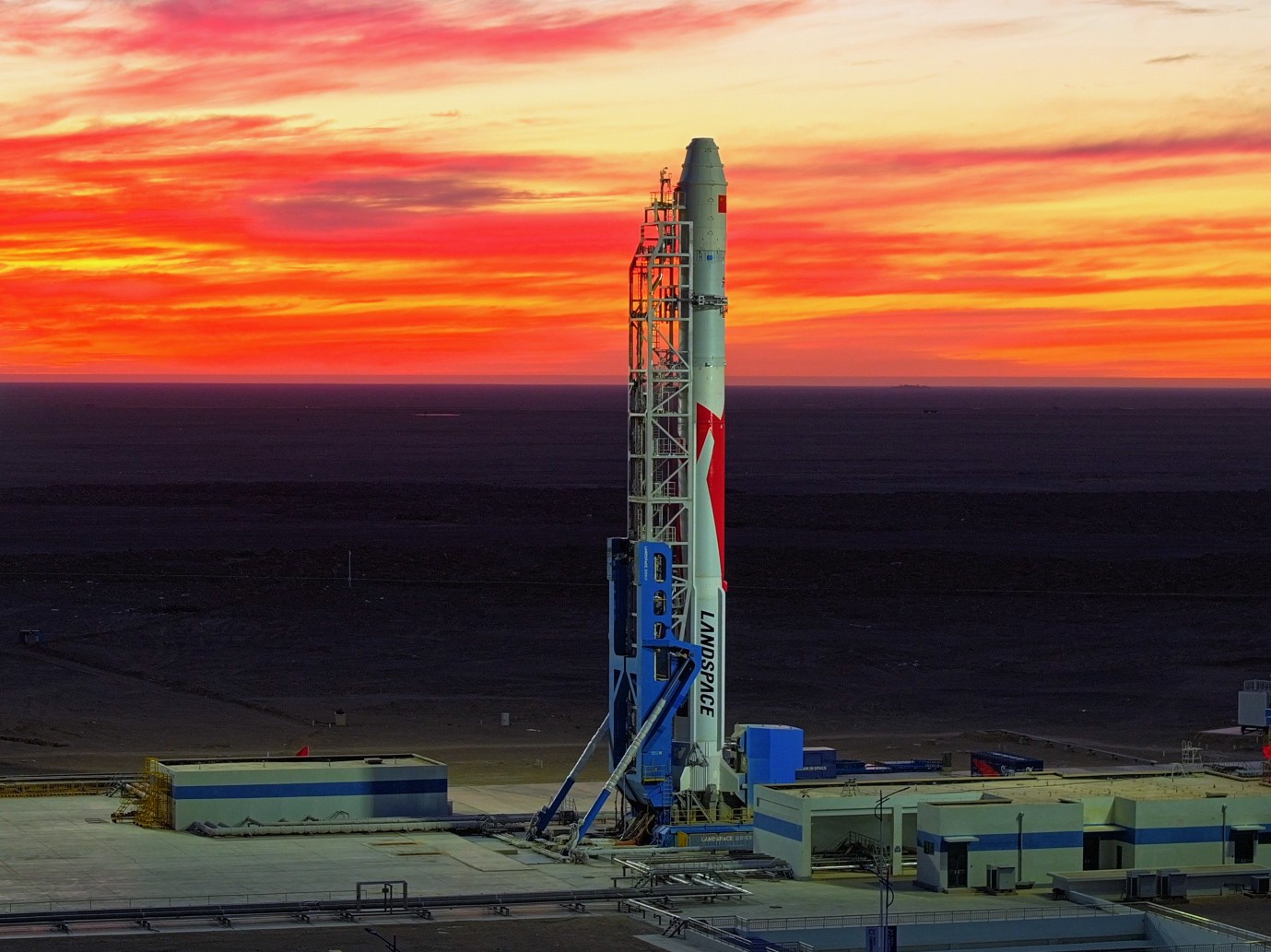
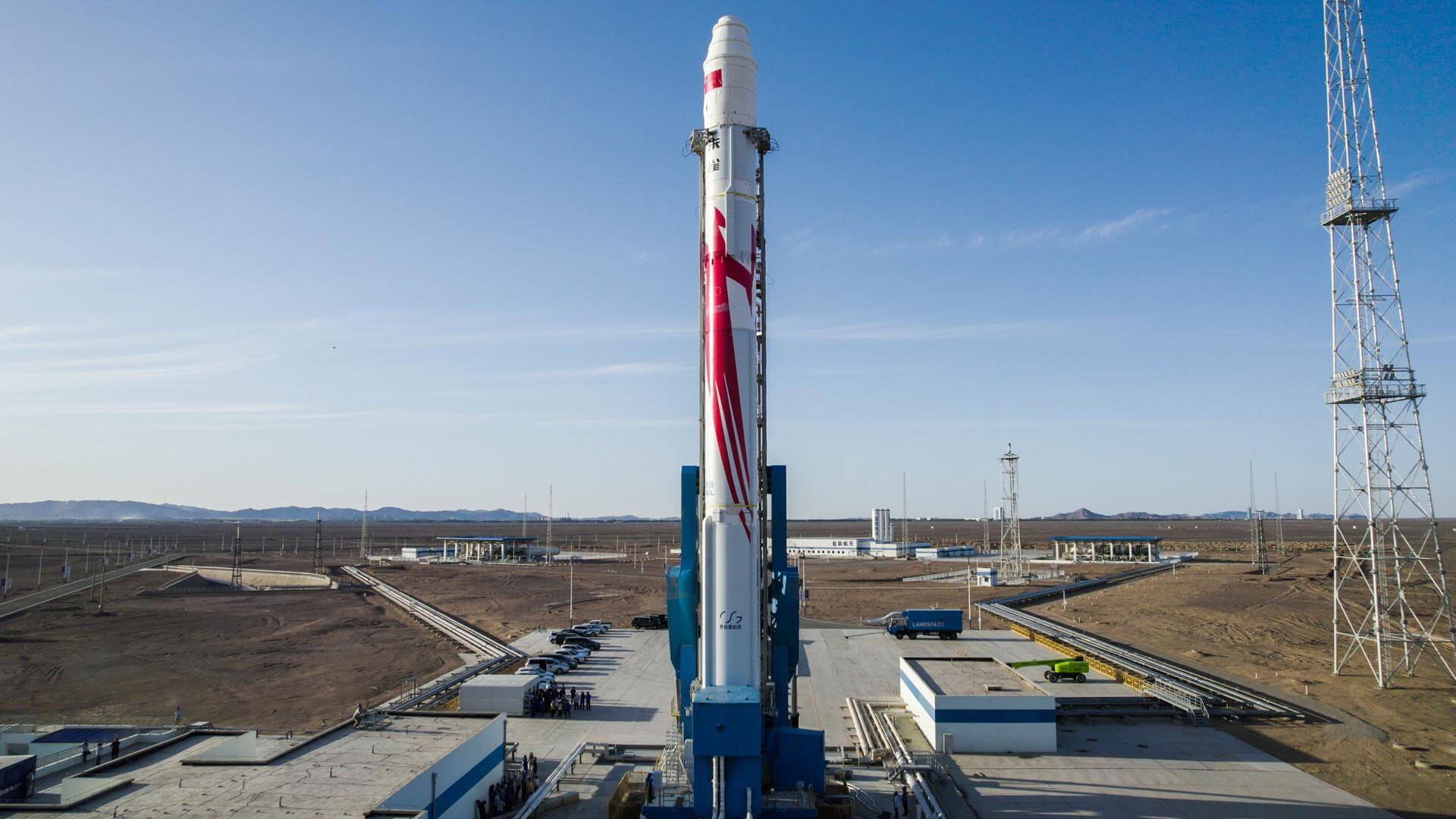
Zhuque-3 • Zhuque
First test launch of LandSpace’s ZQ-3 rocket, with a dummy payload. The rocket’s 1st stage attempted to land on a landing pad about 300 km downrange of the launch site.
Falcon 9 • Falcon
A batch of 29 satellites for the Starlink mega-constellation - SpaceX's project for space-based Internet communication system.
Falcon 9 • Falcon
A batch of 27 satellites for the Starlink mega-constellation - SpaceX's project for space-based Internet communication system.
Vega-C • Vega
KOMPSAT-7 is the follow-up model of KOMPSAT-3A whose mission is to provide high-resolution satellite images to satisfy South-Korea's governmental and institutional needs.
Falcon 9 • Falcon
A batch of 29 satellites for the Starlink mega-constellation - SpaceX's project for space-based Internet communication system.
Long March 7A • Long March
Classified experimental Chinese satellite of unknown purposes.
Falcon 9 • Falcon
Dedicated rideshare flight to a sun-synchronous orbit with dozens of small microsatellites and nanosatellites for commercial and government customers.
Soyuz 2.1a • Soyuz
Soyuz MS-28 will carry three cosmonauts and one astronaut to the International Space Station aboard the Soyuz spacecraft from the Baikonur Cosmodrome in Kazakhstan. The crew consists of Roscosmos cosmonauts Sergei Kud-Sverchkov, Sergei Mikayev and Oleg Platonov.
Nuri • KSLV
CAS500-3 is a South Korean Earth observation satellites to be used by the Ministry of Science and ICT for space technology verification and space science research.
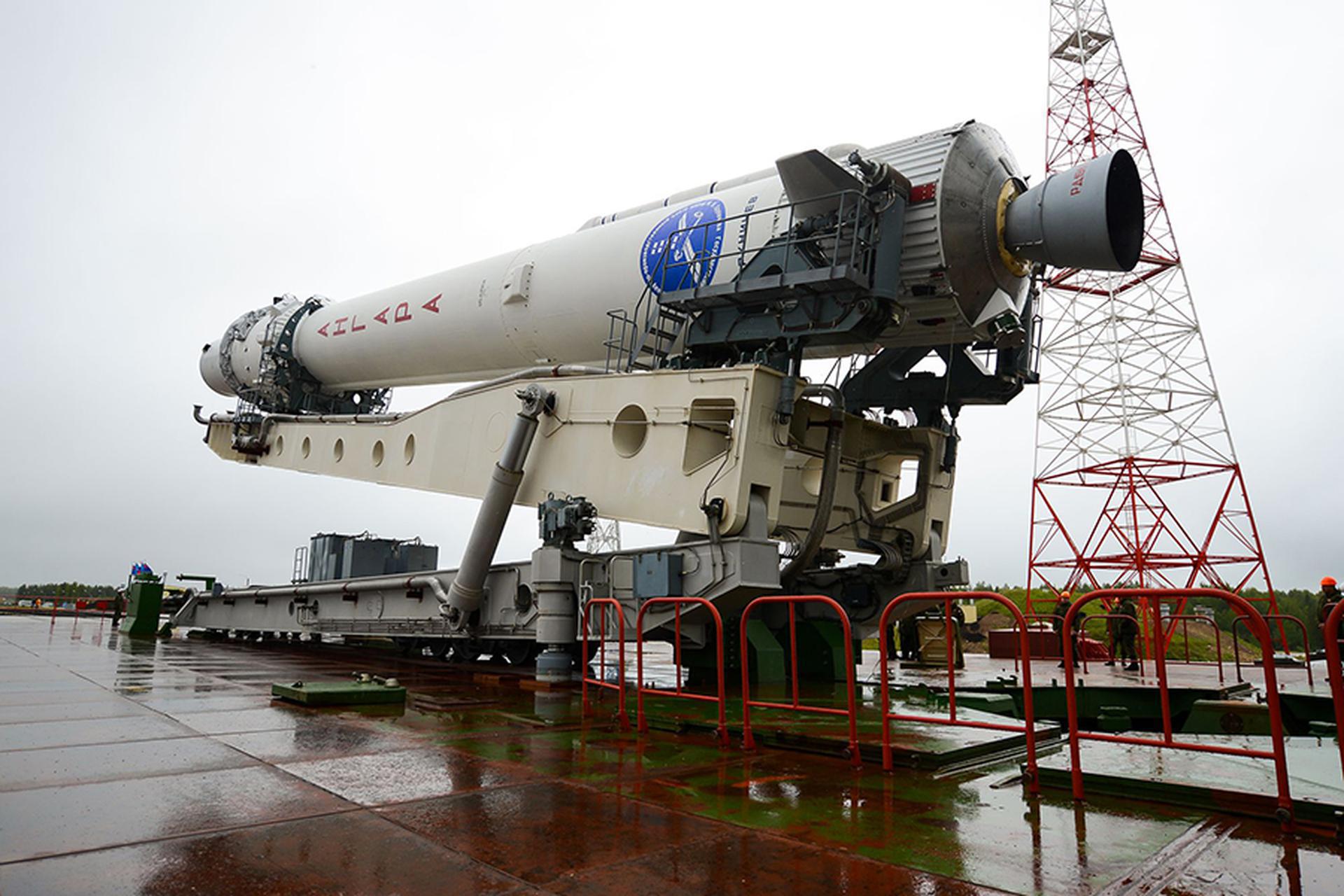
Angara 1.2 • Angara
Note: Payload identity and Cosmos series numbering not confirmed. The Strela (Russian: Стрела) are Soviet, then Russian, military space telecommunication satellites, in use since 1964. These satellites operate as mailboxes ("store-and-forward"): they remember the received messages and then resend them after the scheduled time, or by a command from the Earth. They can serve for up to five years. The satellites are used for transmission of encrypted messages and images. The operational constellation consists of 12 satellites in two orbital planes, spaced 90° apart. The spacecraft had a cylindrical body with a gravity-gradient boom, which was extended on-orbit to provide passive attitude stabilization. On-board storage was 12 Mbits of data, with a transmission rate of 2.4 kbit/s. The first three satellites were launched in 1964 by a Cosmos launcher. After one year of service, new and improved satellites were launched, called Strela-2. In 1970, these satellites were modernized, and became the Strela-1M and Strela-2M satellites. From 1985, these satellites will be gradually replaced by Strela-3, and then by Strela-3M from 2005. A civilian version of these satellites was created, called Goniets. Initially they were launched in groups of six on Tsyklon; when the launcher was retired, they were only launched by two on Cosmos, before Rokot was put into service and allowed the sending of triplets of Strela satellites.
Long March 2F/G • Long March
Shenzhou 22 (Chinese: 神舟二十二号) will be the 22nd flight of the Shenzhou program. The spacecraft will be launched without crew to replace Shenzhou 20 that was damaged by orbital debris on the descent module porthole window, and thus deemed unsuitable for crew re-entry. The spacecraft will later return three Chinese astronauts on the 10th flight to the Chinese Space Station back to Earth, after launching on Shenzhou 21.
Falcon 9 • Falcon
A batch of 28 satellites for the Starlink mega-constellation - SpaceX's project for space-based Internet communication system.
Falcon 9 • Falcon
A batch of 29 satellites for the Starlink mega-constellation - SpaceX's project for space-based Internet communication system.
Long March 3B/E • Long March
Chinese classified satellite claimed to be for communication technology test purposes. Actual mission not known.
Falcon 9 • Falcon
A batch of 29 satellites for the Starlink mega-constellation - SpaceX's project for space-based Internet communication system.
Electron •
Note: Payload and customer identities were not publicly announced. 3rd of the BlackSky Gen-3 high resolution Earth-imaging satellites.
Long March 2C • Long March
3 Chinese satellites described as for “Space Environment Measurements” purposes. Actual usage not known.
Falcon 9 • Falcon
A batch of 29 satellites for the Starlink mega-constellation - SpaceX's project for space-based Internet communication system.
Electron •
Sub-orbital launch under Rocket Lab’s Hypersonic Accelerator Suborbital Test Electron (HASTE) program. This mission was lead by MDA and deployed a government-provided primary payload developed by the John Hopkins University Applied Physics Laboratory (JHUAPL), and multiple secondary payloads by federal and industry partners, which tested key technologies for missile defense applications. The mission was contracted to Rocket Lab through the DIU’s Hypersonic and High-Cadence Airborne Testing Capabilities (HyCAT) program, an initiative supporting test and evaluation of new and emerging hypersonic technologies through low cost, responsive and long endurance flight testing.
Falcon 9 • Falcon
The Sentinel-6 Michael Freilich (launched November 2020) and Sentinel-6B make up the Sentinel-6 mission, also known as Jason Continuity of Service (Jason-CS), which is a partnership between NASA, NOAA, ESA, and EUMETSAT. This mission continues the long-term global sea surface height data record begun by first Jason satellites in 1992.
Falcon 9 • Falcon
A batch of 29 satellites for the Starlink mega-constellation - SpaceX's project for space-based Internet communication system.
Falcon 9 • Falcon
A batch of 29 satellites for the Starlink mega-constellation - SpaceX's project for space-based Internet communication system.
Atlas V 551 • Atlas
The ViaSat-3 is a series of three Ka-band satellites is expected to provide vastly superior capabilities in terms of service speed and flexibility for a satellite platform. Each ViaSat-3 class satellite is expected to deliver more than 1-Terabit per second of network capacity, and to leverage high levels of flexibility to dynamically direct capacity to where customers are located.
New Glenn •
Second flight of Blue Origin's New Glenn launch vehicle carrying the Escape and Plasma Acceleration and Dynamics Explorers (EscaPADE), a dual-spacecraft mission from University of California, Berkeley to study ion and sputtered escape from Mars. The spacecrafts' scientific goals are to understand the processes controlling the structure of Mars' hybrid magnetosphere and how it guides ion flows; understand how energy and momentum are transported from the solar wind through Mars' magnetosphere; and understand the processes controlling the flow of energy and matter into and out of the collisional atmosphere.
Falcon 9 • Falcon
A batch of 29 satellites for the Starlink mega-constellation - SpaceX's project for space-based Internet communication system.
Ceres-1 • Ceres-1
Earth Observation satellite for the Jilin-1 commercial constellation. Other payloads: * Jilin-1 Platform-02A-04 * Zhongbei University-1
Long March 12 • Long March
A batch of 9 Low Earth Orbit communication satellites for the Chinese state owned SatNet constellation operated by the China Satellite Network Group. The constellation will eventually consists of 13000 satellites.
Falcon 9 • Falcon
A batch of 29 satellites for the Starlink mega-constellation - SpaceX's project for space-based Internet communication system.
Kinetica 1 •
2 satellites built by the China Aerospace Science and Industry Corporation (CASIC) for testing operations of Very Low Earth Orbit (VLEO) satellites for Earth observation purposes.
Long March 11 • Long March
3 Chinese satellites reported to be for "orbital technological testing" purposes. Actual usage not known.
Falcon 9 • Falcon
A batch of 28 satellites for the Starlink mega-constellation - SpaceX's project for space-based Internet communication system.
Falcon 9 • Falcon
A batch of 29 satellites for the Starlink mega-constellation - SpaceX's project for space-based Internet communication system.
Electron •
Synthetic aperture radar Earth observation satellite for Japanese Earth imaging company iQPS.
Ariane 62 • Ariane
Sentinel-1D carries an advanced radar technology to provide an all-weather, day-and-night supply of imagery of Earth’s surface as part of the Sentinel-1 constellation.
Long March 7A • Long March
Classified Earth observation satellite officially reported as for "national resources/hydrology/meteorology surveying & disaster management" purposes.
LVM-3 (GSLV Mk III) • GSLV
Communications Satellite for the Indian Navy, replacing GSAT-7 for secure real-time links between Indian warships, submarines, aircraft, and shore-based command centers across the Indian Ocean.
Falcon 9 • Falcon
Dedicated rideshare flight to a mid-inclination orbit with dozens of small microsatellites and nanosatellites for commercial and government customers.
Falcon 9 • Falcon
A batch of 28 satellites for the Starlink mega-constellation - SpaceX's project for space-based Internet communication system.
Long March 2F/G • Long March
Tenth crewed flight to the Chinese space station.
Falcon 9 • Falcon
A batch of 29 satellites for the Starlink mega-constellation - SpaceX's project for space-based Internet communication system.
Falcon 9 • Falcon
A batch of 28 satellites for the Starlink mega-constellation - SpaceX's project for space-based Internet communication system.
Falcon 9 • Falcon
A batch of 28 satellites for the Starlink mega-constellation - SpaceX's project for space-based Internet communication system.
Long March 3B/E • Long March
Gaofen is a series of civilian Earth observation satellites developed and launched for the China High-definition Earth Observation System (CHEOS), a state-sponsored programme aimed to develop a near-real time, all-weather, global surveillance network consisting of satellite, near-space (stratosphere) airships, and aerial observation platforms.
H3-24 • H3
First flight of the upgraded Japanese HTV-X spacecraft designed to resupply the International Space Station.
Falcon 9 • Falcon
A batch of 28 satellites for the Starlink mega-constellation - SpaceX's project for space-based Internet communication system.
Falcon 9 • Falcon
Second of two new-generation satellites built by Airbus to provide secure communications to the Spanish government, its allies, and various international organizations.
Long March 5 • Long March
Chinese classified satellite claimed to be for communication technology test purposes. Actual mission not known.
Falcon 9 • Falcon
A batch of 28 satellites for the Starlink mega-constellation - SpaceX's project for space-based Internet communication system.
Falcon 9 • Falcon
A batch of 28 satellites for the Starlink mega-constellation - SpaceX's project for space-based Internet communication system.
Falcon 9 • Falcon
A batch of 28 satellites for the Starlink mega-constellation - SpaceX's project for space-based Internet communication system.
Kinetica 1 •
* PRSC-HS1 is a hyperspectral Earth observation satellite for SUPARCO of Pakistan. * AIRSAT-03/04 are 2 X-band synthetic aperture radar (SAR) Earth observation satellite made by the Chinese Academy of Sciences, with 0.5 meter resolution. AIRSAT-03 is built for TerraXpace of Malaysia.
Long March 6A • Long March
18 Low Earth Orbit communication satellites with Ku, Q and V band payloads for the G60 constellation operated by Shanghai Spacesail Technologies with funding backed by the Shanghai local government. Initial constellation will consist of 1296 satellites by 2027 with long term plans to expand it to 12000 satellites.
Falcon 9 • Falcon
A batch of 28 satellites for the Starlink mega-constellation - SpaceX's project for space-based Internet communication system.
Long March 8A • Long March
A batch of 9 Low Earth Orbit communication satellites for the Chinese state owned SatNet constellation operated by the China Satellite Network Group. The constellation will eventually consists of 13000 satellites.
Falcon 9 • Falcon
Tranche 1 Transport Layer C is one of six missions by the United States Space Force Space Development Agency (SDA) for the Proliferated Warfighter Space Architecture (PWSA) Tranche 1 Transport Layer constellation, which will provide assured, resilient, low-latency military data and connectivity worldwide to the full range of warfighter platforms from Low Earth Orbit satellites. The constellation will be interconnected with Optical Inter-Satellite Links (OISLs) which have significantly increased performance over existing radio frequency crosslinks. It is expected to operate over Ka band, have stereo coverage and be dynamically networked for simpler hand-offs, greater bandwidth and fault tolerance. This launch carries 21 satellites manufactured by Lockheed Martin.
Electron •
Synthetic aperture radar satellite for Japanese Earth imaging company Synspective.
Falcon 9 • Falcon
Third of a three launches contract for Amazon's Kuiper low Earth orbit satellite internet constellation, with 24 satellites on board. Amazon Leo, formerly known as Project Kuiper, is a mega constellation of satellites in Low Earth Orbit that will offer broadband internet access, this constellation will be managed by Kuiper Systems LLC, a subsidiary of Amazon. This constellation is planned to be composed of 3,276 satellites. The satellites are projected to be placed in 98 orbital planes in three orbital layers, one at 590 km, 610 km and 630 km altitude.
Starship • Starship
11th test flight of the two-stage Starship launch vehicle.
Long March 2D • Long March
Chinese satellite reported to be for "new optical imaging technological demonstration" purposes. Actual usage not known.
Gravity-1 •
Carried 3 satellites to sun-synchronous orbit, including the Earth observation satellite Jilin-1 Wideband-02B-07. Details TBD.
New Shepard •
NS-36 is the 15th crewed flight for the New Shepard program and the 36th in the New Shepard program's history.
Falcon 9 • Falcon
A batch of 28 satellites for the Starlink mega-constellation - SpaceX's project for space-based Internet communication system.
Falcon 9 • Falcon
A batch of 28 satellites for the Starlink mega-constellation - SpaceX's project for space-based Internet communication system.
Falcon 9 • Falcon
A batch of 28 satellites for the Starlink mega-constellation - SpaceX's project for space-based Internet communication system.
Electron •
Sub-orbital launch under Rocket Lab’s Hypersonic Accelerator Suborbital Test Electron (HASTE) program, details TBD.
Long March 2D • Long March
A pair of Chinese satellites reported to be for "Earth observation technological testing and validation" purposes. Actual usage not known.
Falcon 9 • Falcon
A batch of 28 satellites for the Starlink mega-constellation - SpaceX's project for space-based Internet communication system.
Long March 6A • Long March
A batch of 5 Low Earth Orbit communication satellites for the Chinese state owned SatNet constellation operated by the China Satellite Network Group. The constellation will eventually consists of 13000 satellites.
Long March 4C • Long March
The Fengyun-3 (FY-3) series is the 2nd generation of Chinese polar-orbiting meteorological satellites, following on from the FY-1 series. The series has been developed collaboratively by CMA (Chinese Meteorological Administration) and CNSA (China National Space Administration). The FY-3 series’ objectives are to provide global measurements of 3-D temperature and moisture soundings, cloud and precipitation parameters, meteorological and hydrological events, biosphere anomalies and geophysical parameters in support of global change and climate monitoring.
Falcon 9 • Falcon
A batch of 24 satellites for the Starlink mega-constellation - SpaceX's project for space-based Internet communication system.
Atlas V 551 • Atlas
Amazon Leo, formerly known as Project Kuiper, is a mega constellation of satellites in Low Earth Orbit that will offer broadband internet access, this constellation will be managed by Kuiper Systems LLC, a subsidiary of Amazon. This constellation is planned to be composed of 3,276 satellites. The satellites are projected to be placed in 98 orbital planes in three orbital layers, one at 590 km, 610 km and 630 km altitude.
Falcon 9 • Falcon
A batch of 28 satellites for the Starlink mega-constellation - SpaceX's project for space-based Internet communication system.
Falcon 9 • Falcon
IMAP (Interstellar Mapping and Acceleration Probe) is a NASA mission to study interactions between solar wind and the local interstellar medium. Carrying a suite of 10 scientific instruments, IMAP is able to investigate how particles are accelerated, determine their composition, as well as help to advance space weather forecasting models. The IMAP launch also includes the space weather satellite SWFO-L1 (Space Weather Follow-On - L1) for NOAA and the GLIDE (Global Lyman-alpha Imagers of the Dynamic Exosphere/Carruthers Geocorona Observatory) mission to study far ultraviolet emission in the Earth's exosphere.
Smart Dragon 3 • Smart Dragon
12 LEO communications satellites for Chinese car manufacturer Geely Automotive for testing autonomous driving/inter-vehicle communication services. They also carry payloads for ocean observation.
Electron •
Sub-orbital launch under Rocket Lab’s Hypersonic Accelerator Suborbital Test Electron (HASTE) program, details TBD.
Falcon 9 • Falcon
Eleventh batch of satellites for a reconnaissance satellite constellation built by SpaceX and Northrop Grumman for the National Reconnaissance Office to provide imaging and other reconnaissance capabilities.
Falcon 9 • Falcon
A batch of 28 satellites for the Starlink mega-constellation - SpaceX's project for space-based Internet communication system.
Falcon 9 • Falcon
A batch of 24 satellites for the Starlink mega-constellation - SpaceX's project for space-based Internet communication system.
New Shepard •
NS-35 is the 35th flight for the New Shepard program. This flight will fly more than 40 scientific and research payloads to space and back, including 24 experiments from NASA’s TechRise Student Challenge and payloads for Johns Hopkins Applied Physics Laboratory, Oklahoma State University, University of Florida, Carthage College, University of Central Florida, Teledyne, Space Lab Technologies, and Teachers in Space, among others.
Falcon 9 • Falcon
A batch of 28 satellites for the Starlink mega-constellation - SpaceX's project for space-based Internet communication system.
Long March 2C/YZ-1S • Long March
Officially described as "Satellite-Internet Technology Demonstration Satellite(s)". Probably 4 test satellites for the Chinese state-owned LEO communication satellite constellation SatNet.
Falcon 9 • Falcon
This is the 23rd flight of the Northrop Grumman's uncrewed resupply spacecraft Cygnus and its 22nd flight to the International Space Station under the Commercial Resupply Services contract with NASA.
Falcon 9 • Falcon
A batch of 24 satellites for the Starlink mega-constellation - SpaceX's project for space-based Internet communication system.
Soyuz 2.1b/Fregat • Soyuz
Glonass-K1 are the third generation of satellite design for GLONASS satellite navigation system. GLONASS is a Russian space-based navigation system comparable to the similar GPS and Galileo systems. This generation improves on accuracy, power consumption and design life. Each satellite is unpressurized and weighs 935 kg, and has an operational lifetime of 10 years. This launch also carries Mozhayets-6 (Kosmos 2596), a small experimental satellite built by the Mozhaiskiy Military Space Academy of St. Petersburg.
Falcon 9 • Falcon
Nusantara Lima is an Indonesian geostationary communications satellite with a capacity of more than 160 Gbps.
Soyuz 2.1a • Soyuz
Progress resupply mission to the International Space Station.
Falcon 9 • Falcon
Tranche 1 Transport Layer B is one of six missions by the United States Space Force Space Development Agency (SDA) for the Proliferated Warfighter Space Architecture (PWSA) Tranche 1 Transport Layer constellation, which will provide assured, resilient, low-latency military data and connectivity worldwide to the full range of warfighter platforms from Low Earth Orbit satellites. The constellation will be interconnected with Optical Inter-Satellite Links (OISLs) which have significantly increased performance over existing radio frequency crosslinks. It is expected to operate over Ka band, have stereo coverage and be dynamically networked for simpler hand-offs, greater bandwidth and fault tolerance. This launch carries 21 satellites manufactured by York Space Systems.
Long March 7A • Long March
A Chinese military “remote sensing” satellite of unknown purposes.
Smart Dragon 3 • Smart Dragon
11 LEO communications satellites for Chinese car manufacturer Geely Automotive for testing autonomous driving/inter-vehicle communication services. They also carry payloads for ocean observation.
Falcon 9 • Falcon
A batch of 24 satellites for the Starlink mega-constellation - SpaceX's project for space-based Internet communication system.
Long March 6A • Long March
3 Chinese reconnaissance satellites of unknown purposes, officially reported as for "Electromagnetic environment probing".
Falcon 9 • Falcon
A batch of 28 satellites for the Starlink mega-constellation - SpaceX's project for space-based Internet communication system.
Ceres-1 • Ceres-1
Carried 3 satellites to Sun-synchronous orbit: * Kaiyun-1 * Yuxing-3-08 * Yunyao-27
Long March 3C/YZ-1 • Long March
Satellite officially named for "space environment detection" purposes, exact details unknown.
Falcon 9 • Falcon
A batch of 28 satellites for the Starlink mega-constellation - SpaceX's project for space-based Internet communication system.
Falcon 9 • Falcon
A batch of 24 satellites for the Starlink mega-constellation - SpaceX's project for space-based Internet communication system.
Shavit-2 • Shavit
Ofek-19 is an Israeli SAR (Synthetic Aperture Radar) reconnaissance satellite with enhanced capabilities.
Falcon 9 • Falcon
A batch of 28 satellites for the Starlink mega-constellation - SpaceX's project for space-based Internet communication system.
Falcon 9 • Falcon
A batch of 24 satellites for the Starlink mega-constellation - SpaceX's project for space-based Internet communication system.
Falcon 9 • Falcon
A batch of 28 satellites for the Starlink mega-constellation - SpaceX's project for space-based Internet communication system.
Falcon 9 • Falcon
A batch of 28 satellites for the Starlink mega-constellation - SpaceX's project for space-based Internet communication system.
Starship • Starship
10th test flight of the two-stage Starship launch vehicle.
Falcon 9 • Falcon
NAOS (National Advanced Optical System) is the space component of Luxembourg's governmental dual-use observation satellite system LUXEOSys (Luxembourg Earth Observation System). Its purpose is to provide high resolution images to national and international governmental and military organizations such as NATO. The 800 kg satellite is built by OHB Italia and is equipped with a very high-resolution optical camera with a ground reolution of 50 cm in an around 450 km high sun-synchronous orbit. It will have a operational life time of 7 years. Also on board the launch is Dhruva Space's LEAP-1; Planet's Pelican-3 and Pelican-4; and Exolaunch’s Acadia-6, FFLY-1, FFLY-2, and FFLY-3.
Long March 8A • Long March
A batch of 9 Low Earth Orbit communication satellites for the Chinese state owned SatNet constellation operated by the China Satellite Network Group. The constellation will eventually consists of 13000 satellites.
Falcon 9 • Falcon
33rd commercial resupply services mission to the International Space Station operated by SpaceX. The flight will be conducted under the second Commercial Resupply Services contract with NASA. Cargo Dragon 2 brings supplies and payloads, including critical materials to directly support science and research investigations that occur onboard the orbiting laboratory. The CRS SpX-33 Mission will be the first mission including a boost module inside the dragons trunk for ISS orbit raising.
Electron •
'Live, Laugh, Launch' is the second of two dedicated missions on Electron for a confidential customer in 2025. This mission deployed 5 satellites to a 655 km circular Earth orbit identified as “Calistus A to E”, identified as most likely for Low Earth Orbit communication satellite constellation operator E-Space.
Falcon 9 • Falcon
A batch of 24 satellites for the Starlink mega-constellation - SpaceX's project for space-based Internet communication system.
Falcon 9 • Falcon
Eighth flight of the X-37B program. The X-37B is a dynamic and responsive spacecraft responsible for conducting a range of tests and experiments that expedite the development of critical next-generation technologies and operational concepts for reusable space capabilities. The OTV-8 mission in Low Earth Orbit includes operational demonstrations and experiments of next-generation technologies, including laser communications and the highest performing strategic grade quantum inertial sensor ever tested in space. Mission partners include the Air Force Research Lab and the Defense Innovation Unit, respectively.
Angara 1.2 • Angara
4 classified satellites for the Russian military.
Soyuz 2.1b • Soyuz
Bion-M is the next generation of Russian biological research satellites. While retaining the Vostok/Zenit-derived reentry module of the earlier Bion, the propulsion module has been replace by a Yantar type module, which provides maneuvering capabilities and longer mission support. The mission duration has been increased to up to 6 months by using solar cells for energy generation. The weight of scientific equipment has been increased by 100 kilograms.
Kinetica 1 •
A share ride mission of 7 various Earth observation and technological demonstration satellites: * AIRSAT-05/Haishao-2 * Tianyan 26 * Duogongneng Shiyan-2 01-03 * ThumbSat-1/2 (Mexico)
Falcon 9 • Falcon
A batch of 24 satellites for the Starlink mega-constellation - SpaceX's project for space-based Internet communication system.
Long March 6A • Long March
A batch of 5 Low Earth Orbit communication satellites for the Chinese state owned SatNet constellation operated by the China Satellite Network Group. The constellation will eventually consists of 13000 satellites.
Long March 4C • Long March
Satellite officially named for "space environment detection" purposes, exact details unknown.
Zhuque-2E • Zhuque
Officially described as "Satellite-Internet Technology Demonstration Satellite(s)". Probably 4 test satellites for the Chinese state-owned LEO communication satellite constellation SatNet.
Falcon 9 • Falcon
A batch of 28 satellites for the Starlink mega-constellation - SpaceX's project for space-based Internet communication system.
Falcon 9 • Falcon
A batch of 24 satellites for the Starlink mega-constellation - SpaceX's project for space-based Internet communication system.
Long March 5B/YZ-2 • Long March
A batch of 10 Low Earth Orbit communication satellites for the Chinese state owned SatNet constellation operated by the China Satellite Network Group. The constellation will eventually consists of 13000 satellites.
Vulcan VC4S • Vulcan
USSF-106 is a mission for the United States Space Force. The launch will deploy various payloads directly into geosynchronous orbit, including the NTS-3 (Navigation Technology Satellite 3), a demonstration navigation satellite testing a new digital signal generator that can be reprogrammed on-orbit to broadcast new signals, improve performance by avoiding and defeating interference, and adding signatures for detecting spoofing attacks.
Ariane 62 • Ariane
First of EUMETSAT's second generation of Metop weather satellites.
Falcon 9 • Falcon
Second of a three launches contract for Amazon's Kuiper low Earth orbit satellite internet constellation, with 24 satellites on board. Amazon Leo, formerly known as Project Kuiper, is a mega constellation of satellites in Low Earth Orbit that will offer broadband internet access, this constellation will be managed by Kuiper Systems LLC, a subsidiary of Amazon. This constellation is planned to be composed of 3,276 satellites. The satellites are projected to be placed in 98 orbital planes in three orbital layers, one at 590 km, 610 km and 630 km altitude.
Smart Dragon 3 • Smart Dragon
11 LEO communications satellites for Chinese car manufacturer Geely Automotive for testing autonomous driving/inter-vehicle communication services. They also carry payloads for ocean observation.
Electron •
Synthetic aperture radar Earth observation satellite for Japanese Earth imaging company iQPS.
Long March 12 • Long March
A batch of 9 Low Earth Orbit communication satellites for the Chinese state owned SatNet constellation operated by the China Satellite Network Group. The constellation will eventually consists of 13000 satellites.
Falcon 9 • Falcon
A batch of 28 satellites for the Starlink mega-constellation - SpaceX's project for space-based Internet communication system.
New Shepard •
NS-34 is the 14th crewed flight for the New Shepard program and the 34th in its history.
Falcon 9 • Falcon
SpaceX Crew-11 is the eleventh crewed operational flight of a Crew Dragon spacecraft to the International Space Station as part of NASA's Commercial Crew Program.
Falcon 9 • Falcon
A batch of 19 satellites for the Starlink mega-constellation - SpaceX's project for space-based Internet communication system.
Kuaizhou 1A • Kuaizhou
Chinese built Earth observation satellite for Pakistan’s SUPARCO (Space & Upper Atmosphere Research Commission).
GSLV Mk II • GSLV
The NASA-ISRO Synthetic Aperture Radar, or NISAR satellite, will use advanced radar imaging to map the elevation of Earth's land and ice masses 4 to 6 times a month at resolutions of 5 to 10 meters. It is designed to observe and measure some of the planet's most complex natural processes, including ecosystem disturbances, ice-sheet collapse, and natural hazards such as earthquakes, tsunamis, volcanoes and landslides. Under the terms of the agreement, NASA will provide the mission's L band synthetic aperture radar (SAR), a high-rate telecommunication subsystem for scientific data, GPS receivers, a solid-state recorder, and a payload data subsystem. ISRO will provide the satellite bus, an S band synthetic aperture radar, the launch vehicle, and associated launch services.
Long March 8A • Long March
A batch of 9 Low Earth Orbit communication satellites for the Chinese state owned SatNet constellation operated by the China Satellite Network Group. The constellation will eventually consists of 13000 satellites.
Falcon 9 • Falcon
A batch of 28 satellites for the Starlink mega-constellation - SpaceX's project for space-based Internet communication system.
Eris-1 • Eris
Maiden flight of Gilmour Space's orbital launch vehicle Eris.
Hyperbola-1 •
Commercial Earth observation satellite in SSO with sub-meter resolution capability.
Long March 6A • Long March
A batch of 5 Low Earth Orbit communication satellites for the Chinese state owned SatNet constellation operated by the China Satellite Network Group. The constellation will eventually consists of 13000 satellites.
Falcon 9 • Falcon
A batch of 24 satellites for the Starlink mega-constellation - SpaceX's project for space-based Internet communication system.
Falcon 9 • Falcon
A batch of 28 satellites for the Starlink mega-constellation - SpaceX's project for space-based Internet communication system.
Vega-C • Vega
CO3D is a CNES-Airbus Defence & Space constellation of four small satellites designed to map the globe in 3D from low Earth to serve public and private sector needs. Microcarb is a small satellite designed to map sources and sinks of carbon dioxide (CO2)—the most important greenhouse gas — on a global scale.
Soyuz 2.1b/Fregat-M • Soyuz
Ionosfera is a constellation of four ionospheric and magnetospheric research satellites developed by for Roscosmos for the project Ionozond. The satellites will operate on circular sun-synchronous orbits (SSO), at altitude of about 800 km and located in two orbital planes of two satellites each. The following science instruments are carried on the satellites: * SPER/1 Plasma and energy radiation spectrometer * SG/1 Gamma-ray spectrometer * GALS/1 Galactic cosmic ray spectrometer / 1 * LAERTES On-board Ionosonde * NBK/2 Low-frequency wave complex * ESEP Ionospheric plasma energy spectrometer * Ozonometer-TM Ozonometer * MayaK On-board radio transmitters * PES GPS-GLONASS device
Falcon 9 • Falcon
NASA's Tandem Reconnection and Cusp Electrodynamics Reconnaissance Satellites (TRACERS) mission, consisting of two identical satellites that will orbit Earth in tandem (one following the other), will help understand magnetic re-connection and its effects in Earth’s atmosphere. Magnetic re-connection occurs when activity from the Sun interacts with Earth’s magnetic field. By understanding this process, scientists will be able to better understand and prepare for impacts of solar activity on Earth. Hitchhiking small satellites: * Athena EPIC (Economical Payload Integration Cost) * Polylingual Experimental Terminal (PExT) * Relativistic Electron Atmospheric Loss (REAL)
Falcon 9 • Falcon
2 high-throughput communications satellites in Medium Earth Orbit (MEO) built by Boeing and operated by SES.
Falcon 9 • Falcon
A batch of 24 satellites for the Starlink mega-constellation - SpaceX's project for space-based Internet communication system.
Falcon 9 • Falcon
First of a three launches contract for Amazon's Kuiper low Earth orbit satellite internet constellation, with 24 satellites on board. Amazon Leo, formerly known as Project Kuiper, is a mega constellation of satellites in Low Earth Orbit that will offer broadband internet access, this constellation will be managed by Kuiper Systems LLC, a subsidiary of Amazon. This constellation is planned to be composed of 3,276 satellites. The satellites are projected to be placed in 98 orbital planes in three orbital layers, one at 590 km, 610 km and 630 km altitude.
Falcon 9 • Falcon
A batch of 26 satellites for the Starlink mega-constellation - SpaceX's project for space-based Internet communication system.
Long March 7 • Long March
Eighth cargo delivery mission to the Chinese space station.
Falcon 9 • Falcon
Note: SpaceX identifies the mission as "Commercial GTO 1". Dror-1 is a geostationary communication satellite built and developed by Israel Aerospace Industries (IAI). It is intended to meet the satellite communication needs of Israel for the next 15 years. Dror-1 is comprised primarily of local Israeli technologies developed at IAI, including an advanced digital communication payload and “smartphone in space” capabilities, to provide communication agility throughout the satellite’s lifetime in space.
Falcon 9 • Falcon
A batch of 28 satellites for the Starlink mega-constellation - SpaceX's project for space-based Internet communication system.
Soyuz 2.1a • Soyuz
Progress resupply mission to the International Space Station.
Long March 4C • Long March
Satellite officially named for "space environment detection" purposes, exact details unknown.
Falcon 9 • Falcon
A batch of 27 satellites for the Starlink mega-constellation - SpaceX's project for space-based Internet communication system.
Falcon 9 • Falcon
Second of EUMETSAT's third generation of weather satellite.
New Shepard •
NS-33 is the 13th crewed flight for the New Shepard program and the 33rd in its history.
Falcon 9 • Falcon
A batch of 26 satellites for the Starlink mega-constellation - SpaceX's project for space-based Internet communication system.
H-IIA • H-II
GOSAT-GW (Greenhouse Gases Observing Satellite Greenhouse gases and Water cycle), also known as Ibuki GW and formerly known as GOSAT 3, is JAXA's next generation satellite to monitor the greenhosue gases like carbon dioxide in the Earth's atmosphere. It is the follow on to the GOSAT 2 (Ibuki 2) and GCOM-W (Shizuku) missions. GOSAT-GW will have two missions: greenhouse gases observation for Japan's Ministry of the Environment and the National Institute for Environmental Studies (NIES), and water-cycle observation for JAXA. By developing the GOSAT-GW satellite, Mitsubishi Electric will contribute to measures for preventing disasters attributed to global warming and climate change, and to advance scientific and technological methods that enable more accurate prediction of climate change. In December 2013, Mitsubishi Electric (MELCO) was selected as the prime contractor for the spacecraft and the instruments.
Electron •
'Symphony In The Stars' is the first of two dedicated missions on Electron to deploy a single spacecraft to a 650km circular Earth orbit for a confidential commercial customer. A second dedicated launch on Electron to meet those same mission requirements is scheduled for launch before the end of 2025. The payload has since been identified by USSF as EchoStar's Lyra-4, an EchoStar Lyra Block 1 satellite. It is a 4-satellite constellation that will deliver global Internet of Things (IoT), machine-to-machine (M2M) and other data services through S-band. EchoStar will operate the constellation from its Australian subsidiary, EchoStar Global.
Falcon 9 • Falcon
A batch of 27 satellites for the Starlink mega-constellation - SpaceX's project for space-based Internet communication system.
Electron •
HawkEye 360 is a a space-based civil global intelligence satellite network using radio frequency (RF) technology to help monitor transportation across air, land and sea and assist with emergencies, and to provide civil SIGINT (Signal Intelligence) mission. The constellation of small satellites (named Hawk) will collect information on specific radio signals worldwide to provide high-precision radio frequency mapping and analytics from Low Earth orbit (LEO). 3 of the satellites will comprise HawkEye 360’s Cluster 12 and will operate in a dawn-to-dusk polar orbit, while the 4th is Kestrel-0A, an experimental satellite designed to evaluate emerging capabilities and future technology enhancements.
Falcon 9 • Falcon
A batch of 27 satellites for the Starlink mega-constellation - SpaceX's project for space-based Internet communication system.
Falcon 9 • Falcon
This is a Crew Dragon flight for a private company Axiom Space. The mission will carry a professionally trained commander alongside three private astronauts to and from the International Space Station. This crew will stay aboard space station for at least eight days.
Falcon 9 • Falcon
Dedicated rideshare flight to a sun-synchronous orbit with dozens of small microsatellites and nanosatellites for commercial and government customers.
Atlas V 551 • Atlas
Amazon Leo, formerly known as Project Kuiper, is a mega constellation of satellites in Low Earth Orbit that will offer broadband internet access, this constellation will be managed by Kuiper Systems LLC, a subsidiary of Amazon. This constellation is planned to be composed of 3,276 satellites. The satellites are projected to be placed in 98 orbital planes in three orbital layers, one at 590 km, 610 km and 630 km altitude.
Falcon 9 • Falcon
A batch of 27 satellites for the Starlink mega-constellation - SpaceX's project for space-based Internet communication system.
Long March 3B/E • Long March
Ku- and Ka-band geostationary communication satellite for China Satcom at 92.2° East, replacing ChinaSat 9.
Angara A5/Briz-M • Angara
Unidentified payload for the Russian military. Kosmos 2590 was separated from Kosmos 2589 after launch.
Falcon 9 • Falcon
A batch of 28 satellites for the Starlink mega-constellation - SpaceX's project for space-based Internet communication system.
Falcon 9 • Falcon
A batch of 26 satellites for the Starlink mega-constellation - SpaceX's project for space-based Internet communication system.
Long March 2D • Long March
Zhangheng 1-02, also known as CSES-02 (China Seismo-Electromagnetic Satellite-02), is the follow-on mission to Zhangheng 1/CSES, a Chinese–Italian space mission dedicated to monitoring the electromagnetic field and waves, plasma parameters, and particle fluxes induced by natural sources and artificial emitters in near-Earth space, to study their correlations with the occurrence of seismic events. The satellite mission is part of a collaboration program between the CNSA (China National Space Administration) and ASI (Italian Space Agency), and developed by CEA (China Earthquake Administration) and INFN (Italian National Institute for Nuclear Physics), together with several Chinese and Italian Universities and research Institutes.
Falcon 9 • Falcon
A batch of 23 satellites for the Starlink mega-constellation - SpaceX's project for space-based Internet communication system.
Falcon 9 • Falcon
A batch of 26 satellites for the Starlink mega-constellation - SpaceX's project for space-based Internet communication system.
Electron •
Synthetic aperture radar Earth observation satellite for Japanese Earth imaging company iQPS.
Falcon 9 • Falcon
A batch of 23 satellites for the Starlink mega-constellation - SpaceX's project for space-based Internet communication system.
Falcon 9 • Falcon
A batch of 26 satellites for the Starlink mega-constellation - SpaceX's project for space-based Internet communication system.
Falcon 9 • Falcon
SXM-10 is the 11th high-powered, digital, audio radio satellite built by Maxar (SSL) for SiriusXM. The SXM-10 satellite will be based on Maxar’s proven 1300-class platform and built at the company’s manufacturing facility in Palo Alto, California. SXM-10 has a large, mesh, unfurlable reflector almost 10 meters in diameter that allows SiriusXM programming to reach its radios, including those in moving vehicles.
Long March 6A • Long March
A batch of 5 Low Earth Orbit communication satellites for the Chinese state owned SatNet constellation operated by the China Satellite Network Group. The constellation will eventually consists of 13000 satellites.
Falcon 9 • Falcon
A batch of 27 satellites for the Starlink mega-constellation - SpaceX's project for space-based Internet communication system.
Falcon 9 • Falcon
A batch of 23 satellites for the Starlink mega-constellation - SpaceX's project for space-based Internet communication system.
Electron •
2nd of the BlackSky Gen-3 high resolution Earth-imaging satellites.
Falcon 9 • Falcon
A batch of 27 satellites for the Starlink mega-constellation - SpaceX's project for space-based Internet communication system.
New Shepard •
NS-32 is the 12th crewed flight for the New Shepard program and the 32nd in its history.
Falcon 9 • Falcon
Eighth of ten GPS III missions.
Long March 4B • Long March
Chinese experimental satellite claimed to be for "Earth observation & environmental management" purposes, details not known.
Long March 3B/E • Long March
Tianwen-2 is a planned Chinese asteroid sample return and comet orbiter mission due for launch in May 2025. The spacecraft will visit the Near Earth asteroid 469219 Kamoʻoalewa (2016 HO3), collecting samples from its surface using both touch-and-go and anchor-and-drill approaches. It will return the samples back to Earth around 2.5 years after launch, with the main spacecraft proceeding to visit the main-belt comet 311P/PANSTARRS in the mid-2030s.
Falcon 9 • Falcon
A batch of 27 satellites for the Starlink mega-constellation - SpaceX's project for space-based Internet communication system.
Starship • Starship
9th test flight of the two-stage Starship launch vehicle.
Falcon 9 • Falcon
A batch of 24 satellites for the Starlink mega-constellation - SpaceX's project for space-based Internet communication system.
Falcon 9 • Falcon
A batch of 23 satellites for the Starlink mega-constellation - SpaceX's project for space-based Internet communication system.
Falcon 9 • Falcon
A batch of 27 satellites for the Starlink mega-constellation - SpaceX's project for space-based Internet communication system.
Soyuz 2.1b/Fregat-M • Soyuz
Unknown classified payload for the Russian military.
Kinetica 1 •
Carried 6 satellites to Sun-synchronous orbit, including commercial Earth observation satellites Taijing-3-04 & Taijing-4-02A: * Taijing-3-04 * Taijing-4-02A * Xingrui-11 * Xiguang-1 02 * Xingjiyuan-1 * Cube-108 001
Falcon 9 • Falcon
A batch of 23 satellites for the Starlink mega-constellation - SpaceX's project for space-based Internet communication system.
Long March 7A • Long March
Chinese communication geostationary satellite for unknown purposes.
Ceres-1S • Ceres-1
4 small satellites for LEO Internet of Things (IoT) communication purposes.
PSLV-XL • PSLV
RISAT-1B is the third in the series of radar imaging RISAT-1 satellites of ISRO using an active C-band SAR (Synthetic Aperture Radar), providing all-weather as well as the day-and-night SAR observation capability in applications such as agriculture, forestry, soil moisture, geology, sea ice, coastal monitoring, object identification, and flood monitoring, in addition to military surveillance. The RISAT-1 series is developed, manufactured and integrated by ISRO. The 3-axis stabilized spacecraft bus consists of a hexagonal prism shape build around a central cylinder. Most of the spacecraft subsystems and the payload are integrated in the prism structure and the central cylinder. The solar panels and some subsystems are mounted on the cube-shaped section of the spacecraft.
Electron •
Synthetic aperture radar Earth observation satellite for Japanese Earth imaging company iQPS.
Zhuque-2E • Zhuque
6 satellites from satellite manufacturer SpaceTY, including 3 multi-spectral Earth observation satellites and 3 technology demonstration satellites for various academic institutions. * Tianyi-29 * Tianyi-34 * Tianyi-35 * Tianyi-42 * Tianyi-45 * Tianyi-46
Falcon 9 • Falcon
A batch of 26 satellites for the Starlink mega-constellation - SpaceX's project for space-based Internet communication system.
Falcon 9 • Falcon
A batch of 28 satellites for the Starlink mega-constellation - SpaceX's project for space-based Internet communication system.
Long March 2D • Long March
12 satellites from ADASPACE testing in-orbit data processing capabilities for other satellites with artificial intelligence assistance, as well as inter-satellite laser link communication techniques.
Falcon 9 • Falcon
A batch of 28 satellites for the Starlink mega-constellation - SpaceX's project for space-based Internet communication system.
Falcon 9 • Falcon
A batch of 26 satellites for the Starlink mega-constellation - SpaceX's project for space-based Internet communication system.
Long March 3C/E • Long March
Chinese classified satellite claimed to be for communication technology test purposes. Actual mission not known.
Long March 6A • Long March
3 Chinese reconnaissance satellites of unknown purposes, officially reported as for "Electromagnetic environment probing".
Falcon 9 • Falcon
A batch of 28 satellites for the Starlink mega-constellation - SpaceX's project for space-based Internet communication system.
Falcon 9 • Falcon
A batch of 26 satellites for the Starlink mega-constellation - SpaceX's project for space-based Internet communication system.
Falcon 9 • Falcon
A batch of 28 satellites for the Starlink mega-constellation - SpaceX's project for space-based Internet communication system.
Falcon 9 • Falcon
A batch of 29 satellites for the Starlink mega-constellation - SpaceX's project for space-based Internet communication system.
Falcon 9 • Falcon
A batch of 28 satellites for the Starlink mega-constellation - SpaceX's project for space-based Internet communication system.
Firefly Alpha •
Sixth flight of the Firefly Alpha small satellite launcher, launching the demonstration mission for Lockheed Martin's new LM400 satellite bus, which will carry a communications payload. The satellite bus is customizable to support different missions, including remote sensing, communications, imagery and radar Earth observations. It can also support different kinds of orbits and launch configurations.
Vega-C • Vega
Biomass is an European Space Agency mission designed to measure the density of carbon stored in the world's forests. The spacecraft, built by Airbus Defence and Space, features the first civilian P-band synthetic aperture radar as well as a 12m-diameter deployable reflector from L3Harris made of over 900 km of gold-coated molybdenum 25µm wire. With a minimum operational lifetime of 5 years in its 666km 6am/6pm sun-synchronous orbit, the global coverage achieved every 9 months allows to precisely monitor the evolution of forests over time.
Falcon 9 • Falcon
A batch of 23 satellites for the Starlink mega-constellation - SpaceX's project for space-based Internet communication system.
Atlas V 551 • Atlas
Amazon Leo, formerly known as Project Kuiper, is a mega constellation of satellites in Low Earth Orbit that will offer broadband internet access, this constellation will be managed by Kuiper Systems LLC, a subsidiary of Amazon. This constellation is planned to be composed of 3,276 satellites. The satellites are projected to be placed in 98 orbital planes in three orbital layers, one at 590 km, 610 km and 630 km altitude.
Falcon 9 • Falcon
A batch of 27 satellites for the Starlink mega-constellation - SpaceX's project for space-based Internet communication system.
Long March 5B/YZ-2 • Long March
A batch of 10 Low Earth Orbit communication satellites for the Chinese state owned SatNet constellation operated by the China Satellite Network Group. The constellation will eventually consists of 13000 satellites.
Falcon 9 • Falcon
A batch of 23 satellites for the Starlink mega-constellation - SpaceX's project for space-based Internet communication system.
Long March 3B/E • Long March
Tianlian is a Chinese data tracking and relay communications geostationary satellite series. The TL 2 (Tian Lian 2) satellites represent the second generation of this relay satellite network, and is based on the DFH-4 Bus, a three-axis-stabilized telecommunications satellite platform. TL 2 will be used to support real-time communications between orbiting satellites and ground control stations. This system will replace the current network of ground-based space tracking and telemetry stations and space tracking ships.
Falcon 9 • Falcon
A batch of 28 satellites for the Starlink mega-constellation - SpaceX's project for space-based Internet communication system.
Long March 2F/G • Long March
Ninth crewed flight to the Chinese space station. Due to damage sustained by the spacecraft's descent module porthole window by orbital debris collision found in early November 2025, the spacecraft was deemed unsuitable for crew return. Shenzhou 22 was launched without crew as replacement, and Shenzhou 20 will return to Earth without crew after EVA inspection by the onboard crew.
Falcon 9 • Falcon
Dedicated rideshare flight to a mid-inclination orbit with dozens of small microsatellites and nanosatellites for commercial and government customers.
Falcon 9 • Falcon
32nd commercial resupply services mission to the International Space Station operated by SpaceX. The flight will be conducted under the second Commercial Resupply Services contract with NASA. Cargo Dragon 2 brings supplies and payloads, including critical materials to directly support science and research investigations that occur onboard the orbiting laboratory.
Falcon 9 • Falcon
Tenth batch of satellites for a reconnaissance satellite constellation built by SpaceX and Northrop Grumman for the National Reconnaissance Office to provide imaging and other reconnaissance capabilities.
Long March 6A • Long March
A group of 6 Chinese satellites reported to be for "space environment probing and other related technological testing". Actual usage not known.
Minotaur IV • Minotaur
Classified payload for the U.S. National Reconnaissance Office.
New Shepard •
NS-31 is the 11th crewed flight for the New Shepard program and the 31st in its history.
Falcon 9 • Falcon
A batch of 27 satellites for the Starlink mega-constellation - SpaceX's project for space-based Internet communication system.
Falcon 9 • Falcon
A batch of 21 satellites for the Starlink mega-constellation - SpaceX's project for space-based Internet communication system.
Falcon 9 • Falcon
Ninth batch of satellites for a reconnaissance satellite constellation built by SpaceX and Northrop Grumman for the National Reconnaissance Office to provide imaging and other reconnaissance capabilities.
Long March 3B/E • Long March
Chinese classified satellite claimed to be for communication technology test purposes. Actual mission not known.
Soyuz 2.1a • Soyuz
Soyuz MS-27 will carry two cosmonauts and one astronaut to the International Space Station aboard the Soyuz spacecraft from the Baikonur Cosmodrome in Kazakhstan. The crew consists of Roscosmos cosmonauts Sergey Ryzhikov, Alexey Zubritsky, and NASA astronaut Jonathan "Jonny" Kim.
Falcon 9 • Falcon
A batch of 27 satellites for the Starlink mega-constellation - SpaceX's project for space-based Internet communication system.
Falcon 9 • Falcon
A batch of 28 satellites for the Starlink mega-constellation - SpaceX's project for space-based Internet communication system.
Falcon 9 • Falcon
A batch of 27 satellites for the Starlink mega-constellation - SpaceX's project for space-based Internet communication system.
Long March 6 • Long March
Satellite be used as calibration target for ground based orbital objects surveillance services such as atmospheric space environment study and orbital prediction model correction.
Long March 2D • Long March
Officially described as "Satellite-Internet Technology Demonstration Satellites". Probable 4 test satellites for the Chinese state-owned LEO communication satellite constellation SatNet, 2 by Galaxy Space and 2 by Chang Guang Satellite Technology Co.
Falcon 9 • Falcon
Fram2 is the world’s first astronaut mission to polar orbit. Named after the Norwegian polar research ship Fram, the Crew Dragon spacecraft will launch into a 90° circular orbit from Florida, making it the first human spaceflight to fly over Earth’s polar regions from low-Earth orbit. A cupola will be installed on the Dragon spacecraft to allow for Earth observation from at an altitude of 425 – 450 km. During the 3-to-5-day mission, the crew will study green fragments and mauve ribbons of continuous emissions comparable to the phenomenon known as STEVE (Strong Thermal Emission Velocity Enhancement), persistently measured at an altitude of approximately 400 - 500 km above Earth’s atmosphere, among other studies. The crew will also work with SpaceX to conduct a variety of research to better understand the effects of spaceflight on the human body, which includes capturing the first human x-ray images in space, Just-in-Time training tools, and studying the effects of spaceflight on behavioural health. Chun Wang, an entrepreneur and explorer who co-founded f2pool and stakefish, serves as the mission commander. The vehicle commander will be Jannicke Mikkelsen, a film director, and cinematographer. The vehicle pilot will be Eric Philips, a professional polar adventurer and guide who has completed ski expeditions to the North and South Poles. The final crew member will be mission specialist Rabea Rogge, a robotics researcher from Berlin, currently pursuing her PhD in Norway.
Falcon 9 • Falcon
A batch of 28 satellites for the Starlink mega-constellation - SpaceX's project for space-based Internet communication system.
Spectrum •
First flight of the Isar Spectrum launch vehicle.
Long March 7A • Long March
Chinese classified satellite claimed to be for communication technology test purposes. Actual mission not known.
Falcon 9 • Falcon
A batch of 27 satellites for the Starlink mega-constellation - SpaceX's project for space-based Internet communication system.
Long March 3B/E • Long March
Tianlian is a Chinese data tracking and relay communications geostationary satellite series. The TL 2 (Tian Lian 2) satellites represent the second generation of this relay satellite network, and is based on the DFH-4 Bus, a three-axis-stabilized telecommunications satellite platform. TL 2 will be used to support real-time communications between orbiting satellites and ground control stations. This system will replace the current network of ground-based space tracking and telemetry stations and space tracking ships.
Electron •
8 satellites for a constellation of satellites developed by Orora Technologies (OroraTech) of Germany, with thermal infrared cameras that can provide 24/7 monitoring of wildfires globally, supporting better and faster wildfire response to protect forests, people, and infrastructure worldwide. The company plans to expand their constellation with up to 100 satellites in total by 2028.
Falcon 9 • Falcon
Classified payload for the US National Reconnaissance Office
Ceres-1 • Ceres-1
6 weather satellites performing atmospheric measurements using GNSS Radio Occultation for a Tianjin based company. Constellation is planned to have an eventual 90 satellites.
Falcon 9 • Falcon
Eighth batch of satellites for a reconnaissance satellite constellation built by SpaceX and Northrop Grumman for the National Reconnaissance Office to provide imaging and other reconnaissance capabilities.
Falcon 9 • Falcon
A batch of 23 satellites for the Starlink mega-constellation - SpaceX's project for space-based Internet communication system.
Electron •
Last of five batches of five satellites for the French Kinéis IoT constellation designed to operate with 25 nanosatellites of 30 kg each.
Ceres-1 • Ceres-1
Carried 8 satellites to 535 km high SSO: * Yunyao-1 #55-60 * AIRSAT-06 & 07
Angara 1.2 • Angara
Note: Payload identity and Cosmos series numbering not confirmed. The Strela (Russian: Стрела) are Soviet, then Russian, military space telecommunication satellites, in use since 1964. These satellites operate as mailboxes ("store-and-forward"): they remember the received messages and then resend them after the scheduled time, or by a command from the Earth. They can serve for up to five years. The satellites are used for transmission of encrypted messages and images. The operational constellation consists of 12 satellites in two orbital planes, spaced 90° apart. The spacecraft had a cylindrical body with a gravity-gradient boom, which was extended on-orbit to provide passive attitude stabilization. On-board storage was 12 Mbits of data, with a transmission rate of 2.4 kbit/s. The first three satellites were launched in 1964 by a Cosmos launcher. After one year of service, new and improved satellites were launched, called Strela-2. In 1970, these satellites were modernized, and became the Strela-1M and Strela-2M satellites. From 1985, these satellites will be gradually replaced by Strela-3, and then by Strela-3M from 2005. A civilian version of these satellites was created, called Goniets. Initially they were launched in groups of six on Tsyklon; when the launcher was retired, they were only launched by two on Cosmos, before Rokot was put into service and allowed the sending of triplets of Strela satellites.
Falcon 9 • Falcon
A batch of 23 satellites for the Starlink mega-constellation - SpaceX's project for space-based Internet communication system.
Falcon 9 • Falcon
Dedicated rideshare flight to a sun-synchronous orbit with dozens of small microsatellites and nanosatellites for commercial and government customers.
Long March 2D • Long March
Commercial Earth observation satellite built by CAST for China Siwei Survey and Mapping Technology Co. Ltd, with 0.5 m resolution over 9 image wavelength bands and a 130 km wide imaging swath. Hitch-hiking payload: Tianyan 23
Electron •
Synthetic aperture radar Earth observation satellite for Japanese Earth imaging company iQPS.
Falcon 9 • Falcon
SpaceX Crew-10 is the tenth crewed operational flight of a Crew Dragon spacecraft to the International Space Station as part of NASA's Commercial Crew Program.
Falcon 9 • Falcon
A batch of 21 satellites for the Starlink mega-constellation - SpaceX's project for space-based Internet communication system.
Falcon 9 • Falcon
SPHEREx is a planned two-year astrophysics mission to survey the sky in the near-infrared light, which, though not visible to the human eye, serves as a powerful tool for answering cosmic questions involving the birth of the universe, and the subsequent development of galaxies. It also will search for water and organic molecules – essentials for life as we know it – in regions where stars are born from gas and dust, known as stellar nurseries, as well as disks around stars where new planets could be forming. Astronomers will use the mission to gather data on more than 300 million galaxies, as well as more than 100 million stars in our own Milky Way galaxy. NASA’s Polarimeter to Unify the Corona and Heliosphere (PUNCH) mission will share a ride to space with SPHEREx. It consists of four suitcase-sized satellites, which will focus on the Sun’s outer atmosphere (the corona) and how it generates the solar wind. The spacecraft also will track coronal mass ejections – large eruptions of solar material that can drive large space weather events near Earth – to better understand their evolution and develop new techniques for predicting such eruptions.
Long March 8 • Long March
18 Low Earth Orbit communication satellites with Ku, Q and V band payloads for the G60 constellation operated by Shanghai Spacecom Satellite Technology (SSST) with funding backed by the Shanghai local government. Initial constellation will consist of 1296 satellites by 2027 with long term plans to expand it to 12000 satellites. First launch from the Wenchang Commercial Space Launch Site's LC-1.
Long March 3B/E • Long March
Chinese classified satellite claimed to be for communication technology test purposes. Actual mission not known.
Starship • Starship
Eighth test flight of the two-stage Starship launch vehicle.
Ariane 62 • Ariane
The CSO-3 (Composante Spatiale Optique-3 satellite is the third of three new-generation high-resolution optical imaging satellites for the French military, replacing the Helios 2 spy satellite series.
Falcon 9 • Falcon
A batch of 21 satellites for the Starlink mega-constellation - SpaceX's project for space-based Internet communication system.
Soyuz 2.1b/Fregat-M • Soyuz
Glonass-K2 are the fourth generation of satellite design for GLONASS satellite navigation system. GLONASS is a Russian space-based navigation system comparable to the similar GPS and Galileo systems. This generation improves on accuracy, power consumption and design life. Each satellite is unpressurized and weighs 1645 kg, and has an operational lifetime of 10 years.
Kuaizhou 1A • Kuaizhou
Details TBD.
Soyuz 2.1a • Soyuz
Progress resupply mission to the International Space Station.
Long March 2C • Long March
Commercial Earth observation satellites (~540 kg each) built by CAST for China Siwei Survey and Mapping Technology Co. Ltd., with resolution down to 0.5 meters.
Falcon 9 • Falcon
A batch of 21 satellites for the Starlink mega-constellation - SpaceX's project for space-based Internet communication system.
Falcon 9 • Falcon
This is the second mission of Nova-C lunar lander developed and built by Intuitive Machines. This time it carries a NASA payload called PRIME-1 (Polar Resources Ice Mining Experiment-1), which is to be the first demonstration of in-situ resource utilization on the Moon. PRIME-1 consists of two instruments: TRIDENT drill and Msolo mass spectrometer. Also on board are: * Lunar Trailblazer, a small (class D) lunar orbiter, part of NASA's SIMPLEx program, that will detect and map water on the lunar surface to determine how its form, abundance, and location relate to geology. Its mission is to aid in the understanding of lunar water and the Moon's water cycle. * Odin, a spacecraft for AstroForge, a company that plans to mine asteroid resources. Odin intends to head into deep space to observe near-Earth asteroid 2022 OB5 in preparation for their first retrieval mission. Odin will fly by the asteroid at a distance of about 1 kilometer, arriving 11 months after launch. * CHIMERA GEO 1, a transfer spacecraft by Epic Aerospace to a geostationary orbit, with the aim of covering an orbital position. For this launch, CHIMERA-GEO is carrying an unidentified 16U cubesat manifested by Exolaunch.
New Shepard •
NS-30 is the 10th crewed flight for the New Shepard program and the 30th in its history.
Falcon 9 • Falcon
A batch of 22 satellites for the Starlink mega-constellation - SpaceX's project for space-based Internet communication system.
Long March 3B/E • Long March
Ku-band geostationary communication satellite for China Satcom at 110.5° East, replacing ChinaSat 10.
Falcon 9 • Falcon
A batch of 23 satellites for the Starlink mega-constellation - SpaceX's project for space-based Internet communication system.
Falcon 9 • Falcon
A batch of 23 satellites for the Starlink mega-constellation - SpaceX's project for space-based Internet communication system. First Starlink launch to feature a Falcon 9 booster landing within The Bahamas waters.
Electron •
The first of five BlackSky Technology missions to deploy its new next-generation BlackSky Gen-3 satellites. The commercial constellation of Gen-3 satellites has the capability to produce imagery with 50-centimeter resolution and host multiple sensors, including in shortwave infrared (SWIR). The improved resolution and enhanced spectral diversity of the Gen-3 satellites will expand BlackSky's ability to provide real-time information to its customers.
Falcon 9 • Falcon
A batch of 21 satellites for the Starlink mega-constellation - SpaceX's project for space-based Internet communication system.
Falcon 9 • Falcon
A batch of 21 satellites for the Starlink mega-constellation - SpaceX's project for space-based Internet communication system.
Long March 8A • Long March
Demonstration flight of the Long March 8A rocket with upgraded first stage and boosters engines, and a new larger liquid hydrogen/liquid oxygen second stage with new YF-75H engines derived from ones used on the Long March 5. Payload is a batch of 9 Low Earth Orbit communication satellites for the Chinese state owned SatNet constellation operated by the China Satellite Network Group. The constellation will eventually consists of 13000 satellites.
Falcon 9 • Falcon
A batch of 23 satellites for the Starlink mega-constellation - SpaceX's project for space-based Internet communication system.
Electron •
Fourth batch of five satellites for the French Kinéis IoT constellation designed to operate with 25 nanosatellites of 30 kg each.
Falcon 9 • Falcon
A batch of 21 satellites for the Starlink mega-constellation - SpaceX's project for space-based Internet communication system.
Soyuz 2.1v • Soyuz
Unidentified classified satellites for the Russian military.
Falcon 9 • Falcon
WorldView Legion is a constellation of Earth observation satellites built and operated by Maxar. Constellation is planned to consist of 6 satellites in both polar and mid-inclination orbits, providing 30 cm-class resolution.
New Shepard •
NS-29 will simulate the Moon’s gravity and fly 30 payloads, all but one of which is focused on testing lunar-related technologies. The payloads will experience at least two minutes of lunar gravity forces, a first for New Shepard and made possible in part through support from NASA. The flight will test six broad lunar technology areas: In-situ resource utilization, dust mitigation, advanced habitation systems, sensors and instrumentation, small spacecraft technologies, and entry descent and landing. Proving out these technologies at lower cost is another step toward Blue Origin’s mission to lower the cost of access to space for the benefit of Earth. It also enables NASA and other lunar surface technology providers to test innovations critical to achieving Artemis program goals and exploring the Moon’s surface. The New Shepard crew capsule is using its Reaction Control System (RCS) to spin up to approximately 11 revolutions per minute. This spin rate simulates one-sixth Earth gravity at the midpoint of the crew capsule lockers. In simulated lunar gravity, customers can accelerate their learning and technology readiness for lunar payloads at much lower cost.
Falcon 9 • Falcon
A batch of 21 satellites for the Starlink mega-constellation - SpaceX's project for space-based Internet communication system.
H3-22 • H3
QZSS (Quasi Zenith Satellite System) is a Japanese satellite navigation system operating from inclined, elliptical geosynchronous orbits to achieve optimal high-elevation visibility in urban canyons and mountainous areas. The navigation system objective is to broadcast GPS-interoperable and augmentation signals as well as original Japanese (QZSS) signals from a three-spacecraft constellation. The navigation system objective is to broadcast GPS-interoperable and augmentation signals as well as original Japanese (QZSS) signals from a three-spacecraft constellation in inclined, elliptical geosynchronous orbits.
Falcon 9 • Falcon
A batch of 22 satellites for the Starlink mega-constellation - SpaceX's project for space-based Internet communication system.
Falcon 9 • Falcon
First of two new-generation satellites built by Airbus to provide secure communications to the Spanish government, its allies, and various international organizations.
GSLV Mk II • GSLV
This is a replacement satellite for the Indian Regional Navigation Satellite System. The constellation will provide India with an alternative to GPS and will be used for military and civilian use. Located at a geosynchronous orbit, the system will be operated by the Indian government.
Falcon 9 • Falcon
A batch of 21 satellites for the Starlink mega-constellation - SpaceX's project for space-based Internet communication system.
Falcon 9 • Falcon
A batch of 23 satellites for the Starlink mega-constellation - SpaceX's project for space-based Internet communication system.
Long March 3B/E • Long March
Chinese classified satellite claimed to be for communication technology test purposes. Actual mission not known.
Long March 6A • Long March
18 Low Earth Orbit communication satellites with Ku, Q and V band payloads for the G60 constellation operated by Shanghai Spacecom Satellite Technology (SSST) with funding backed by the Shanghai local government. Initial constellation will consist of 1296 satellites by 2027 with long term plans to expand it to 12000 satellites.
Falcon 9 • Falcon
A batch of 27 satellites for the Starlink mega-constellation - SpaceX's project for space-based Internet communication system.
Falcon 9 • Falcon
A batch of 21 satellites for the Starlink mega-constellation - SpaceX's project for space-based Internet communication system.
Ceres-1 • Ceres-1
Carried 5 satellites to sun synchronous orbit: * Yunyao-1 37 to 40 * Jitianxing A-05
Long March 2D • Long March
Optical Earth observation satellite for SUPARCO of Pakistan. Hitchhiking payloads: * DAO-1 * Blue Carbon 1
Starship • Starship
Seventh test flight of the two-stage Starship launch vehicle.
New Glenn •
Maiden flight of the New Glenn launch vehicle. Will carry the prototype Blue Ring payload tug and payload hoisting platform, consisting of communications array, power systems, and a flight computer affixed to a secondary payload adapter ring, remaining attached to the 2nd stage. This launch will serve as New Glenn's first National Security Space Launch certification flight. Target orbit is 2400 x 19300 km at 30° inclination.
Falcon 9 • Falcon
Blue Ghost is a commercial lunar lander developed by Firefly Aerospace for NASA’s CLPS program. Blue Ghost is designed to bring up to 155kg of payload to the lunar surface. It will land at Mare Crisium in the Crisium Basin and is designed to last 14 days before freezing in the lunar night. Resilience is the second mission of the Hakuto-R commercial lunar lander developed by private Japanese company ispace. The lander will carry a small rover developed by ispace to perform studies on the moon's surface. The rover is also expected to collect lunar regolith as part of a contract with NASA signed in 2020, in which companies will collect materials on the moon and then transfer ownership "in situ" to the agency.
Falcon 9 • Falcon
Dedicated rideshare flight to a sun-synchronous orbit with dozens of small microsatellites and nanosatellites for commercial and government customers.
Falcon 9 • Falcon
A batch of 21 satellites for the Starlink mega-constellation - SpaceX's project for space-based Internet communication system.
Smart Dragon 3 • Smart Dragon
Chinese commercial small satellites by Beijing-based company Future Navigation for providing GNSS augmentation signals services from LEO. They are part of a planned 160 satellites constellation.
Falcon 9 • Falcon
A batch of 21 satellites for the Starlink mega-constellation - SpaceX's project for space-based Internet communication system.
Falcon 9 • Falcon
Seventh batch of satellites for a reconnaissance satellite constellation built by SpaceX and Northrop Grumman for the National Reconnaissance Office to provide imaging and other reconnaissance capabilities.
Falcon 9 • Falcon
A batch of 21 satellites for the Starlink mega-constellation - SpaceX's project for space-based Internet communication system.
Falcon 9 • Falcon
A batch of 24 satellites for the Starlink mega-constellation - SpaceX's project for space-based Internet communication system.
Long March 3B/E • Long March
Technological demonstration mission for spacecraft refueling and satellite life extension services.
Falcon 9 • Falcon
Thuraya 4-NGS is a communication satellite being built by Airbus Defense and Space for the UAE based Yahsat. Based on the all-electric Airbus Eurostar-Neo Platform, Thuraya 4-NGS will incorporate a large 12-meter L-band antenna and a payload with on-board processing providing advanced routing flexibility of up to 3200 channels with dynamic power allocation over a large number of spot beams.
Falcon 9 • Falcon
A batch of 21 satellites for the Starlink mega-constellation - SpaceX's project for space-based Internet communication system.
PSLV • PSLV
SPADEX (Space Docking Experiment) is an Indian Space Research Organisation (ISRO) technology mission to demonstrate autonomous docking between 2 spacecraft in orbit. The mission will involve two spacecraft (Chaser and Target) rendezvous and docking together, plus testing attitude control of the combined spacecraft under docked conditions. The Chaser and Target spacecraft will then be separated for operating other payload. The mission is critical to develop rendezvous and docking abilities for ISRO’s future human spaceflight and lunar sample return missions.
Falcon 9 • Falcon
Four Astranis MicroGEO communications satellite to be inserted in a custom geostationary orbit, from where they conduct on-orbit maneuvers to reach their individual slots.
Falcon 9 • Falcon
A batch of 22 satellites for the Starlink mega-constellation - SpaceX's project for space-based Internet communication system.
Kinetica 1 •
Launched 11 satellites including AZSPACE's DEAR-3 prototype recoverable science experiment spacecraft and the French CASAA-Sat cubesat from the Marseille Astrophysics Laboratory.
Soyuz 2.1b • Soyuz
Resurs-P is a series of Russian commercial Earth observation satellites capable of acquiring high-resolution imagery (resolution up to 1.0 m).
Falcon 9 • Falcon
A batch of 21 satellites for the Starlink mega-constellation - SpaceX's project for space-based Internet communication system.
Electron •
Synthetic aperture radar satellites for Japanese Earth imaging company Synspective.
Falcon 9 • Falcon
Dedicated rideshare flight to a mid-inclination orbit with dozens of small microsatellites and nanosatellites for commercial and government customers. Payloads include the South Korean government's 425 Project Flight 3.
Long March 3B/E • Long March
Chinese classified satellite claimed to be for communication technology test purposes. Actual mission not known.
Ceres-1S • Ceres-1
4 small satellites for LEO Internet of Things (IoT) communication purposes.
KAIROS •
Second flight of the KAIROS launch vehicle. 5 satellites for testing various technologies will be on board: * TATARA-1 * PARUS-T1A * SC-Sat1 * ISHIKI
Falcon 9 • Falcon
Seventh and eighth of a constellation of eleven high-throughput communications satellites in Medium Earth Orbit (MEO) built by Boeing and operated by SES.
Falcon 9 • Falcon
Sixth batch of satellites for a reconnaissance satellite constellation built by SpaceX and Northrop Grumman for the National Reconnaissance Office to provide imaging and other reconnaissance capabilities.
Falcon 9 • Falcon
GPS-III (Global Positioning System) is the first evolution stage of the third generation of the GPS satellites. It consists of the first ten (known as "tranche") of GPS III satellites. This spacecraft was original contracted to launch on United Launch Alliance's Vulcan rocket, and was reassigned to Falcon 9 following uncertainties in Vulcan's readiness to launch. As a result it was re-manifested within 6 months of launch under the name Rapid Response Trailblazer-1 (RRT-1). GPS III SV10, originally planned to launch on Falcon 9, will now launch on Vulcan instead.
Long March 2D • Long March
4 X-band synthetic-aperture radar Earth observation satellites for the Chinese Earth observation satellite company PIESAT.
Long March 5B/YZ-2 • Long March
A batch of 10 Low Earth Orbit communication satellites for the Chinese state owned SatNet constellation operated by the China Satellite Network Group. The constellation will eventually consists of 13000 satellites.
Electron •
Sub-orbital launch of the Hypersonic Accelerator Suborbital Test Electron (HASTE) program for a confidential customer.
Falcon 9 • Falcon
A batch of 22 satellites for the Starlink mega-constellation - SpaceX's project for space-based Internet communication system.
Long March 2D/YZ-3 • Long March
5 prototype satellites for Low Earth Orbit communications satellite constellation testing, in 3 different orbits.
Falcon 9 • Falcon
A batch of 23 satellites for the Starlink mega-constellation - SpaceX's project for space-based Internet communication system.
Simorgh •
Fakhr-1 is a 3U size cubesat to test locally produced spacecraft components, a communication payload and launch vehicle's multi-payload carrying capability. Saman-1 is a prototype solid fuel kick stage with 3-axis control for sending payloads into higher orbits.
Vega-C • Vega
Sentinel-1C carries an advanced radar technology to provide an all-weather, day-and-night supply of imagery of Earth’s surface. It is a replacement satellite to complete the Sentinel-1 duo after Sentinel-1B suffered a technical anomaly.
Falcon 9 • Falcon
SXM-9 is the 10th high-powered, digital, audio radio satellite built by Maxar (SSL) for SiriusXM. The SXM-9 satellite will be based on Maxar’s proven 1300-class platform and built at the company’s manufacturing facility in Palo Alto, California. It is expected that SXM-9 will launch in 2024. SXM-9 has a large, mesh, unfurlable reflector almost 10 meters in diameter that allows SiriusXM programming to reach its radios, including those in moving vehicles.
PSLV-XL • PSLV
Proba-3 (Project for On-Board Autonomy 3) is the first close formation flying mission for the European Space Agency (ESA). It consists of two independent, three-axis stabilised spacecraft flying 150 meters from one another with the ability to accurately control the attitude and separation of the two craft. Such formation flying will be maintained for 6 hours, creating ″artificial solar eclipse″ for the satellite below. The spacecraft pair will fly a highly elliptical orbit divided between periods of accurate formation flying around apogee, when payload operations will be possible, and periods of free flight.
Long March 6A • Long March
18 Low Earth Orbit communication satellites with Ku, Q and V band payloads for the G60 constellation operated by Shanghai Spacecom Satellite Technology (SSST) with funding backed by the Shanghai local government. Initial constellation will consist of 1296 satellites by 2027 with long term plans to expand it to 12000 satellites.
Falcon 9 • Falcon
A batch of 20 satellites for the Starlink mega-constellation - SpaceX's project for space-based Internet communication system.
Soyuz 2.1b • Soyuz
Note: Payload identity uncertain. Multiple other military payloads that are not identified may be on board. Lotos-S1 spacecraft is a part of the Liana constellation, designed for orbital electronic intelligence.
Falcon 9 • Falcon
A batch of 24 satellites for the Starlink mega-constellation - SpaceX's project for space-based Internet communication system.
Kuaizhou 1A • Kuaizhou
Synthetic-aperture radar Earth observation satellite from the Chinese Academy of Sciences to observe dynamics properties of oceans.
Long March 3B/E • Long March
Chinese classified satellite claimed to be for communication technology test purposes. Actual mission not known.
Long March 12 • Long March
First launch of the Long March 12 launch vehicle and the first launch from the Wenchang Commercial Space Launch Site. 2 satellites are on board: * Satellite Internet Technology Demonstration Satellite * JSW-03
Falcon 9 • Falcon
Fifth batch of satellites for a reconnaissance satellite constellation built by SpaceX and Northrop Grumman for the National Reconnaissance Office to provide imaging and other reconnaissance capabilities. 20 of the 22 satellites launched are actually civilian use Starlink satellites.
Falcon 9 • Falcon
A batch of 24 satellites for the Starlink mega-constellation - SpaceX's project for space-based Internet communication system.
Soyuz 2.1a/Fregat-M • Soyuz
The Kondor-FKA is a small civilian radar Earth observation satellite designed by NPO Mashinostroyeniya as a civilian counterpart to the Kondor-E satellite. The Kondor satellite features a S-band synthetic aperture radar (SAR), which can conduct both continous swath surweys or detailed spot surveys. The swath width is 10 km. Ground resolution is 1 to 2 m in spotlight mode, 1 to 3 m in stripmap mode and 5 to 30 m in ScanSAR mode.
Falcon 9 • Falcon
A batch of 24 satellites for the Starlink mega-constellation - SpaceX's project for space-based Internet communication system.
Zhuque-2E • Zhuque
2 satellites for testing and demonstrating LEO communication satellite constellation technologies. First flight of the enhanced Zhuque-2.
Falcon 9 • Falcon
A batch of 23 satellites for the Starlink mega-constellation - SpaceX's project for space-based Internet communication system.
Electron •
Third batch of five satellites for the French Kinéis IoT constellation designed to operate with 25 nanosatellites of 30 kg each.
Long March 2C • Long March
Commercial Synthetic-aperture radar Earth observation satellites built by CAST for China Siwei Survey and Mapping Technology Co. Ltd.
Electron •
Second sub-orbital launch of Electron of the Hypersonic Accelerator Suborbital Test Electron (HASTE) program for Leidos and Dynetics.
Falcon 9 • Falcon
A batch of 20 satellites for the Starlink mega-constellation - SpaceX's project for space-based Internet communication system.
New Shepard •
Twenty-eighth flight of New Shepard carrying six passengers.
Falcon 9 • Falcon
A batch of 24 satellites for the Starlink mega-constellation - SpaceX's project for space-based Internet communication system.
Soyuz 2.1a • Soyuz
Progress resupply mission to the International Space Station.
Starship • Starship
Sixth test flight of the two-stage Starship launch vehicle.
Falcon 9 • Falcon
GSAT-20 is an Indian geostationary Ka-band high-throughput communications satellite. GSAT 20 is reportedly built on the I-6K unified modular bus and features a Ka-band high-throughput communications payload with 70 Gbps throughput utilizing multiple spot beams providing broadband services across the Indian region. It will be the first fully Electric Propulsion/EP enabled satellite which can be five to six times more efficient than chemical-based propulsion. It will be the first ISRO made satellite to move from Geostationary transfer orbit to Geosynchronous orbit using Electric Propulsion.
Falcon 9 • Falcon
A batch of 20 satellites for the Starlink mega-constellation - SpaceX's project for space-based Internet communication system.
Falcon 9 • Falcon
An unannounced geostationary communication satellite built by Northrop Grumman, alleged for the Australian telecommunications operator Optus. Details TBD.
Long March 7 • Long March
Seventh cargo delivery mission to the Chinese space station.
Falcon 9 • Falcon
A batch of 24 satellites for the Starlink mega-constellation - SpaceX's project for space-based Internet communication system.
Falcon 9 • Falcon
A batch of 20 satellites for the Starlink mega-constellation - SpaceX's project for space-based Internet communication system.
Long March 4B • Long March
Next generation Chinese ocean salinity measurements satellite to study ocean climatic changes and its effects on ecology and biological cycles.
Falcon 9 • Falcon
A batch of 24 satellites for the Starlink mega-constellation - SpaceX's project for space-based Internet communication system.
Falcon 9 • Falcon
The Koreasat 6A spacecraft, built by Thales Alenia Space, will have 20 transponders for fixed satellite services and six for TV broadcasting to replace the Koreasat 6 launched in 2010. Koreasat 6A will be based on the manufacturer’s Spacebus 4000B2 platform and is expected to weigh about 3.5 metric tons at launch. It will be designed to operate for at least 15 years.
Kinetica 1 •
Launch of 15 satellites on share-ride to SSO: * Shiyan 26 A/B/C * Jilin-1 High Resolution-05B * Jilin-1 Platform-02A-03 * Yunyao-1 31-36 * Xiguang-1-04/05 * Tianyan-24 * Omani IRSS-1/OL-1
Falcon 9 • Falcon
A batch of 20 satellites for the Starlink mega-constellation - SpaceX's project for space-based Internet communication system.
Long March 2C • Long March
4 X-band synthetic-aperture radar Earth observation satellites for the Chinese Earth observation satellite company PIESAT.
Falcon 9 • Falcon
A batch of 23 satellites for the Starlink mega-constellation - SpaceX's project for space-based Internet communication system.
Electron •
Launch of a yet to identified satellite to SSO for an undisclosed customer. The customer is highly likely to be Low Earth Orbit communication satellite constellation operator E-Space. Launch contract was signed less than 2 months before launch.
Falcon 9 • Falcon
31st commercial resupply services mission to the International Space Station operated by SpaceX. The flight will be conducted under the second Commercial Resupply Services contract with NASA. Cargo Dragon 2 brings supplies and payloads, including critical materials to directly support science and research investigations that occur onboard the orbiting laboratory.
Soyuz 2.1b/Fregat-M • Soyuz
Ionosfera is a constellation of four ionospheric and magnetospheric research satellites developed by for Roscosmos for the project Ionozond. The satellites will operate on circular sun-synchronous orbits (SSO), at altitude of about 800 km and located in two orbital planes of two satellites each. The following science instruments are carried on the satellites: * SPER/1 Plasma and energy radiation spectrometer * SG/1 Gamma-ray spectrometer * GALS/1 Galactic cosmic ray spectrometer / 1 * LAERTES On-board Ionosonde * NBK/2 Low-frequency wave complex * ESEP Ionospheric plasma energy spectrometer * Ozonometer-TM Ozonometer * MayaK On-board radio transmitters * PES GPS-GLONASS device The launch also include a secondary payload of 53 small satellites developed by various institutions and companies in Russia and other nations (including 2 from Iran) for technology demonstration, communication and Earth observation purposes.
H3-22 • H3
DSN 3, also known as Kirameki 3, is a geostationary communications satellite to be used for military communications by the Japanese military.
Soyuz 2.1a • Soyuz
Note: Payload identity uncertain. Bars-M is the second incarnation of the Bars project, which was started in the mid 1990ies to develop a successor for the Komtea class of area surveillance satellites. The original Bars project was halted in the early 2000s. In 2007, TsSKB-Progress was contracted for Bars-M, for which reportedly the Yantar-based service module was replaced by a new developed advanced service module. The Bars-M satellites feature an electro-optical camera system called Karat, which is developed and built by the Leningrad Optical Mechanical Association (LOMO), and a dual laser altimeter instrument to deliver topographic imagery, stereo images, altimeter data and high-resolution images with a ground resolution around 1 meter.
Falcon 9 • Falcon
A batch of 23 satellites for the Starlink mega-constellation - SpaceX's project for space-based Internet communication system.
Falcon 9 • Falcon
A batch of 20 satellites for the Starlink mega-constellation - SpaceX's project for space-based Internet communication system.
Long March 2F/G • Long March
Eighth crewed flight to the Chinese space station.
Falcon 9 • Falcon
A batch of 22 satellites for the Starlink mega-constellation - SpaceX's project for space-based Internet communication system.
Falcon 9 • Falcon
Fourth batch of satellites for a reconnaissance satellite constellation built by SpaceX and Northrop Grumman for the National Reconnaissance Office to provide imaging and other reconnaissance capabilities.
Falcon 9 • Falcon
A batch of 23 satellites for the Starlink mega-constellation - SpaceX's project for space-based Internet communication system.
New Shepard •
Twenty-seventh flight of New Shepard, flying without crew as a test for the newest booster.
Long March 2C • Long March
The Yaogan 43 Group 03 is a group of Chinese military “remote sensing” satellites of unknown purposes.
Long March 6 • Long March
3 satellites be used as calibration targets for ground based orbital objects surveillance services such as atmospheric space environment study and orbital prediction model correction.
Falcon 9 • Falcon
A batch of 20 satellites for the OneWeb satellite constellation, which is intended to provide global Internet broadband service for individual consumers. The constellation is planned to have around 648 microsatellites (of which 60 are spares), around 150 kg each, operating in Ku-band from low Earth orbit.
Falcon 9 • Falcon
A batch of 20 satellites for the Starlink mega-constellation - SpaceX's project for space-based Internet communication system.
Long March 4C • Long March
Gaofen 12-05 is a microwave remote sensing satellite mainly used in the fields of land census, urban planning, land rights determination, road network design, crop yield estimation and disaster prevention and mitigation.
Long March 6A • Long March
18 Low Earth Orbit communication satellites with Ku, Q and V band payloads for the G60 constellation operated by Shanghai Spacecom Satellite Technology (SSST) with funding backed by the Shanghai local government. Initial constellation will consist of 1296 satellites by 2027 with long term plans to expand it to 12000 satellites.
Falcon 9 • Falcon
A batch of 20 satellites for the Starlink mega-constellation - SpaceX's project for space-based Internet communication system.
Falcon 9 • Falcon
A batch of 23 satellites for the Starlink mega-constellation - SpaceX's project for space-based Internet communication system.
Falcon Heavy • Falcon
Europa Clipper is the first dedicated mission to study Jupiter's moon Europa. Mission is developed by NASA and comprises of an orbiter spacecraft, which, while in orbit around Jupiter, will perform numerous flybys over Europa. Europa Clipper payload suit included high-resolution cameras and spectrometers for imaging Europa's surface and thin atmosphere, an ice-penetrating radar to search for subsurface water, and a magnetometer and gravity measurements to measure the moon's magnetic field and unlock clues about its ocean and deep interior.
Starship • Starship
Fifth test flight of the two-stage Starship launch vehicle.
Long March 3B/E • Long March
Chinese communication satellite with name meaning "Satellite Internet - High Orbit Satellite 03" in Chinese. Details TBD.
Falcon 9 • Falcon
Hera is a space mission in development at the European Space Agency in its Space Safety program. Its primary objective is to study the Didymos binary asteroid system that was impacted by DART and contribute to validation of the kinetic impact method to deviate a near-Earth asteroid in a colliding trajectory with Earth. It will measure the size and the morphology of the crater created by and momentum transferred by an artificial projectile impacting an asteroid, which will allow measuring the efficiency of the deflection produced by the impact. It will also analyze the expanding debris cloud caused by the impact.
Vulcan VC2S • Vulcan
Replacement Vulcan test launch with inert payload, experiments, and demonstrations for certification with the USSF after delays caused by payload testing of the Sierra Space Dreamchaser CRS SNC-1 mission, the original planned payload. One of the GEM-63XL SRBs was observed to blown out its booster nozzle at T+37 seconds, causing reduced and asymmetric thrust during ascent, however the performance shortfall was fully compensated by Vulcan's other stages.
Falcon 9 • Falcon
SpaceX Crew-9 is the ninth crewed operational flight of a Crew Dragon spacecraft to the International Space Station as part of NASA's Commercial Crew Program.
Long March 2D • Long March
Shijian 19 is a Chinese recoverable satellite for hoisting various scientific experiments in microgravity. Unlike previous similar Chinese satellites, the return capsule can be reused up to 15 times and can carry about 500 kg of recoverable payload, as well as 200 kg of unrecoverable payload. This type of satellite can be flown in a short term configuration powered by batteries or in a long term configuration with solar arrays.
H-IIA • H-II
The IGS Radar 8 is a Japanese radar reconnaissance satellite. The satellite is operated by the Cabinet Satellite Information Center. The satellite serves both Japan's national defense and civil natural disaster monitoring.
Falcon 9 • Falcon
A batch of 20 satellites for the Starlink mega-constellation - SpaceX's project for space-based Internet communication system.
Kinetica 1 •
Carried 5 satellites to Sun-synchronous orbit: * Zhongke-01/02 * Jilin-1 SAR-01A * Yunyao-21/22
Smart Dragon 3 • Smart Dragon
Carried 8 satellites to a 500 km Sun-synchronous orbit: * Tianyi-41 * Luojia 4-01 * Fudan-1 * Tianyan-15 * Jitianxing A-01 * Xingshidai-15/21/22
Electron •
Second batch of five satellites for the French Kinéis IoT constellation designed to operate with 25 nanosatellites of 30 kg each.
Falcon 9 • Falcon
A batch of 20 satellites for the Starlink mega-constellation - SpaceX's project for space-based Internet communication system.
Kuaizhou 1A • Kuaizhou
4 small satellites for LEO Internet of Things (IoT) communication purposes.
Long March 2D • Long March
Earth observation satellites for the Jilin-1 commercial Earth observation satellites constellation.
Long March 3B/YZ-1 • Long March
These two satellites will be used to provide global navigation coverage as part of the Chinese Beidou (Compass) satellite navigation system.
Falcon 9 • Falcon
Two satellites for Europe's Galileo navigation system. Originally planned for launch on Soyuz-ST and then Ariane 6 but both were unavailable. Galileo provides Europe with an alternative to the American GPS and Russian GLONASS constellations, but will be interoperable with both systems.
Angara 1.2 • Angara
2 Russian military satellites of unknown identities.
Qaem 100 •
Iranian technological demonstration satellite to test out a propulsion system, with mass of 60 kg.
Falcon 9 • Falcon
A batch of 21 satellites for the Starlink mega-constellation - SpaceX's project for space-based Internet communication system.
Falcon 9 • Falcon
First five satellites for SpaceMobile’s cellphone-compatible broadband constellation.
Soyuz 2.1a • Soyuz
Soyuz MS-26 will carry two cosmonauts and one astronaut to the International Space Station aboard the Soyuz spacecraft from the Baikonur Cosmodrome in Kazakhstan.
Falcon 9 • Falcon
First mission of the privately funded Polaris program. The goal of this mission, lasting up to five days in orbit, is to fly higher than previous Dragon missions, perform the first-ever commercial EVA with SpaceX-designed spacesuits, orbit through portions of the Van Allen radiation belt, conduct medical research, and test laser-based Starlink communications in space.
Falcon 9 • Falcon
Third batch of satellites for a reconnaissance satellite constellation built by SpaceX and Northrop Grumman for the National Reconnaissance Office to provide imaging and other reconnaissance capabilities.
Long March 6 • Long March
10 LEO communications satellites for Chinese car manufacturer Geely Automotive for testing autonomous driving/inter-vehicle communication services. They also carry payloads for ocean observation.
Falcon 9 • Falcon
A batch of 21 satellites for the Starlink mega-constellation - SpaceX's project for space-based Internet communication system.
Vega • Vega
Sentinel-2C is the third satellite in the Sentinel-2 constellation, which is designed to provide high-resolution optical imagery for land services.
Long March 4B • Long March
The Yaogan 43 Group 02 is a group of Chinese military “remote sensing” satellites of unknown purposes.
Falcon 9 • Falcon
A batch of 21 satellites for the Starlink mega-constellation - SpaceX's project for space-based Internet communication system.
Falcon 9 • Falcon
A batch of 21 satellites for the Starlink mega-constellation - SpaceX's project for space-based Internet communication system.
New Shepard •
Twenty-sixth flight of New Shepard carrying six passengers.
Ceres-1S • Ceres-1
Carried 6 satellites to sun synchronous orbit: * Yunyao-1 15 to 17 * Jitianxing A-03 * Suxing 1-01 * Tianfu Gaofen 2
Falcon 9 • Falcon
A batch of 21 satellites for the Starlink mega-constellation - SpaceX's project for space-based Internet communication system.
Long March 7A • Long March
Chinese communication geostationary satellite for unknown purposes.
Falcon 9 • Falcon
A batch of 22 satellites for the Starlink mega-constellation - SpaceX's project for space-based Internet communication system.
Falcon 9 • Falcon
Dedicated rideshare flight to a sun-synchronous orbit with dozens of small microsatellites and nanosatellites for commercial and government customers.
Long March 4B • Long March
The Yaogan 43 Group 01 is a group of Chinese military “remote sensing” satellites of unknown purposes.
SSLV •
Earth observation micro-satellite for ISRO designed to test new technologies for building an Earth observation satellite in a micro-satellite bus. The satellite hoists an Electro-Optical Infrared Payload (EOIR) for Earth observation, a Global Navigation Satellite System-Reflectometry payload (GNSS-R) for weather studies, and an UV Dosimeter to measure UV radiation in low Earth orbit. Also flying is the cubesat Space Rickshaw-0.
Falcon 9 • Falcon
WorldView Legion is a constellation of Earth observation satellites built and operated by Maxar. Constellation is planned to consist of 6 satellites in both polar and mid-inclination orbits, providing 30 cm-class resolution.
Soyuz 2.1a • Soyuz
Progress resupply mission to the International Space Station.
Falcon 9 • Falcon
A batch of 23 satellites for the Starlink mega-constellation - SpaceX's project for space-based Internet communication system.
Falcon 9 • Falcon
ASBM (Arctic Satellite Broadband Mission) 1 & 2 are two twin satellites built by Northrop Grumman for Space Norway, in cooperation with Inmarsat and the Norwegian Ministry of Defence. They are designed to bring mobile broadband coverage in the Arctic for both civilians and military. The US Air Force provides the Extremely High Frequency eXtended Data Rate payloads on ASBM satellites as part of the Enhanced Polar System Recapitalization (EPS-R) program.
Electron •
Payload consists of a single SAR Earth-imaging Acadia satellite, a new generation satellite designed, manufactured, and operated by Capella Space.
Falcon 9 • Falcon
A batch of 21 satellites for the Starlink mega-constellation - SpaceX's project for space-based Internet communication system.
Long March 6A • Long March
18 Low Earth Orbit communication satellites with Ku, Q and V band payloads for the G60 constellation operated by Shanghai Spacecom Satellite Technology (SSST) with funding backed by the Shanghai local government. Initial constellation will consist of 1296 satellites by 2027 with long term plans to expand it to 12000 satellites.
Falcon 9 • Falcon
This is the 21st flight of the Orbital ATK's uncrewed resupply spacecraft Cygnus and its 20th flight to the International Space Station under the Commercial Resupply Services contract with NASA.
Falcon 9 • Falcon
A batch of 23 satellites for the Starlink mega-constellation - SpaceX's project for space-based Internet communication system.
Electron •
Synthetic aperture radar satellites for Japanese Earth imaging company Synspective.
Falcon 9 • Falcon
A batch of 23 satellites for the Starlink mega-constellation - SpaceX's project for space-based Internet communication system.
Long March 3B/E • Long March
Chinese communication satellite with name meaning "Satellite Internet - High Orbit Satellite 02" in Chinese. Details TBD.
Atlas V 551 • Atlas
Classified payload for the US Space Force.
Falcon 9 • Falcon
A batch of 21 satellites for the Starlink mega-constellation - SpaceX's project for space-based Internet communication system.
Falcon 9 • Falcon
A batch of 23 satellites for the Starlink mega-constellation - SpaceX's project for space-based Internet communication system.
Falcon 9 • Falcon
A batch of 23 satellites for the Starlink mega-constellation - SpaceX's project for space-based Internet communication system.
Long March 4B • Long March
Gaofen is a series of civilian Earth observation satellites developed and launched for the China High-definition Earth Observation System (CHEOS), a state-sponsored programme aimed to develop a near-real time, all-weather, global surveillance network consisting of satellite, near-space (stratosphere) airships, and aerial observation platforms.
Falcon 9 • Falcon
A batch of 20 satellites for the Starlink mega-constellation - SpaceX's project for space-based Internet communication system.
Hyperbola-1 •
3 weather satellites performing atmospheric measurements using GNSS Radio Occultation for a Tianjin based company. Constellation is planned to have an eventual 90 satellites.
Ariane 62 • Ariane
Maiden Flight of the Ariane 62 launch vehicle, carrying ten cubesats, two deployers, five experiments, and two reentry capsules.
Falcon 9 • Falcon
Türksat 6A is Turkey's first domestically manufactured geostationary communications satellite. It is to reside in 42° East orbital slot, providing services to customers in Turkey, as well as in Europe, Northern coast of Africa, Middle East, India and Indonesia.
Long March 6A • Long March
A pair of satellites officially described as for cartographic surveying purposes, details TBD.
Firefly Alpha •
Fifth flight of the Firefly Alpha small sat launcher, carrying eight cubesats for NASA's ELaNa 43 (Educational Launch of a Nanosatellite) mission.
Falcon 9 • Falcon
A batch of 20 satellites for the Starlink mega-constellation - SpaceX's project for space-based Internet communication system.
H3-22 • H3
The Advanced Land Observing Satellite-4 (ALOS-4) is a Japanese satellite designed to observe the Earth's surface using a phased array type L-band synthetic aperture radar (PALSAR-3).
Long March 7A • Long March
Chinese communication geostationary satellite for unknown purposes.
Falcon 9 • Falcon
Second batch of satellites for a reconnaissance satellite constellation built by SpaceX and Northrop Grumman for the National Reconnaissance Office to provide imaging and other reconnaissance capabilities.
Falcon 9 • Falcon
A batch of 23 satellites for the Starlink mega-constellation - SpaceX's project for space-based Internet communication system.
Falcon Heavy • Falcon
The Geostationary Operational Environmental Satellite-U (GOES-U) is the fourth of the next generation of geostationary weather satellites, known as the GOES-R series. The four satellites of the series provide advanced imaging with increased spatial resolution and faster coverage for more accurate forecasts, real-time mapping of lightning activity, and improved monitoring of solar activity. Once GOES-U reaches orbit, it will be renamed GOES-19.
Falcon 9 • Falcon
A batch of 20 satellites for the Starlink mega-constellation - SpaceX's project for space-based Internet communication system.
Falcon 9 • Falcon
A batch of 22 satellites for the Starlink mega-constellation - SpaceX's project for space-based Internet communication system.
Long March 2C • Long March
The Space Variable Objects Monitor (SVOM) is a French/Chinese planned small X-ray telescope satellite under development by China National Space Administration (CNSA) and the Centre National d'Études Spatiales (CNES). SVOM will study the explosions of massive stars by analysing the resulting gamma-ray bursts. The lightweight X-ray mirror for SVOM weighs just 1 kg (2.2 lb). SVOM will add new capabilities to the work of finding gamma-ray bursts currently being done by the multinational satellite Swift. Its anti-solar pointing strategy makes the Earth cross the field of view of its payload every orbit.
Falcon 9 • Falcon
ASTRA 1P, a classic wide-beam satellite, will support SES’s prime TV neighbourhood and enable content owners, private and public broadcasters across Germany, France and Spain to continue broadcasting satellite TV channels in the highest-picture quality in the most cost-efficient manner. It will be based on the full electric and powerful Spacebus NEO platform developed by Thales Alenia Space and already flight proven in orbit.
Electron •
First batch of five satellites for the French Kinéis IoT constellation designed to operate with 25 nanosatellites of 30 kg each.
Falcon 9 • Falcon
A batch of 20 satellites for the Starlink mega-constellation - SpaceX's project for space-based Internet communication system.
SpaceShipTwo •
Seventh commercial Virgin Galactic mission.
Falcon 9 • Falcon
A batch of satellites for the Starlink mega-constellation - SpaceX's project for space-based Internet communication system.
Falcon 9 • Falcon
A batch of 22 satellites for the Starlink mega-constellation - SpaceX's project for space-based Internet communication system.
Starship • Starship
Fourth test flight of the two-stage Starship launch vehicle.
Ceres-1 • Ceres-1
Carried 3 satellites to polar orbit, details TBD: * TEE-01B *Naxing-3A/B
Atlas V N22 • Atlas
This is the first crewed test flight of Starliner spacecraft. It will carry NASA astronauts Barry Wilmore and Suni Williams to the International Space Station.
Electron •
Second 6U Cubesat carrying a miniaturized IR spectrometer, covering 0- 45 μm at 0.84 μm spectral resolution, operating for one seasonal cycle for NASAs PREFIRE (Polar Radiant Energy in the Far-InfraRed Experiment) mission.
Falcon 9 • Falcon
A batch of 20 satellites for the Starlink mega-constellation - SpaceX's project for space-based Internet communication system.
Falcon 9 • Falcon
A batch of satellites for the Starlink mega-constellation - SpaceX's project for space-based Internet communication system.
Ceres-1 • Ceres-1
Carried 5 satellites to orbit: * Jiguang 01 & 02, a pair of inter-satellite laser communication testing satellites * Yunyao-1-14/25/26 GNSS occultation weather satellites
Long March 3B/E • Long March
Chinese built geostationary communication satellite for the Pakistan Space and Upper Atmosphere Research Commission (SUPARCO), with 48 C/Ku/Ka/L band transponders for use at 38.2° E.
Soyuz 2.1a • Soyuz
Progress resupply mission to the International Space Station.
Ceres-1S • Ceres-1
4 small satellites for LEO Internet of Things (IoT) communication purposes.
Falcon 9 • Falcon
EarthCARE (Earth Cloud Aerosol and Radiation Explorer) is a joint mission of ESA and JAXA. The main goal of the mission is the observation and characterization of clouds and aerosols as well as measuring the reflected solar radiation and the infrared radiation emitted from Earth's surface and atmosphere.
Falcon 9 • Falcon
A batch of 23 satellites for the Starlink mega-constellation - SpaceX's project for space-based Internet communication system.
Chollima-1 • Taepodong
Malligyong-1-1 (meaning "Telescope-1") is the fourth attempt by North Korea to launch a satellite officially declared to be for military reconnaissance purposes, and the third failure one.
Electron •
First 6U Cubesat carrying a miniaturized IR spectrometer, covering 0- 45 μm at 0.84 μm spectral resolution, operating for one seasonal cycle for NASAs PREFIRE (Polar Radiant Energy in the Far-InfraRed Experiment) mission.
Falcon 9 • Falcon
A batch of 23 satellites for the Starlink mega-constellation - SpaceX's project for space-based Internet communication system.
Falcon 9 • Falcon
A batch of 23 satellites for the Starlink mega-constellation - SpaceX's project for space-based Internet communication system.
Falcon 9 • Falcon
First batch of satellites for a reconnaissance satellite constellation built by SpaceX and Northrop Grumman for the National Reconnaissance Office to provide imaging and other reconnaissance capabilities.
Kuaizhou 11 • Kuaizhou
Carried 4 satellites to SSO: * Wuhan-1 * Chutian 001 * Tianyan 22 * Lingque-3 01
Long March 2D • Long March
Commercial optical Earth observation constellation of 4 satellites for 21AT (Twenty First Century Aerospace Technology Company Ltd).
New Shepard •
Twenty-fifth flight of New Shepard carrying six passengers.
Falcon 9 • Falcon
A batch of 23 satellites for the Starlink mega-constellation - SpaceX's project for space-based Internet communication system.
Soyuz 2.1b/Fregat-M • Soyuz
Russian military payload of unknown purposes. Hitchhiking Payloads: SITRO-AIS 53-56; Zorkiy-2M-4 & 6
Falcon 9 • Falcon
A batch of 20 satellites for the Starlink mega-constellation - SpaceX's project for space-based Internet communication system.
Falcon 9 • Falcon
A batch of 23 satellites for the Starlink mega-constellation - SpaceX's project for space-based Internet communication system.
Long March 4C • Long March
Satellite officially named for "space environment detection" purposes, exact details unknown.
Falcon 9 • Falcon
A batch of 20 satellites for the Starlink mega-constellation - SpaceX's project for space-based Internet communication system.
Long March 3B/E • Long March
Zhihui Tianwang 1-01 are 2 experimental Medium Earth Orbit communication satellites in a collaboration between Tsinghua University, SAST and the Shanghai local government for communication tests, including with Chinese Antarctic research bases and other Low Earth Orbit satellites. They are China's first Medium Earth Orbit communication satellites launched.
Falcon 9 • Falcon
A batch of 23 satellites for the Starlink mega-constellation - SpaceX's project for space-based Internet communication system.
Long March 6C • Long March
Carried 4 Earth observation satellites to orbit: * Haiwangxing-01, 239 kg X-band SAR satellite built by SAST for Zhihui Space Tech * Zhixing-1C, X-band radar sat for Smart Satellite Technology * 2 unidentified optical Earth observation satellites
Falcon 9 • Falcon
A batch of 23 satellites for the Starlink mega-constellation - SpaceX's project for space-based Internet communication system.
Long March 5 • Long March
Chang'e 6/CE-6 is scheduled to launch in 2024 to return samples from the Far Side of the Moon (near southern edge of the Apollo Basin) for the first time. International science instruments from France, Italy, Sweden and Pakistan will also be on board.
SR75 •
Test flight of HyImpulse's SR75 sounding rocket
Falcon 9 • Falcon
A batch of 23 satellites for the Starlink mega-constellation - SpaceX's project for space-based Internet communication system.
Falcon 9 • Falcon
WorldView Legion is a constellation of Earth observation satellites built and operated by Maxar. Constellation is planned to consist of 6 satellites in both polar and mid-inclination orbits, providing 30 cm-class resolution.
Falcon 9 • Falcon
A batch of 23 satellites for the Starlink mega-constellation - SpaceX's project for space-based Internet communication system.
Falcon 9 • Falcon
Two satellites for Europe's Galileo navigation system. Originally planned for launch on Soyuz-ST and then Ariane 6 but both were unavailable. Galileo provides Europe with an alternative to the American GPS and Russian GLONASS constellations, but will be interoperable with both systems.
Long March 2F/G • Long March
Seventh crewed flight to the Chinese space station.
Electron •
NASA's Advanced Composite Solar Sail System (ACS3) is a technology demonstration mission tasked with deploying a composite boom solar sail. NeonSat-1 is a high-resolution optical satellite by South Korea's KAIST that will be deployed as a technology demonstration for a planned future Earth observation constellation.
Falcon 9 • Falcon
A batch of 23 satellites for the Starlink mega-constellation - SpaceX's project for space-based Internet communication system.
Long March 2D • Long March
The Yaogan 42-02 is a Chinese military “remote sensing” satellite of unknown purposes.
Falcon 9 • Falcon
A batch of satellites for the Starlink mega-constellation - SpaceX's project for space-based Internet communication system.
Falcon 9 • Falcon
A batch of 23 satellites for the Starlink mega-constellation - SpaceX's project for space-based Internet communication system.
Long March 2D • Long March
Commercial Earth observation satellite built by CAST for China Siwei Survey and Mapping Technology Co. Ltd, with 0.5 m resolution over 9 image wavelength bands and a 130 km wide imaging swath.
Falcon 9 • Falcon
A batch of 23 satellites for the Starlink mega-constellation - SpaceX's project for space-based Internet communication system.
Falcon 9 • Falcon
First Weather System Follow-on (WSF) satellite. WSF-M (Weather System Follow-on - Microwave) is the next-generation operational environmental satellite system for the Department of Defense (DoD), to replace the microwave wavelength weather forecasting capabilities of the DMSP satellites. Ball Aerospace has been selected in late November 2017 to be the prime contractor for 2 Low Earth Orbit (LEO) weather satellites with a passive microwave imaging radiometer instrument and hosted Government furnished energetic charged particle (ECP) sensor space weather payload developed by the Air Force Research Laboratory. The radiometer leverages the Ball-built Global Precipitation Measurement (GPM) Microwave Imager (GMI) instrument. This mission will improve weather forecasting over maritime regions by taking global measurements of the atmosphere and ocean surface.
Angara A5/Blok DM-03 • Angara
First test launch of the Angara A5 launch vehicle from the Vostochny Cosmodrome. The rocket will carry a mass simulator payload.
Falcon 9 • Falcon
A batch of 23 satellites for the Starlink mega-constellation - SpaceX's project for space-based Internet communication system.
Delta IV Heavy • Delta
Classified payload for the NRO. Last flight of the Delta IV Heavy rocket.
Falcon 9 • Falcon
Dedicated rideshare flight to a mid-inclination orbit with dozens of small microsatellites and nanosatellites for commercial and government customers. Payloads include Capella Space's Acadia-4 and the South Korean government's 425 Project Flight 2.
Falcon 9 • Falcon
A batch of 21 satellites for the Starlink mega-constellation - SpaceX's project for space-based Internet communication system.
Falcon 9 • Falcon
A batch of 23 satellites for the Starlink mega-constellation - SpaceX's project for space-based Internet communication system.
Long March 2D • Long March
The Yaogan 42-01 is a Chinese military “remote sensing” satellite of unknown purposes.
Falcon 9 • Falcon
A batch of 22 satellites for the Starlink mega-constellation - SpaceX's project for space-based Internet communication system.
Soyuz 2.1b • Soyuz
Resurs-P is a series of Russian commercial Earth observation satellites capable of acquiring high-resolution imagery (resolution up to 1.0 m).
Falcon 9 • Falcon
A batch of satellites for the Starlink mega-constellation - SpaceX's project for space-based Internet communication system.
Falcon 9 • Falcon
Eutelsat 36D is a planned new generation multi-mission geostationary telecommunications satellite for Eutelsat, replacing and enhance capacity at 36° East, a key orbital slot for Eutelsat for TV broadcasting (DTH) and government services over Africa, Russia, and Europe. It is based on the Airbus Eurostar-Neo platform, with electric power generation capability of 18 kW, EOR (Electric Orbit Raising) capability, and a launch mass of 5 tons. With 70 Ku-band transponders over five downlink beams and a steerable antenna, Eutelsat 36D provides flexibility and performance optimisation to deliver service in Africa, Russia and Europe for an operational lifetime of more than 15 years.
Long March 6A • Long March
Chinese satellite reported for atmospheric/ocean/environmental/spatial parameter research purposes, details TBD.
Falcon 9 • Falcon
A batch of 23 satellites for the Starlink mega-constellation - SpaceX's project for space-based Internet communication system.
Falcon 9 • Falcon
A batch of 23 satellites for the Starlink mega-constellation - SpaceX's project for space-based Internet communication system.
Soyuz 2.1a • Soyuz
Soyuz MS-25 will carry two cosmonauts and one astronaut to the International Space Station aboard the Soyuz spacecraft from the Baikonur Cosmodrome in Kazakhstan.
Falcon 9 • Falcon
30th commercial resupply services mission to the International Space Station operated by SpaceX. The flight will be conducted under the second Commercial Resupply Services contract with NASA. Cargo Dragon 2 brings supplies and payloads, including critical materials to directly support science and research investigations that occur onboard the orbiting laboratory.
Electron •
Mission for the National Reconnaissance Office.
Long March 2D/YZ-3 • Long March
Yunhai-2 is a constellation of Chinese military meteorological satellites. Reportedly the satellites use Global Navigation Satellite System (GNSS) Radio Occultation (GNSS-RO) to collect atmospheric data for weather prediction and for ionosphere, climate, and gravity research.
Long March 8 • Long March
Queqiao-2 is a Chinese artificial satellite to serve as a communications relay for future Chinese lunar far side missions that cannot communicate directly with the Earth, beginning with the Chang'e 6 lunar sample return mission in 2024. It will operate from a Distant Retrograde Orbit (DRO) of the Moon. The launch also carries the Tiandu-1 & 2 small satellites testing cis-lunar space navigation and inter-satellite communication techniques for CNSA’s Deep Space Exploration Laboratory (DSEL).
Falcon 9 • Falcon
A batch of 22 satellites for the Starlink mega-constellation - SpaceX's project for space-based Internet communication system.
Falcon 9 • Falcon
A batch of 23 satellites for the Starlink mega-constellation - SpaceX's project for space-based Internet communication system.
Starship • Starship
Third test flight of the two-stage Starship launch vehicle.
Long March 2C/YZ-1S • Long March
Two spacecraft by the Chinese Academy of Sciences designed to perform communication and navigation testing from a Distant Retrograde Orbit (DRO) around the Moon with a 3rd satellite in Low Earth Orbit.
KAIROS •
Carried a prototype "quick response" satellite for the Japanese government Cabinet Satellite Intelligence Center, operator of the IGS series of Japanese spysats.
Electron •
StriX-3 is a synthetic aperture radar satellite for Japanese Earth imaging company Synspective. It can gather high resolution Earth observation data regardless of conditions or daylight, offering a resilient and effective resource for the purposes of urban development, infrastructure monitoring, and disaster response.
Falcon 9 • Falcon
A batch of 23 satellites for the Starlink mega-constellation - SpaceX's project for space-based Internet communication system.
Falcon 9 • Falcon
A batch of 23 satellites for the Starlink mega-constellation - SpaceX's project for space-based Internet communication system.
Falcon 9 • Falcon
A batch of 23 satellites for the Starlink mega-constellation - SpaceX's project for space-based Internet communication system.
Falcon 9 • Falcon
Transporter 10 mission is a dedicated rideshare flight to a sun-synchronous orbit with dozens of small microsatellites and nanosatellites for commercial and government customers. There will be 53 payloads on this flight, including CubeSats, MicroSats, and a hosted payload.
Falcon 9 • Falcon
SpaceX Crew-8 is the eighth crewed operational flight of a Crew Dragon spacecraft to the International Space Station as part of NASA's Commercial Crew Program.
Falcon 9 • Falcon
A batch of 23 satellites for the Starlink mega-constellation - SpaceX's project for space-based Internet communication system.
Long March 3B/E • Long March
Chinese communication satellite with name meaning "Satellite Internet - High Orbit Satellite 01" in Chinese. Details TBD.
Soyuz 2.1b/Fregat-M • Soyuz
Meteor-M satellites are a new generation of Russian meteorological satellites. Hitchhiking Payloads: SITRO-AIS 13-28, Zorkiy-2M-2, Pars 1 (Iran).
Falcon 9 • Falcon
A batch of 24 satellites for the Starlink mega-constellation - SpaceX's project for space-based Internet communication system.
Long March 5 • Long March
Chinese classified satellite claimed to be for communication technology test purposes. Actual mission not known.
Falcon 9 • Falcon
A batch of 22 satellites for the Starlink mega-constellation - SpaceX's project for space-based Internet communication system.
Falcon 9 • Falcon
HTS-113BT is a new High Throughput Satellite telecommunications satellite in C-band/Ku-Band for PT Telkom Satelit Indonesia (Telkomsat) , a state-owned digital telecommunication company in Indonesia, for its orbital position at 113° East. Built on Thales Alenia Space's historical Spacebus 4000B2 platform, HTS 113BT will provide more than 32 Gbps capacity over Indonesia. The satellite will weigh about 4 metric tons at launch and will be delivered early 2024 for a 15-year expected lifetime.
Electron •
The Active Debris Removal by Astroscale-Japan (ADRAS-J) mission consists of a spacecraft developed and operated by Astroscale aiming to rendezvous with and characterize a large piece of debris. Its target is the H-2A upper stage left in Low Earth Orbit after the launch of the GOSAT Earth observation satellite in 2009.
GSLV Mk II • GSLV
INSAT-3DS is an Indian weather satellite built by the Indian Space Research Organisation and operated by ISRO as part of the Indian National Satellite System. It provides meteorological services to India using a 6-channel imager and a 19-channel sounder, as well as search and rescue information and message relay for terrestrial data collection platforms. The satellite will be a follow-up to INSAT-3DR.
H3-22 • H3
New test flight of the H3 ordered following the failure of the inaugural launch of H3 in March 2023 with ALOS-3. Main payload is VEP 4 (Vehicle Evaluation Payload 4), a 2.6 tonnes mass simulator payload that will be carried on the 2nd test flight of the H3 rocket, instead of the ALOS-4 Earth observation satellite as originally planned. It will be deployed after the 2nd de-orbit burn is completed to test the payload separation mechanism. 2 hitchhiking secondary payloads have been selected in June 2023: * CE-SAT-1E - 70 kilograms class optical Earth observation satellite from Canon Electronics Inc., similar to the previously launched CE-SAT-1. * TIRSAT - 3U cubesat by Japan Space Systems and other institutes to test an infrared sensor for Earth surface observation purposes.
Falcon 9 • Falcon
A batch of 22 satellites for the Starlink mega-constellation - SpaceX's project for space-based Internet communication system.
Falcon 9 • Falcon
This is the first flight of Nova-C lander which was developed by Intuitive Machines. This mission is a part of CLPS program and carries various NASA payloads in support of Artemis lunar program, as well as multiple commercial payloads.
Soyuz 2.1a • Soyuz
Progress resupply mission to the International Space Station.
Falcon 9 • Falcon
2 satellites, one by L3Harris and the other by Northrop Grumman, will be launched as the Hypersonic and Ballistic Tracking Space Sensor (HBTSS) mission for the US Missile Defense Agency. These satellites have improved sensitivity to detect and track hypersonic missiles with fainter signatures. 4 SDA Tranche 0 Tracking Layer missile warning satellites by L3Harris will also be on board.
Falcon 9 • Falcon
A batch of 22 satellites for the Starlink mega-constellation - SpaceX's project for space-based Internet communication system.
Soyuz • Soyuz
Note: Payload identity and Cosmos series numbering uncertain. Russian military payload of unknown purposes.
Falcon 9 • Falcon
PACE (Plankton, Aerosol, Cloud, ocean Ecosystem) is a NASA Earth observation satellite mission. It will make global ocean color measurements to provide extended data records on ocean ecology and global biogeochemistry (e.g., carbon cycle) along with polarimetry measurements to provide extended data records on clouds and aerosols.
Smart Dragon 3 • Smart Dragon
Carried 9 satellites to Sun-synchronous orbit: * DRO-L * Zhixing-2A (SmartSat-2A) * DongFangHuiYan-GF01 * WeiHai-1-01/02 * XingShiDai-18/19/20 * NEXSAT-1
Long March 2C • Long March
11 LEO communications satellites for Chinese car manufacturer Geely Automotive for testing autonomous driving/inter-vehicle communication services. They also carry payloads for ocean observation.
Electron •
Four space situational awareness (SSA) satellites for Canadian company NorthStar Earth and Space.
Falcon 9 • Falcon
This is the 20th flight of the Orbital ATK's uncrewed resupply spacecraft Cygnus and its 19th flight to the International Space Station under the Commercial Resupply Services contract with NASA.
Falcon 9 • Falcon
A batch of 22 satellites for the Starlink mega-constellation - SpaceX's project for space-based Internet communication system.
Falcon 9 • Falcon
A batch of 23 satellites for the Starlink mega-constellation - SpaceX's project for space-based Internet communication system.
Simorgh •
Mehda is a small satellite testing new satellite subsystems and to monitor multiple payload deployment from the Simorgh launch vehicle. Kahyan-2 is a cubesat by Iran Electronic Industries to test satellite attitude control systems. Hatef-1 is a cubesat by Iran Electronic Industries with an Internet communication payload.
SpaceShipTwo •
Sixth commercial Virgin Galactic mission.
Falcon 9 • Falcon
A batch of 22 satellites for the Starlink mega-constellation - SpaceX's project for space-based Internet communication system.
Kinetica 1 •
Carries 5 Earth and spatial observation satellites manufactured by MINOSPACE; details TBD: * Taijing-1-03 * Taijing-2-02 * Taijing-2-04 * Taijing-3-02 * Taijing-4-03
Qaem 100 •
Satellite of unknown purposes for the Iranian Space Organization, orbiting in an 750 km high LEO.
Falcon 9 • Falcon
This is a Crew Dragon flight for a private company Axiom Space. The mission will carry a professionally trained commander alongside three private astronauts to and from the International Space Station. This crew will stay aboard space station for at least eight days.
Long March 7 • Long March
Sixth cargo delivery mission to the Chinese space station.
Falcon 9 • Falcon
A batch of 23 satellites for the Starlink mega-constellation - SpaceX's project for space-based Internet communication system.
Falcon 9 • Falcon
A batch of 22 satellites for the Starlink mega-constellation - SpaceX's project for space-based Internet communication system.
H-IIA • H-II
The IGS Optical 8 (Intelligence Gathering Satellite) is a Japanese optical reconnaissance satellite. The satellite is operated by the Cabinet Satellite Information Center. The satellite serves both Japan's national defense and civil natural disaster monitoring.
Gravity-1 •
First launch of Chinese private company OrienSpace's Gravity-1 launch vehicle from an ocean-going launch platform. Payload is Yunyao-1 18-20, 3 weather satellites performing atmospheric measurements using GNSS Radio Occultation for a Tianjin based company. Constellation is planned to have an eventual 90 satellites.
Kuaizhou 1A • Kuaizhou
Satellite reported as for "spatial environment measurement" purposes. Actual usage TBD.
Long March 2C • Long March
The Einstein Probe (EP) is a Chinese Wide-Field X-ray astronomy observatory for detecting high energy flashes of cataclysmic cosmic events. These includes tidal disruption events (stars pulled apart by supermassive black holes), supernovae, and high-energy, electromagnetic counterparts of gravitational wave events. The spacecraft, weighing ~1400 kilograms, will be launched into a 600-kilometer-high, low-inclination orbit. The probe's instruments include a Wide-field X-ray Telescope (WXT) with a field of view of 3,600 square degrees, employing cutting-edge "lobster eye" optics to view X-ray events more deeply and widely than previously possible, and a Follow-up X-ray Telescope (FXT), developed in collaboration with Europe, that performs follow-up detailed observations as soon as WXT detects an X-ray event. The Einstein Probe mission is managed by the NSSC, with participation from the CAS's NAOC, the Institute of High Energy Physics (IHEP), the Shanghai Institute of Technical Physics (SITP), and the Innovation Academy for Microsatellites, a spacecraft manufacturer that has previously produced space science and Beidou navigation spacecraft. The European Space Agency is contributing to the mission with a mirror module for the FXT instrument, as well as ground station and science management support. The FXT instrument is also supported by Germany's Max Planck Institute for Extraterrestrial Physics.
Vulcan VC2S • Vulcan
Maiden flight of ULA's Vulcan launch vehicle carrying the Peregrine lunar lander developed by Astrobotic Technology. Astrobotic was selected by NASA’s Commercial Lunar Payload Services (CLPS) program to deliver up to 14 NASA payloads to the Moon on its Peregrine lunar lander in 2022.
Falcon 9 • Falcon
A batch of satellites for the Starlink mega-constellation - SpaceX's project for space-based Internet communication system.
Kuaizhou 1A • Kuaizhou
Small meteorology research satellites using GNSS radio occultation by CASIC subsidiary Xiyong Microelectronics Park.
Falcon 9 • Falcon
Ovzon 3 is a planned small communications satellite of the Swedish / US company Ovzon . The satellite was ordered in December 2018 from Maxar Technologies to meet the demand for increased mobile broadband connectivity in under-served regions. Ovzon selected the new mid-size SSL-500 (Legion class) platform for its first satellite. The satellite will be equipped with a third party built central on-board processor (OBP) attached to high-performance steerable Ku-band beams.
Falcon 9 • Falcon
A batch of 21 satellites for the Starlink mega-constellation - SpaceX's project for space-based Internet communication system.
PSLV-DL • PSLV
XPoSat (X-ray Polarimeter Satellite) is India’s first dedicated polarimetry mission to study various dynamics of bright astronomical X-ray sources in extreme conditions. The spacecraft will carry two scientific payloads in a low earth orbit. The primary payload POLIX (Polarimeter Instrument in X-rays) will measure the polarimetry parameters (degree and angle of polarization) in medium X-ray energy range of 8-30 keV photons of astronomical origin. The XSPECT (X-ray Spectroscopy and Timing) payload will give spectroscopic information in the energy range of 0.8-15 keV. In addition, 10 attached payloads on the PSLV 4th stage will perform various experiments and testing from Indian institutions coordinated by ISRO, known as PSLV Orbital Experimental Module-3 (POEM-3).
Long March 2C/YZ-1S • Long March
Officially described as "Satellite-Internet Technology Demonstration Satellite(s)" manufactured by CAST. Probably 3 test satellites for the Chinese state-owned LEO communication satellite constellation SatNet.
Falcon 9 • Falcon
A batch of satellites for the Starlink mega-constellation - SpaceX's project for space-based Internet communication system.
Falcon Heavy • Falcon
It is the seventh flight of the X-37B program. United States Air Force Orbital Test Vehicle is built by Boeing. It's an uncrewed 5000 kg, 8.8 m-long reusable mini-spaceplane capable of autonomous re-entry and landing.
Soyuz • Soyuz
Note: Payload identity and Cosmos series numbering uncertain. Russian military satellite of unknown purposes.
Kuaizhou 1A • Kuaizhou
Small meteorology research satellites using GNSS radio occultation by CASIC subsidiary Xiyong Microelectronics Park.
Long March 3B/YZ-1 • Long March
These two satellites will be used to provide global navigation coverage as part of the Chinese Beidou (Compass) satellite navigation system.
Long March 11 • Long March
3 satellites of unknown testing purposes, officially referred as for "orbital technology testing".
Kuaizhou 1A • Kuaizhou
Small meteorology research satellites using GNSS radio occultation by CASIC subsidiary Xiyong Microelectronics Park.
Falcon 9 • Falcon
SARah 2 & 3 are two passive reflector antenna radar satellites built by OHB-System, based on the reflector-antenna technology of SAR-Lupe. They are part of the three satellite constellation being built for the German government as a follow-up to the SAR-Lupe radar sat constellation.
Falcon 9 • Falcon
A batch of satellites for the Starlink mega-constellation - SpaceX's project for space-based Internet communication system.
Firefly Alpha •
Firefly’s Alpha rocket will launch Lockheed Martin’s new wideband Electronically Steerable Antenna (ESA) technology integrated on a Terran Orbital Nebula satellite bus. Developed within Lockheed Martin Space’s Ignite organization using a proprietary design, the ESA payload will demonstrate faster on-orbit sensor calibration to deliver rapid capabilities to U.S. warfighters.
Soyuz 2.1b • Soyuz
Note: Payload identity uncertain, possibly Bars-M #5 or a similar satellite as the insertion orbit is similar. Bars-M is the second incarnation of the Bars project, which was started in the mid 1990ies to develop a successor for the Komtea class of area surveillance satellites. The original Bars project was halted in the early 2000s. In 2007, TsSKB-Progress was contracted for Bars-M, for which reportedly the Yantar-based service module was replaced by a new developed advanced service module. The Bars-M satellites feature an electro-optical camera system called Karat, which is developed and built by the Leningrad Optical Mechanical Association (LOMO), and a dual laser altimeter instrument to deliver topographic imagery, stereo images, altimeter data and high-resolution images with a ground resolution around 1 meter.
New Shepard •
Twenty-fourth flight of New Shepard carrying the same 36 science and research payloads and tens of thousands of postcards from Club For Future that flew on the failed NS-23 flight.
Falcon 9 • Falcon
A batch of satellites for the Starlink mega-constellation - SpaceX's project for space-based Internet communication system.
Hyperbola-1 •
Prototype recoverable experiment spacecraft by Chinese firm AZSPACE.
Soyuz 2.1b/Fregat-M • Soyuz
Arktika-M ("Arctic-M") is a series of Earh observation satellites which will gather meteorological and hydrological data on polar region. Arktika-M satellites will also provide communication services for the region.
Long March 5 • Long March
Chinese reconnaissance satellite explicitly named in official news as a "high orbit optical remote sensing satellite". Satellite was found in standard geostationary transfer orbit after launch; other details TBD.
Electron •
QPS-SAR-5 is a synthetic-aperture radar (SAR) satellite that will join a constellation after QPS-SAR-6 already in orbit. iQPS’s satellites are small, high-performance SAR satellites that use a lightweight, large, stowable antenna to collect high resolution images of Earth, even through clouds and adverse weather conditions.
Long March 2F/G • Long March
Note: Launch time is approximated. Probable 3rd flight of the Chinese spaceplane capable of returning to Earth, which flew in orbit September 4 - 6, 2020 and August 4, 2022 - May 8, 2023.
Long March 2D • Long March
Chinese reconnaissance satellites.
Zhuque-2 • Zhuque
First operational flight of LandSpace's Zhuque-2 rocket with 3 payloads: Tianyi-33 - 50 kg class satellite from TYSPACE & Hunan University of Science and Technology that tests various new technologies including a camera, new spacecraft thermal control, composite material for anti-radiation effects, high-output electric power supplies and payload control software using the Rust programming language; Honghu-1 & 2 - 50 kg class satellites for long term testing of Xenon & Krypton-based Hall-effect thrusters & Argon-based ion thrusters.
Falcon 9 • Falcon
A batch of 22 satellites for the Starlink mega-constellation - SpaceX's project for space-based Internet communication system.
Falcon 9 • Falcon
A batch of 23 satellites for the Starlink mega-constellation - SpaceX's project for space-based Internet communication system.
Smart Dragon 3 • Smart Dragon
Officially described as "Satellite-Internet Technology Demonstration Satellite(s)" built by Chinese Academy of Sciences. Probable 1 (?) test satellite for the Chinese state-owned LEO communication satellite constellation SatNet.
Ceres-1 • Ceres-1
2 Earth observation and/or communication satellites for MinoSpace (Tianyan-16) & ELLISPACE (Starpool-01A).
South Korean ADD Solid-Fuel SLV (3 stage) • South Korean ADD Solid-Fuel SLV
Note: Launch vehicle name is provisional. Prototype small synthetic-aperture radar (SAR) satellite built by Hanhwa Aerospace on a planar satellite bus. First orbital test launch of the South Korean military small satellite launch vehicle after 2 sub-orbital tests of individual stages on 30 March and 30 December 2022. Does not include planned 2nd stage of the full LV.
Long March 2C • Long March
MisrSat-2 is an Earth observation satellite for the Egyptian Space Agency built by China, with participation from Egyptian engineers and scientists offering opportunity to acquire on-the-project experience in satellite design and integration from China, using facilities available in Egypt. Also riding on this launch is Starpool-02A/B, multi-purpose communication, remote sensing and navigation enhancement satellites from Beijing based ELLIPSPACE.
Falcon 9 • Falcon
A batch of satellites for the Starlink mega-constellation - SpaceX's project for space-based Internet communication system.
Falcon 9 • Falcon
Note: Name of payload is provisional. First launch of an ultimately 5 reconnaissance satellites for the South Korean Defense Acquisition Program Administration (DAPA), with 1 satellite featuring an electro-optical infrared (EO/IR) telescope. The other 4 synthetic aperture radar (SAR) satellites are to be launched at a later date. They will be launched to low Earth orbit between 600 and 700 km by 2025, enabling South Korea’s military to observe the nuclear-armed neighbor’s key military facilities every two hours with 30-50 centimeters resolution imagery, according to a 2019 report produced by the Korea Institute of S&T Evaluation and Planning. The project is lead by the Korean Agency for Defense Development (ADD) and Korea Aerospace Research Institute (KARI), with input from Korea Aerospace Industries (KAI), Hanwha Systems and Thales Alenia Space. ESA's EIRSAT-1 is also onboard as a rideshare passenger. This 2U cubesat carries three experiments, including a novel gamma ray detector to study some of the most luminous explosions in the universe.
Soyuz 2.1a • Soyuz
Progress resupply mission to the International Space Station.
Falcon 9 • Falcon
A batch of 23 satellites for the Starlink mega-constellation - SpaceX's project for space-based Internet communication system.
Soyuz 2.1b • Soyuz
Note: Payload identity and Cosmos series number uncertain. The Razdan satellite is reportedly a new electro-optical reconnaissance satellite designed as a successor to the Persona (Kvarts) satellites. Reportedly Razdan will feature a significant improvement over the capabilities of its predecessors, including a new high-speed secure radio channel. Razdan features a LOMO-built optical system. The third satellite will be the first to carry a new 2 meter mirror optics that will be built by the Zverev factory in Krasnogorsk.
Long March 2D/YZ-3 • Long March
Officially described as "Satellite-Internet Technology Demonstration Satellite(s)" built by Chinese Academy of Sciences. Probable 3 (?) test satellites for the Chinese state-owned LEO communication satellite constellation SatNet.
Falcon 9 • Falcon
A batch of 23 satellites for the Starlink mega-constellation - SpaceX's project for space-based Internet communication system.
Chollima-1 • Taepodong
Malligyong-1c (meaning "Telescope-1") is the third attempt by North Korea to launch a satellite officially declared to be for military reconnaissance purposes, and the first successful one. It became the third North Korean satellite to reach orbit.
Falcon 9 • Falcon
A batch of 22 satellites for the Starlink mega-constellation - SpaceX's project for space-based Internet communication system.
Starship • Starship
Second test flight of the two-stage Starship launch vehicle. The booster is expected to separate 170 seconds into flight and return to land approximately 32 km off the shore in the Gulf of Mexico. The second stage will follow a suborbital trajectory and perform an unpowered splashdown approximately 100 km off the northwest coast of Kauai (Hawaii).
Falcon 9 • Falcon
A batch of 23 satellites for the Starlink mega-constellation - SpaceX's project for space-based Internet communication system.
Long March 2C/YZ-1S • Long March
Next generation Chinese ocean color measurements satellite to study ocean ecology and effects on biological cycles and the climate.
Falcon 9 • Falcon
Fifth and sixth of a constellation of eleven high-throughput communications satellites in Medium Earth Orbit (MEO) built by Boeing and operated by SES.
Falcon 9 • Falcon
Transporter 9 mission is a dedicated rideshare flight to a sun-synchronous orbit with dozens of small microsatellites and nanosatellites for commercial and government customers.
Falcon 9 • Falcon
29th commercial resupply services mission to the International Space Station operated by SpaceX. The flight will be conducted under the second Commercial Resupply Services contract with NASA. Cargo Dragon 2 brings supplies and payloads, including critical materials to directly support science and research investigations that occur onboard the orbiting laboratory.
Long March 3B/E • Long March
Geostationary direct broadcasting comsat for China Satcom in the C and Ku bands. Replaces ChinaSat 6B launched in 2007.
Falcon 9 • Falcon
A batch of satellites for the Starlink mega-constellation - SpaceX's project for space-based Internet communication system.
Falcon 9 • Falcon
A batch of 23 satellites for the Starlink mega-constellation - SpaceX's project for space-based Internet communication system.
Long March 7A • Long March
Chinese classified satellite claimed to be for communication technology test purposes. Actual mission not known.
SpaceShipTwo •
Fifth commercial Virgin Galactic mission.
Long March 6A • Long March
A pair of satellites officially described as for cartographic surveying purposes, details TBD.
Falcon 9 • Falcon
A batch of 23 satellites for the Starlink mega-constellation - SpaceX's project for space-based Internet communication system.
Falcon 9 • Falcon
A batch of 22 satellites for the Starlink mega-constellation - SpaceX's project for space-based Internet communication system.
Soyuz 2.1b • Soyuz
Note: Payload identity uncertain. Multiple other military payloads that are not identified may be on board. Lotos-S1 spacecraft is a part of the Liana constellation, designed for orbital electronic intelligence.
Long March 2F/G • Long March
Sixth crewed flight to the Chinese space station.
Long March 2D • Long March
Chinese reconnaissance satellites.
Falcon 9 • Falcon
A batch of satellites for the Starlink mega-constellation - SpaceX's project for space-based Internet communication system.
Falcon 9 • Falcon
A batch of 21 satellites for the Starlink mega-constellation - SpaceX's project for space-based Internet communication system.
Gaganyaan Abort Test Booster •
TV-D1, the first development flight from the Gaganyaan program, will be launched up until 11 km from sea level, where an in-flight abort scenario will be initiated, and the capsule should flight until 15–16 km. The mission should test the separation from the rocket and its trajectory until a safe distance and parachute deployment
Falcon 9 • Falcon
A batch of 22 satellites for the Starlink mega-constellation - SpaceX's project for space-based Internet communication system.
Long March 2D • Long March
The Yunhai-1 satellite is designed for detecting environmental elements in the atmosphere and ocean, the space environment, disaster prevention and reduction, and scientific experimentation. It is made by the Shanghai Institute of Spaceflight Technology.
Falcon 9 • Falcon
A batch of 22 satellites for the Starlink mega-constellation - SpaceX's project for space-based Internet communication system.
Falcon Heavy • Falcon
Psyche is a NASA interplanetary mission to visit the main belt asteroid of the same name, 16 Psyche. Spacecraft will take 4 years and one Mars flyby to reach the asteroid, which is of particular interest due to being comprised mostly of iron and nickel. Psyche is theorized to be a remnant of an early planet's core, and may offer insights into how solar system formed and evolved. The mission is led by Arizona State University, with NASA JPL being responsible for mission management and operations.
Falcon 9 • Falcon
A batch of 21 satellites for the Starlink mega-constellation - SpaceX's project for space-based Internet communication system.
Vega • Vega
THEOS-2 is Thailand’s first Earth observation satellite. Built by Airbus Defense and Space and based on the Astrobus-S platform, it is designed for optical measurements with a ground resolution of approximately 1 meter. TRITON or FORMOSAT-7R is an additional satellite by NSPO added to the joint Taiwanese-US FORMOSAT 7 / COSMIC-2 constellation for collecting atmospheric data for weather prediction and for ionosphere, climate and gravity research. Its GNSS Reflectometry payload can be used to calculate the wind speed over sea surfaces. Cubesats: PROBA-V-CC (Project for On-Board Autonomy - Vegetation - Companion CubeSat) (12U) is a mission that will fly a scaled-down version of the vegetation-monitoring instrument aboard the Earth-observing PROBA-V to conduct combined experimental observations with its predecessor. PRETTY (Passive REflecTomeTry and dosimetrY) (3U) flies a GPS/Galileo signal reflectometer and radiation monitor for Graz University of Technology of Austria. MACSAT (6U) is an In-orbit demonstration (IoD) missionto demonstrate IoT communication over 5G for OQTech. CSC-1 and 2 (6U) contains 7 different experimental payloads from various institutions being flown by ISISPACE/ISL. N3SS (Nanosat 3U pour la Surveillance du Spectre) (3U) is a demonstration system for detecting and localize radio-frequency jammers on civil spectrum for the French CNES. ESTCUBE-2 is a technology demonstration mission with multiple scientific payloads for University of Tartu of Estonia. ANSER LEADER/FOLLOWER 1/2 (Advanced Nanosatellite Systems for Earth observation Research) is a cluster of 3 Earth observing cubesats with panchromatic and hyperspectral cameras for Spain's INTA for monitoring the quality of inland (reservoirs) water over the Iberian Peninsula.
Miura 1 • Miura
The first flight of PLD Space's MIURA 1 SN1 technology demonstrator allows the collection of as much data as possible for the validation and design of the technology to be transferred and integrated into MIURA 5. In addition, this first suborbital flight allows ZARM Research Institution to study microgravity conditions, gathering information necessary for scientific experiments in future suborbital flights. Finally, a PLD Space team shall pick up the rocket in the Atlantic Ocean once splashdown is completed.
Atlas V 501 • Atlas
This launch deployed 2 KuiperSat demonstration satellites to 500 km altitude, 30 degree inclination orbit. They were previously scheduled on the 1st Vulcan launch. Amazon Leo, formerly known as Project Kuiper, is a mega constellation of satellites in Low Earth Orbit that will offer broadband internet access, this constellation will be managed by Kuiper Systems LLC, a subsidiary of Amazon. This constellation is planned to be composed of 3,276 satellites. The satellites are projected to be placed in 98 orbital planes in three orbital layers, one at 590 km, 610 km and 630 km altitude.
SpaceShipTwo •
Fourth commercial Virgin Galactic mission.
Falcon 9 • Falcon
A batch of 22 satellites for the Starlink mega-constellation - SpaceX's project for space-based Internet communication system.
Long March 2D • Long March
Chinese reconnaissance satellites.
Falcon 9 • Falcon
A batch of 22 satellites for the Starlink mega-constellation - SpaceX's project for space-based Internet communication system.
Qased •
Third flight of the Iranian Qased small launch vehicle. Delivered two objects in a 450 km Earth Orbit, one of which is the Noor-3 military satellite.
Long March 4C • Long March
The Yaogan 33-04 is a Chinese military “remote sensing” satellite of unknown purpose.
Falcon 9 • Falcon
A batch of 21 satellites for the Starlink mega-constellation - SpaceX's project for space-based Internet communication system.
Falcon 9 • Falcon
A batch of 22 satellites for the Starlink mega-constellation - SpaceX's project for space-based Internet communication system.
Ceres-1 • Ceres-1
New high resolution Earth observation satellite for the Jilin-1 commercial Earth observation satellites constellation.
Falcon 9 • Falcon
A batch of 22 satellites for the Starlink mega-constellation - SpaceX's project for space-based Internet communication system.
Electron •
Payload consists of a single SAR Earth-imaging Acadia satellite, a new generation satellite designed, manufactured, and operated by Capella Space.
Long March 2D • Long March
Chinese reconnaissance satellites.
Falcon 9 • Falcon
A batch of satellites for the Starlink mega-constellation - SpaceX's project for space-based Internet communication system.
Soyuz 2.1a • Soyuz
Soyuz MS-24 carried two cosmonauts and one astronaut to the International Space Station aboard the Soyuz spacecraft from the Baikonur Cosmodrome in Kazakhstan.
Firefly Alpha •
Third flight of the Firefly Alpha small sat launcher, carrying a payload for the US Department of Defense.
Falcon 9 • Falcon
A batch of 21 satellites for the Starlink mega-constellation - SpaceX's project for space-based Internet communication system.
Atlas V 551 • Atlas
Classified space situational awareness (SSA) payload for the US National Reconnaissance Office (NRO).
Long March 6A • Long March
3 Chinese reconnaissance satellites of unknown purposes, officially reported as for "Electromagnetic environment probing" purposes.
Falcon 9 • Falcon
A batch of 22 satellites for the Starlink mega-constellation - SpaceX's project for space-based Internet communication system.
SpaceShipTwo •
Third commercial Virgin Galactic mission.
H-IIA • H-II
X-Ray Imaging and Spectroscopy Mission (XRISM), formerly the X-Ray Astronomy Recovery Mission (XARM), is a replacement for the Hitomi satellite that malfunctioned few weeks after the launch. Smart Lander for Investigating Moon (SLIM) is a lunar probe that will target a landing on a small crater in Mare Nectaris, an area located near the moon's equator on the side facing Earth.
Long March 4C • Long March
The Yaogan 33-03 is a Chinese military “remote sensing” satellite of unknown purpose.
Ceres-1S • Ceres-1
4 small satellites for LEO Internet of Things (IoT) communication purposes.
Falcon 9 • Falcon
A batch of 21 satellites for the Starlink mega-constellation - SpaceX's project for space-based Internet communication system.
Falcon 9 • Falcon
Second mission launched by the Space Development Agency for the Tranche 0 Transport Layer.
PSLV-XL • PSLV
Aditya L1 is an Indian solar observation satellite to be placed at the Sun-Earth Lagrangian point L1. The major scientific objectives of the mission are to achieve a fundamental understanding of the physical processes that heat the solar corona, accelerate the solar wind and produce Coronal Mass Ejections (CMEs). Originally the mission design started as a small LEO satellite carrying only a coronagraph as a payload. In order to get the best science from the Sun, continuous viewing of the Sun is preferred. A Satellite placed in the halo orbit around the L1 Lagrangian point of the Sun-Earth system has the major advantage of continuously viewing the Sun without any occultation/ eclipses.
Falcon 9 • Falcon
A batch of 22 satellites for the Starlink mega-constellation - SpaceX's project for space-based Internet communication system.
Long March 2D • Long March
Chinese reconnaissance satellites.
Falcon 9 • Falcon
A batch of 22 satellites for the Starlink mega-constellation - SpaceX's project for space-based Internet communication system.
Falcon 9 • Falcon
SpaceX Crew-7 is the seventh crewed operational flight of a Crew Dragon spacecraft to the International Space Station as part of NASA's Commercial Crew Program.
Ceres-1 • Ceres-1
Earth observation satellite for the Jilin-1 commercial Earth observation satellites constellation.
Electron •
Payload consists of a single SAR Earth-imaging Acadia satellite, a new generation satellite designed, manufactured, and operated by Capella Space. First mission to fly with a reused engine.
Chollima-1 • Taepodong
Malligyong-1b (meaning "Telescope-1") was the second attempt by North Korea to launch a satellite officially declared to be for military reconnaissance purposes. It failed to reach orbit.
Soyuz 2.1a • Soyuz
Progress resupply mission to the International Space Station.
Falcon 9 • Falcon
A batch of 21 satellites for the Starlink mega-constellation - SpaceX's project for space-based Internet communication system.
Long March 4C • Long March
Gaofen 12-04 is a microwave remote sensing satellite mainly used in the fields of land census, urban planning, land rights determination, road network design, crop yield estimation and disaster prevention and mitigation.
Falcon 9 • Falcon
A batch of satellites for the Starlink mega-constellation - SpaceX's project for space-based Internet communication system.
Kuaizhou 1A • Kuaizhou
5 commercial ship/traffic AIS tracking satellites.
Long March 3B/E • Long March
China’s (and globally) first synthetic aperture radar (SAR) satellite being put into geosynchronous orbit. It can provide unprecedented all-time Earth observations of an area near the same longitude and can provide unique non-interrupted observations for various uses.
Falcon 9 • Falcon
A batch of 22 satellites for the Starlink mega-constellation - SpaceX's project for space-based Internet communication system.
Soyuz 2.1b/Fregat-M • Soyuz
Luna 25 (ex-Luna-Glob) was a lunar lander mission by the Russian Federal Space Agency (Roscosmos) that crashed into the lunar surface after an anomalous orbital maneuver placed it on a collision trajectory towards the Moon. It was scheduled to land near the lunar south pole at the Boguslavsky crater to prove lunar landing technology. The mission carried 30 kg of scientific instruments, including a robotic arm for soil samples and possible drilling hardware. It was planned to remain active for at least one year on the lunar surface.
SpaceShipTwo •
Second commercial Virgin Galactic mission.
Ceres-1 • Ceres-1
Seventh launch of the Ceres-1 rocket, a share-ride mission with 7 satellites. This launch carried Xiguang-1 (01), Star Pool-1B satellite, GeoSat Intelligent Emergency-1, and the Xi’an Hangtou -88, -96, -104 and -112 satellites.
Long March 2C • Long March
Chinese S-Band Synthetic Aperture Radar satellite with 5 m resolution.
Falcon 9 • Falcon
A batch of 15 satellites for the Starlink mega-constellation - SpaceX's project for space-based Internet communication system.
Soyuz 2.1b/Fregat-M • Soyuz
Glonass-K2 are the fourth generation of satellite design for GLONASS satellite navigation system. GLONASS is a Russian space-based navigation system comparable to the similar GPS and Galileo systems. This generation improves on accuracy, power consumption and design life. Each satellite is unpressurized and weighs 1645 kg, and has an operational lifetime of 10 years.
Falcon 9 • Falcon
A batch of 22 satellites for the Starlink mega-constellation - SpaceX's project for space-based Internet communication system.
Falcon 9 • Falcon
Galaxy 37 is a geostationary communications satellite manufactured by Maxar and operated by Intelsat.
Long March 4C • Long March
The newer FY-3 series is an improved generation of polar-orbiting heliosynchronous weather satellites.
Antares 230+ • Antares
This is the 19th flight of the Orbital ATK's uncrewed resupply spacecraft Cygnus and its 18th flight to the International Space Station under the Commercial Resupply Services contract with NASA.
PSLV • PSLV
DS-SAR is a Singaporean Synthetic Aperture Radar (SAR) Earth Observation satellite built by Israel Aerospace Industries (IAI), to be used by both the Singaporean government DSTA (Defence Science and Technology Agency) and commercially operated by ST Electronics. Co-passengers: * VELOX-AM * Atmospheric Coupling and Dynamics Explorer (ARCADE) * SCOOB-II * NuLIoN by NuSpace * Galassia-2 * ORB-12 STRIDER
Falcon Heavy • Falcon
Geostationary communications satellite built by Maxar Technologies for EchoStar. With a capacity of 500 Gbps, its purpose is to relieve broadband capacity constraints in the Americas.
Falcon 9 • Falcon
A batch of satellites for the Starlink mega-constellation - SpaceX's project for space-based Internet communication system.
Long March 2D • Long March
3 Chinese military reconnaissance satellites.
Falcon 9 • Falcon
A batch of 22 satellites for the Starlink mega-constellation - SpaceX's project for space-based Internet communication system.
Long March 2D • Long March
Skysight AS-01 to 03: 3 Earth observation satellites by Skysight, including optical, radar and infrared observation capabilities. Lingxi-03: Flat-panel satellite bus LEO communication demonstration satellite for Galaxy Space.
Ceres-1 • Ceres-1
Share ride launch of 2 satellites to SSO: * Qiankun-1 Very Low Earth Orbit (VLEO) technology demonstration satellite for CSpace * Xingshidai‐16 Earth observation satellite for ADASpace
Falcon 9 • Falcon
A batch of satellites for the Starlink mega-constellation - SpaceX's project for space-based Internet communication system.
Kuaizhou 1A • Kuaizhou
Small meteorology research satellites using GNSS radio occultation by CASIC subsidiary Xiyong Microelectronics Park.
Electron •
The "Baby Come Back" mission includes NASA's Starling project, which consists of four CubeSats designed to test technologies for future swarm missions. Telesat contributes the LEO 3 demonstration satellite, ensuring continuity for customers and ecosystem vendor testing. Additionally, two 3U satellites carrying GNSS-RO payloads from SpinGlobal will replenish their constellation of over 100 multipurpose satellites.
Falcon 9 • Falcon
A batch of 54 satellites for the Starlink mega-constellation - SpaceX's project for space-based Internet communication system. This is the last launch of the v1.5 Starlink satellites.
LVM-3 (GSLV Mk III) • GSLV
Chandrayaan-3 is India's third mission to the Moon. It repeats most of the failed Chandrayaan-2 mission, with only a lander and rover. After a controlled descent, the lander will perform a soft landing on the lunar surface at a specified site and deploy the rover. The six-wheeled rover weighs around 20 kg and will operate on solar power. It will move around the landing site, performing lunar surface chemical analysis and relaying data back to Earth through the orbiter. The lander will be collecting data on Moon-quakes, thermal properties of the lunar surface, the density and variation of lunar surface plasma. Altogether, the Chandrayaan-3 mission will collect scientific information on lunar topography, mineralogy, elemental abundance, lunar exosphere and signatures of hydroxyl and water-ice.
Zhuque-2 • Zhuque
Second test flight of LandSpace's Zhuque-2 rocket with a dummy payload. This launch was the first successful use of methane/liquid oxygen-powered rocket engines for transportation to Earth orbit and beyond.
Falcon 9 • Falcon
A batch of 22 satellites for the Starlink mega-constellation - SpaceX's project for space-based Internet communication system.
Long March 2C/YZ-1S • Long March
2 satellites officially described as "Satellite-Internet Technology Demonstration Satellite(s)". Probable 1st test satellites for the Chinese state-owned LEO communication satellite constellation SatNet.
Falcon 9 • Falcon
A batch of 48 satellites for the Starlink mega-constellation - SpaceX's project for space-based Internet communication system.
Ariane 5 ECA+ • Ariane
Syracuse 4B is a French military communications satellite built by Thales Alenia Space. Heinrich Hertz (H2Sat) is a small geostationary communications satellite built by OHB System and the German Aerospace Center (DLR) to explore and test new broadband communications technologies.
Falcon 9 • Falcon
European Space Agency telescope designed to explore the evolution of the dark Universe. It will make a 3D-map of the Universe (with time as the third dimension) by observing billions of galaxies out to 10 billion light-years, across more than a third of the sky.
SpaceShipTwo •
Research mission for the Italian Air Force, first commercial Virgin Galactic mission.
Soyuz 2.1b/Fregat-M • Soyuz
Meteor-M satellites are a new generation of Russian meteorological satellites to replace the Meteor-3M series. The first two Meteor-M satellites will feature following instruments: - MSU-MR - Low-resolution Multispectral Scanner for global and regional for cloud cover mapping - KMSS-2 - multichannel scanning unit for Earth surface monitoring - MTVZA-GYa - imager/sounder for Atmospheric temperature and humidity profiles, sea surface wind - IKFS-2 advanced IR sounder for Atmospheric temperature and humidity profiles - BRK SSPD - Data Collection System - RK-SM-MKA - Modified Rescue Radio complex One initial Meteor-M 1 satellite was built, followed by the improved Meteor-M 2 series satellites. 42 cubesats from various Russian and international organizations will be launched as co-passengers.
Falcon 9 • Falcon
A batch of 56 satellites for the Starlink mega-constellation - SpaceX's project for space-based Internet communication system.
Delta IV Heavy • Delta
Classified payload for the National Reconnaissance Office.
Falcon 9 • Falcon
A batch of 47 satellites for the Starlink mega-constellation - SpaceX's project for space-based Internet communication system.
Long March 6 • Long March
Satellite officially reported as for “testing new Earth observation techniques” purposes.
Falcon 9 • Falcon
Indonesian geostationary communications satellite
Electron •
First sub-orbital launch of Electron of the Hypersonic Accelerator Suborbital Test Electron (HASTE) program for Leidos and Dynetics.
Long March 2D • Long March
41 new satellites for the Jilin-1 commercial Earth observation satellites constellation. Satellites list: Jilin-1 GF-03D 19~26 Jilin-1 GF-06A 01~30 Jilin-1 PT-02A 01~02 Khorgas-1 (Jilin-1 IR-A ??)
Falcon 9 • Falcon
Transporter 8 mission is a dedicated rideshare flight to a sun-synchronous orbit with 72 small microsatellites and nanosatellites for commercial and government customers.
Falcon 9 • Falcon
A batch of 52 satellites for the Starlink mega-constellation - SpaceX's project for space-based Internet communication system.
Kuaizhou 1A • Kuaizhou
Low Earth Orbit prototype communication satellite by Harbin Institute of Technology (HIT), to test a new satellite platform in the shape of a plate for future LEO communication satellite constellations uses.
Kinetica 1 •
Will carry 26 different satellites on a ride-share launch mission, including Earth observation satellites, details TBD.
Falcon 9 • Falcon
28th commercial resupply services mission to the International Space Station operated by SpaceX. The flight will be conducted under the second Commercial Resupply Services contract with NASA. Cargo Dragon 2 brings supplies and payloads, including critical materials to directly support science and research investigations that occur onboard the orbiting laboratory.
Falcon 9 • Falcon
A batch of 22 satellites for the Starlink mega-constellation - SpaceX's project for space-based Internet communication system.
Falcon 9 • Falcon
A batch of satellites for the Starlink mega-constellation - SpaceX's project for space-based Internet communication system.
Chollima-1 • Taepodong
Malligyong-1a (meaning "Telescope-1") was the first attempt by North Korea to launch a satellite officially declared to be for military reconnaissance purposes. It failed to reach orbit.
Long March 2F/G • Long March
Fifth crewed flight to the Chinese space station.
GSLV Mk II • GSLV
This is a replacement satellite for the Indian Regional Navigation Satellite System. The constellation will provide India with an alternative to GPS and will be used for military and civilian use. Located at a geosynchronous orbit, the system will be operated by the Indian government.
Falcon 9 • Falcon
Geostationary communications satellite built by Airbus Defense and Space and based on the Eurostar Neo platform for Arabsat.
Soyuz 2.1a/Fregat-M • Soyuz
The Kondor-FKA is a small civilian radar Earth observation satellite designed by NPO Mashinostroyeniya as a civilian counterpart to the Kondor-E satellite. The Kondor satellite features a S-band synthetic aperture radar (SAR), which can conduct both continous swath surweys or detailed spot surveys. The swath width is 10 km. Ground resolution is 1 to 2 m in spotlight mode, 1 to 3 m in stripmap mode and 5 to 30 m in ScanSAR mode.
Electron •
Last two operational (TROPICS-06 & TROPICS-07) satellites for NASA's Time-Resolved Observations of Precipitation Structure and Storm Intensity with a Constellation of SmallSats (TROPICS) mission. The CubeSats are designed to provide rapid-refresh microwave measurements that can be used to determine temperature, pressure, and humidity inside hurricanes as they form and evolve.
SpaceShipTwo •
Virgin Galactic return to space mission ahead of the first commercial flight.
Nuri • KSLV
Third flight of the KSLV-II "Nuri" launch vehicle, carrying NEXTSat-2 as well as SNIPE A through D.
Soyuz 2.1a • Soyuz
Progress resupply mission to the International Space Station.
Falcon 9 • Falcon
This is a Crew Dragon flight for a private company Axiom Space. The mission will carry a professionally trained commander alongside three private astronauts to and from the International Space Station. This crew will stay aboard space station for at least eight days.
Long March 2C • Long March
Macau Science Satellite-1 (MUST-1A/B) are 2 magnetosphere research satellites from the Macau University of Science and Technology (MUST) aiming to study the different layers of the Earth’s magnetosphere system, particularly in the South Atlantic Anomaly by studying the origin and evolution of the geomagnetic field and the geomagnetic inversion mechanism, and draw a high-precision and high-resolution lithospheric geomagnetic map. Luojia-2 01 is a 0.5 m resolution Earth observation Synthetic-aperture radar satellite from Wuhan University.
Falcon 9 • Falcon
5 spare satellites for the Iridium NEXT constellation and 16 satellites for the OneWeb constellation (15 of current generation and 1 demonstration satellite for the next generation) on a share-ride.
Falcon 9 • Falcon
A batch of satellites for the Starlink mega-constellation - SpaceX's project for space-based Internet communication system.
Long March 3B • Long March
This satellite is a part of the geostationary component of the 3rd phase of the Chinese Beidou (Compass) satellite navigation system. It features a phased array antenna for navigation signals and a laser retroreflector and additionally deployable S/L-band and C-band antennas.
Falcon 9 • Falcon
A batch of 56 satellites for the Starlink mega-constellation - SpaceX's project for space-based Internet communication system.
Falcon 9 • Falcon
A batch of 51 satellites for the Starlink mega-constellation - SpaceX's project for space-based Internet communication system.
Long March 7 • Long March
Fifth cargo delivery mission to the Chinese space station.
Electron •
Third and fourth operational (TROPICS-04 & TROPICS-05) satellites for NASA's Time-Resolved Observations of Precipitation Structure and Storm Intensity with a Constellation of SmallSats (TROPICS) mission. The CubeSats are designed to provide rapid-refresh microwave measurements that can be used to determine temperature, pressure, and humidity inside hurricanes as they form and evolve.
Falcon 9 • Falcon
A batch of 56 satellites for Starlink mega-constellation - SpaceX's project for space-based Internet communication system.
Falcon Heavy • Falcon
The ViaSat-3 is a series of three Ka-band satellites is expected to provide vastly superior capabilities in terms of service speed and flexibility for a satellite platform. Each ViaSat-3 class satellite is expected to deliver more than 1-Terabit per second of network capacity, and to leverage high levels of flexibility to dynamically direct capacity to where customers are located. Also onboard this mission is Astranis's first MicroGEO satellite and Gravity Space’s GS-1 satellite.
Falcon 9 • Falcon
Third and fourth of a constellation of eleven high-throughput communications satellites in Medium Earth Orbit (MEO) built by Boeing and operated by SES.
Falcon 9 • Falcon
A batch of 46 satellites for the Starlink mega-constellation - SpaceX's project for space-based Internet communication system.
PSLV • PSLV
TeLEOS-2 is a Singaporean Earth Observation satellite built by ST Electronics (Satellite Systems). It carries a made-in-Singapore Synthetic Aperture Radar (SAR) capable of providing 1 m resolution data. It will be equipped with a 500 GB onboard recorder for recording the data captured and a high speed 800 Mbps downlink.
Starship • Starship
Maiden flight of the two-stage Starship launch vehicle. The booster was supposed to separate 170 seconds into flight and return to land approximately 32 km off the shore in the Gulf of Mexico. The second stage would have followed a suborbital trajectory and performed an unpowered splashdown approximately 100 km off the northwest coast of Kauai (Hawaii). A launch failure was experienced before stage separation.
Falcon 9 • Falcon
A batch of 21 v2 satellites for the Starlink mega-constellation - SpaceX's project for space-based Internet communication system.
Long March 4B • Long March
Fengyun-3G is a dedicated Low Earth Orbit precipitation measurement satellite, previously named FY-3RM-1, of the FY-3 series of Chinese Low Earth Orbit weather satellites.
Falcon 9 • Falcon
Transporter 7 mission is a dedicated rideshare flight to a sun-synchronous orbit with dozens of small microsatellites and nanosatellites for commercial and government customers.
Ariane 5 ECA+ • Ariane
JUICE is an ESA mission to study some of the Jupiter's moons: Ganymede, Callisto and Europa.
Falcon 9 • Falcon
Intelsat 40e is an advanced geostationary satellite that will provide Intelsat’s government and enterprise customers across North and Central America with high-throughput, “coast-to-coast” services. The satellite’s capabilities will support the growing number of customers that depend on Intelsat’s managed services and solutions to easily integrate satellite into their overall networking and communications strategies. Hosted on the Intelsat 40e satellite is NASA’s Tropospheric Emissions: Monitoring of Pollution (TEMPO), an Earth science instrument that will observe air pollution over North America in unprecedented detail.
Hyperbola-1 •
Test launch of Hyperbola-1 to test reliability after 3 successive failures in 2021-22.
Falcon 9 • Falcon
First mission launched by the Space Development Agency for the Tranche 0 Transport Layer.
Tianlong-2 •
First launch of the Tianlong-2 and first launch for the Chinese private company Space Pioneer. It carried a dummy payload and the iTaikong Science cubesat to SSO for technology demonstration and public outreach Earth observation purposes.
Long March 4C • Long March
Officially described as an optical remote-sensing satellite built by SAST.
Long March 2D • Long March
4 X-band synthetic-aperture radar Earth observation satellites for PIESAT (1 main, 3 sub-satellites), operating in tandem using very long baseline interferometry, with resolution at 0.5 - 5 m.
Falcon 9 • Falcon
A batch of 56 satellites for the Starlink mega-constellation - SpaceX's project for space-based Internet communication system.
Soyuz 2.1v • Soyuz
Note: Payload identity uncertain. Russian reconnaissance satellite of unknown purposes, possibly in the same series as Kosmos 2551, 2555 and 2560.
Shavit-2 • Shavit
Ofek is a series of Israeli reconnaissance satellites. Ofek-13 is an Israeli SAR (Synthetic Aperture Radar) reconnaissance satellite that combines high resolution with large area coverage using electronic beam steering.
LVM-3 (GSLV Mk III) • GSLV
A batch of 36 satellites for the OneWeb satellite constellation, which is intended to provide global Internet broadband service for individual consumers. The constellation is planned to have around 648 microsatellites (of which 60 are spares), around 150 kg each, operating in Ku-band from low Earth orbit.
Falcon 9 • Falcon
A batch of 56 satellites for the Starlink mega-constellation - SpaceX's project for space-based Internet communication system.
Electron •
Payload consists of 2 second generation Earth-imaging satellites for BlackSky. They are part of a constellation of 60 Low Earth Orbit Earth imaging satellites adding capacity to the company’s real-time geospatial intelligence and monitoring capabilities.
Soyuz 2.1a • Soyuz
Note: Payload identity uncertain. Bars-M is the second incarnation of the Bars project, which was started in the mid 1990ies to develop a successor for the Komtea class of area surveillance satellites. The original Bars project was halted in the early 2000s. In 2007, TsSKB-Progress was contracted for Bars-M, for which reportedly the Yantar-based service module was replaced by a new developed advanced service module. The Bars-M satellites feature an electro-optical camera system called Karat, which is developed and built by the Leningrad Optical Mechanical Association (LOMO), and a dual laser altimeter instrument to deliver topographic imagery, stereo images, altimeter data and high-resolution images with a ground resolution around 1 meter.
Terran 1 • Terran
Maiden launch of the Terran 1 rocket developed by Relativity Space.
Kuaizhou 1A • Kuaizhou
Small meteorology research satellites using GNSS radio occultation by CASIC subsidiary Xiyong Microelectronics Park. 01 & 02 were launched on Galactic Energy’s Ceres-1 on January 9, 2023.
HANBIT-TLV • HANBIT
Engine verification test flight, carrying the SISNAV payload, an inertial navigation system of the Brazilian Air Force.
Falcon 9 • Falcon
SES-18 & SES-19 are two communications satellites built by Northrop Grumman.
Falcon 9 • Falcon
A batch of 52 satellites for the Starlink mega-constellation - SpaceX's project for space-based Internet communication system.
Long March 3B/E • Long March
Gaofen is a series of civilian Earth observation satellites developed and launched for the China High-definition Earth Observation System (CHEOS), a state-sponsored programme aimed to develop a near-real time, all-weather, global surveillance network consisting of satellite, near-space (stratosphere) airships, and aerial observation platforms. Gaofen 13 is a series of geostationary Earth orbit Earth observation satellites with resolution reported in the 15 m range.
Electron •
Payload consists of 2 Synthetic Aperture Radar (SAR) satellites for Capella Space. These 100-kg class satellites will expand Capella’s existing SAR constellation, increasing imaging capacity to meet growing customer demand.
Long March 11 • Long March
Chinese Earth observation satellite of unknown purposes.
Falcon 9 • Falcon
27th commercial resupply services mission to the International Space Station operated by SpaceX. The flight will be conducted under the second Commercial Resupply Services contract with NASA. Cargo Dragon 2 brings supplies and payloads, including critical materials to directly support science and research investigations that occur onboard the orbiting laboratory.
Long March 2C • Long March
Horus 2 is a remote sensing satellite for the Egyptian Space Agency developed by Aerospace Dongfanghong Satellite Co., Ltd. of CAST.
Proton-M Briz-M • Proton / UR-500
Secretive payload, reportedly known as Olymp-K or Luch, is a geostationary satellite built and launched for the Russian Ministry of defence and the Russian Intelligence agency FSB.
Long March 4C • Long March
Described as satellites for cartography purposes, details TBD.
Falcon 9 • Falcon
A batch of 40 satellites for the OneWeb satellite constellation, which is intended to provide global Internet broadband service for individual consumers. The constellation is planned to have around 648 microsatellites (of which 60 are spares), around 150 kg each, operating in Ku-band from low Earth orbit.
H3-22 • H3
Maiden flight of the H3 launch vehicle, carrying the Advanced Land Observing Satellite-3 (ALOS-3). ALOS-3, also known as Advanced Optical Satellite is a successor of the optical mission of the Advanced Land Observation Satellite “DAICHI” (ALOS). The new satellite will achieve improved ground resolution (0.8 m) while observing a wide -swath (70 km) by a larger sensor with higher performance compared to DAICH, and continuously observe not only Japan but also global land areas to construct a system that can swiftly and timely acquire, process and distribute image data. Based on the accumulated data captured in pre- and post-disaster times, the satellite aims to become one of the imperative devices for disaster prevention and preparation activities of countries and municipal governments. Observation data acquired by the satellite is also expected to be useful in various fields such as contributing to the maintenance and updates of precise geospatial information in Japan as well as developing countries, and research and applications on coastal and land environmental monitoring by its observation capabilities.
Qaem 100 •
Note: Failure officially reported by Israel and not confirmed by Iranian sources. Nahid 1 (Venus 1) is an Iranian low-earth orbit communications microsatellite. The Iranian Space Agency (ISA) has endorsed a contract with the Iranian Space Research Center to build Nahid 1.
Falcon 9 • Falcon
A batch of 51 satellites for the Starlink mega-constellation - SpaceX's project for space-based Internet communication system.
Falcon 9 • Falcon
SpaceX Crew-6 is the sixth crewed operational flight of a Crew Dragon spacecraft to the International Space Station as part of NASA's Commercial Crew Program.
Falcon 9 • Falcon
A batch of 21 satellites for Starlink mega-constellation - SpaceX's project for space-based Internet communication system. First launch of the “v2 Mini” version of Starlink satellites.
Long March 2C • Long March
Horus 1 is a remote sensing satellite for the Egyptian Space Agency developed by Aerospace Dongfanghong Satellite Co., Ltd. of CAST.
Soyuz 2.1a • Soyuz
Soyuz MS-23 will fly without crew to the International Space Station from the Baikonur Cosmodrome in Kazakhstan to replace Soyuz MS-22, that suffered a thermal control system depressurization/leak on the ISS on December 15, 2022.
Long March 3B/E • Long March
ChinaSat 26 (Zhongxing 26) is a Chinese high throughput (HTS) Ka-band communications satellite based on the DFH-4E satellite bus for serving the Greater East Asia-Australia area.
Falcon 9 • Falcon
Inmarsat-6 is the sixth generation of satellites for the London-based global mobile satellite communications operator Inmarsat. It consists of a dual mission to augment both L-band and Ka-band Global Xpress services. Airbus Defence and Space has been awarded a contract by Inmarsat to design and develop the first two Inmarsat-6 (I-6) mobile communications satellites, creating the most versatile mobile services satellites in its fleet. The two I-6 satellites are based on Airbus Defence and Space's Eurostar platform in its E3000e variant, which exclusively uses electric propulsion for orbit raising. The satellites take advantage of the reduction in mass that this electric propulsion technology enables for a dual payload mission, with an exceptionally large next generation digitally processed payload. I-6 F1 and F2 both carry a large 9 m aperture L-band antenna and nine multibeam Ka-band antennas, and feature a high level of flexibility and connectivity. A new generation modular digital processor provides full routing flexibility over up to 8000 channels and dynamic power allocation to over 200 spot beams in L-band. Ka-band spot beams are steerable over the full Earth disk, with flexible channel to beam allocation.
Falcon 9 • Falcon
A batch of 51 satellites for Starlink mega-constellation - SpaceX's project for space-based Internet communication system.
Falcon 9 • Falcon
A batch of 55 satellites for the Starlink mega-constellation - SpaceX's project for space-based Internet communication.
SSLV •
Second test flight of Indian SSLV (Small Satellite Launch Vehicle). The payloads include an Earth observation satellite EOS-7, Janus-1 from US firm Antaris, and another domestic satellite AzaadiSAT-2.
Soyuz 2.1a • Soyuz
Progress resupply mission to the International Space Station.
Falcon 9 • Falcon
High-throughput geostationary communications satellite built by Thales Alenia Space for Hispasat.
Proton-M • Proton / UR-500
Elektro-L is a series of meteorological satellites developed for the Russian Federal Space Agency by NPO Lavochkin. They are designed to capture real-time images of clouds and the Earth's underlying surface, heliogeophysical measurements, collection and translating hydrometeorological and service data.
Falcon 9 • Falcon
A batch of 53 satellites for the Starlink mega-constellation - SpaceX's project for space-based Internet communication system.
Falcon 9 • Falcon
A batch of 49 satellites for the Starlink mega-constellation - SpaceX's project for space-based Internet communication system. This launch carries D-Orbit’s ION SCV009 Eclectic Elena as a rideshare payload.
Falcon 9 • Falcon
A batch of 56 satellites for Starlink mega-constellation - SpaceX's project for space-based Internet communication system.
H-IIA • H-II
The IGS-Radar 7 is a Japanese radar reconnaissance satellite. The satellite is operated by the Cabinet Satellite Information Center. The satellite serves both Japan's national defense and civil natural disaster monitoring.
Electron •
Rideshare mission with 3 HawkEye 360 satellites.
Falcon 9 • Falcon
A batch of satellites for Starlink mega-constellation - SpaceX's project for space-based Internet communication system.
Falcon 9 • Falcon
GPS-IIIA (Global Positioning System) is the first evolution stage of the third generation of the GPS satellites. It consists of the first ten (known as "tranche") of GPS III satellites.
Falcon Heavy • Falcon
USSF-67 is a mission for the United States Space Force with two satellites, including the LDPE-3A rapid prototype platform hosting 5 USSF payloads.
Long March 2D • Long March
This launch carries multiple payloads, including 6 new satellites for the Jilin-1 commercial Earth observation satellite constellation and Qilu-2/3, 2 optical Earth observation satellites for the Shandong Province Industrial Technology Research Institute.
Long March 2D • Long March
Yaogan 37 is a Chinese military reconnaissance satellite. Shiyan 22A/B are 2 small Earth observation satellites built by SAST (SY-22A) & CAS (SY-22B).
Long March 2C • Long March
APStar 6E is a small high-throughput communication satellite for Hong Kong based APT Satellite. It is based on the new DFH-3E small GEO platform developed by the China Academy of Space Technology (CAST), featuring all-electric propulsion. The satellite will provide satellite telecommunication services in the Asia-Pacific region. Payload includes a transfer stage to send the satellite to GTO.
RS1 •
This is the first launch of RS1 launch vehicle developed and built by ABL Space Systems. This launch carries two satellites for OmniTeq.
Falcon 9 • Falcon
A batch of 48 satellites for the OneWeb satellite constellation, which is intended to provide global Internet broadband service for individual consumers. The constellation is planned to have around 648 microsatellites (of which 60 are spares), around 150 kg each, operating in Ku-band from low Earth orbit.
LauncherOne •
7 payloads for government and private customers. This mission is the first launch from the United Kingdom.
Ceres-1 • Ceres-1
5 different satellites on a ride share launch mission, details TBD. The 5 satellites are: * Xiamen SciTech 1 * Tianqi 13 * Tianmu-1 01 & 02 * Nantong Zhongxue
Long March 7A • Long March
Shijian 23 is possibly an experimental Chinese High-throughput communication satellite based on the DFH-4E satellite bus; details TBD.
Falcon 9 • Falcon
Dedicated rideshare flight to a sun-synchronous orbit with dozens of small microsatellites and nanosatellites for commercial and government customers.
Falcon 9 • Falcon
Israeli Earth Observation satellite with 38 cm resolution in panchromatic mode and 76 cm resolution in multi-spectral mode, covering a swath of ~12.5 km. The satellite is similar to OPTSAT-3000 built by Israel Aerospace Industries (IAI) for the Italian Defense Ministry.
Long March 3B/E • Long March
Satellite officially declared for spatial environment monitoring and in-orbit technical validation purposes. First satellite is observed to have entered a Molniya orbit.
Falcon 9 • Falcon
A batch of satellites for Starlink mega-constellation - SpaceX's project for space-based Internet communication system.
Long March 4B • Long March
Gaofen is a series of civilian Earth observation satellites developed and launched for the China High-definition Earth Observation System (CHEOS), a state-sponsored programme aimed to develop a near-real time, all-weather, global surveillance network consisting of satellite, near-space (stratosphere) airships, and aerial observation platforms.
Vega-C • Vega
Pléiades Neo 5 and 6 are the last two in a constellation of four optical high-resolution Earth observation satellites built and operated by Airbus. It is a dual purpose constellation, serving both civilian and military purposes.
Falcon 9 • Falcon
A batch of 52 satellites for Starlink mega-constellation - SpaceX's project for space-based Internet communication system.
Falcon 9 • Falcon
First and second of a constellation of eleven high-throughput communications satellites in Medium Earth Orbit (MEO) built by Boeing and operated by SES.
Falcon 9 • Falcon
Satellite altimeter jointly developed by NASA and CNES, the French space agency, in partnership with the Canadian Space Agency (CSA) and UK Space Agency (UKSA) designed to make the first global survey of the Earth's surface water, to observe the fine details of the ocean surface topography, and to measure how terrestrial surface water bodies change over time.
Long March 11 • Long March
Chinese classified satellite of unknown purposes.
Long March 2D • Long March
3 Chinese military reconnaissance satellites.
Zhuque-2 • Zhuque
First flight of the new methalox rocket developed by Chinese startup LandSpace.
Ariane 5 ECA+ • Ariane
Galaxy 35, 36 are two geostationary communications satellites operated by Intelsat. MTG-I1 is the first of EUMETSAT's third generation of weather satellite.
Long March 4C • Long March
Chinese classified satellites of unknown purposes.
Falcon 9 • Falcon
First mission of the Hakuto-R commercial lunar lander developed by private Japanese company ispace. Rideshare includes Lunar Flashlight, NASA's cubesat that will search for water ice at the Moon’s South Pole.
Smart Dragon 3 • Smart Dragon
First flight of the new solid fuel powered rocket developed by CAST. Payload consists of 14 satellites: * Jilin-1 HR-03D 44-50 * Jilin-1 PT-01A 01 * Tianqi-7 * HEAD-2H * CAS-5A * Golden Bauhinia 1-05 & 06 * Huoju-1
Falcon 9 • Falcon
A batch of 40 satellites for the OneWeb satellite constellation, which is intended to provide global Internet broadband service for individual consumers. The constellation is planned to have around 648 microsatellites (of which 60 are spares), around 150 kg each, operating in Ku-band from low Earth orbit.
Long March 2D • Long March
Gaofen-5-01A is a hyperspectral Earth observation satellite. Instruments include a 1500 km swath width Infared imager, a 2.5nm spectral-resolution visible-near infrared hyperspectral imager & a differential absorption spectrometer for measuring atmospheric trace gas.
Kuaizhou 11 • Kuaizhou
Test satellite for CASIC's own Xingyun Low Earth Orbit communication satellite constellation, with a VHF Data Exchange System payload for maritime traffic operation uses.
Soyuz 2.1b • Soyuz
Note: Payload identity uncertain. Multiple other military payloads that are not identified may be on board. Lotos-S1 spacecraft is a part of the Liana constellation, designed for orbital electronic intelligence.
Long March 2F/G • Long March
Fourth crewed flight to the Chinese large modular space station.
Soyuz 2.1b/Fregat-M • Soyuz
Glonass-M, also known as Uragan-M, are the second generation of Uragan satellite design used for GLONASS satellite navigation system. GLONASS is a Russian space-based navigation system comparable to the similar GPS and Galileo systems. This generation improves on accuracy, power consumption and design life. Each satellite weighs 1415 kg, is equipped with 12 L-band antennas, and has an operational lifetime of 7 years.
Long March 2D • Long March
3 Chinese military reconnaissance satellites.
Falcon 9 • Falcon
26th commercial resupply services mission to the International Space Station operated by SpaceX. The flight will be conducted under the second Commercial Resupply Services contract with NASA. Cargo Dragon 2 brings supplies and payloads, including critical materials to directly support science and research investigations that occur onboard the orbiting laboratory.
PSLV-XL • PSLV
Oceansat-3 is a part of ISRO's Oceansat program. Its main purpose is ocean observation, which includes gathering ocean color data, sea surface temperature measurements and wind vector data.
Falcon 9 • Falcon
Eutelsat 10B is an all-electric geostationary communications satellite equipped with two multi-beam HTS Ku-band payloads able to provide a throughput of approximately 35 Gbps.
Space Launch System (SLS) • Space Launch System
Artemis I (previously Exploration Mission 1) is the first flight on Space Launch System and the second flight of Orion crew spacecraft. Mission is planned to be an uncrewed circumlunar flight.
Ceres-1 • Ceres-1
5 new Earth observation satellites for the Jilin-1 commercial Earth observation satellites constellation.
Long March 4C • Long March
Officially described as an optical remote-sensing satellite built by SAST.
Falcon 9 • Falcon
Galaxy 31, 32 are two geostationary communications satellites manufactured by Maxar and operated by Intelsat.
Long March 7 • Long March
Fourth cargo delivery mission to the Chinese large modular space station.
Long March 6A • Long March
Chinese satellite reported for atmospheric/ocean/environmental/spatial parameter research purposes, details TBD.
Atlas V 401 • Atlas
JPSS is a collaborative program between NOAA and NASA. JPSS-2 is one of five satellites that will comprise the JPSS constellation. These spacecraft gather global measurements of atmospheric, terrestrial and oceanic conditions, including sea and land surface temperatures, vegetation, clouds, rainfall, snow and ice cover, fire locations and smoke plumes, atmospheric temperature, water vapor and ozone. LOFTID is a tech demo for the inflatable heatshield technology. It will attempt to survive a reentry from orbit after JPSS 2 is separated. This test will validate the technology for various applications, such as landing large payloads on Mars and engine reuse on ULA’s Vulcan rocket.
Antares 230+ • Antares
This is the 18th flight of the Orbital ATK's uncrewed resupply spacecraft Cygnus and its 17th flight to the International Space Station under the Commercial Resupply Services contract with NASA.
Long March 3B/E • Long March
ChinaSat 19 (Zhongxing 19) is a Chinese high throughput (HTS) Ka-band communications satellite based on the DFH-4E satellite bus for serving China-US air routes.
Electron •
The payload is a science research satellite by space systems provider OHB Sweden for the Swedish National Space Agency (SNSA). The Mesospheric Airglow/Aerosol Tomography and Spectroscopy (MATS) satellite is the basis for the SNSA’s science mission to investigate atmospheric waves and better understand how the upper layer of Earth’s atmosphere interacts with wind and weather patterns closer to the ground. MATS was originally due to fly on a Russian launch service before the mission was manifested on Rocket Lab’s Electron.
Falcon 9 • Falcon
Hotbird 13G is a communications satellite built by Airbus Defense and Space which will provide television broadcast services over Europe, the Middle East, and North Africa for Eutelsat.
Soyuz 2.1b/Fregat • Soyuz
The Tundra or EKS (meaning Unified Space System) series of satellites is the next generation of Russian early warning satellites.
Falcon Heavy • Falcon
Classified US Space Force carrying two payloads directly to geostationary orbit. One is called the Shepherd Demonstration, and the other is LDPE 2 spacecraft that carries three hosted payloads and three deployable sub-satellites. One of them is an experimental microsatellite called TETRA-1.
Long March 5B • Long March
Mengtian is the second Laboratory Cabin Module (LCM) and third major component of the Chinese spacestation. It will provide a pressurized environment for researchers to conduct science experiments in zero gravity.
Long March 4C • Long March
Chinese classified satellite of unknown purposes.
Falcon 9 • Falcon
A batch of 53 satellites for Starlink mega-constellation - SpaceX's project for space-based Internet communication system.
Soyuz 2.1a • Soyuz
Progress resupply mission to the International Space Station.
Soyuz 2.1b/Fregat-M • Soyuz
Gonets-M are an upgraded version of Gonets satellites, derived from military communications system Strela-3. Gonets-M constellation is tasked with monitoring ecological and industrial objects, providing communication and data transmission services, covering also the remote areas like the Far North region. Also onboard is the Skif-D demonstration satellite for the planned Russian Sfera LEO communication satellite constellation.
LVM-3 (GSLV Mk III) • GSLV
A batch of 36 satellites for the OneWeb satellite constellation, which is intended to provide global Internet broadband service for individual consumers. The constellation is planned to have around 648 microsatellites (of which 60 are spares), around 150 kg each, operating in Ku-band from low Earth orbit.
Soyuz 2.1v • Soyuz
Unidentified classified satellites for the Russian military.
Falcon 9 • Falcon
A batch of 54 satellites for Starlink mega-constellation - SpaceX's project for space-based Internet communication system.
Angara 1.2 • Angara
Russian military reconnaissance satellite.
Falcon 9 • Falcon
Geostationary communications satellite built by Airbus Defence and Space for Eutelsat.
Long March 2D • Long March
3 Chinese military reconnaissance satellites.
Long March 2C • Long March
Chinese S-Band Synthetic Aperture Radar satellite with 5 m resolution.
Proton-M • Proton / UR-500
The AngoSat 2 is a communications satellite built for Angola to replace the failed AngoSat 1. The Angosat Project calls for development of a communications satellite with C- and Ku-band transponders, its launch into a geostationary orbit and development of the ground communication and TV broadcasting infrastructure. In August 2019 it was revealed the replacement satellite is being built by ISS Reshetnev (Bus) and Airbus Defence & Space (payload). Construction has started in February 2018.
Epsilon • Epsilon
RAISE-3 (RApid Innovative payload demonstration Satellite-3) was a satellite for on-orbit demonstrations of 7 demonstration components and equipment selected by public solicitation. The satellite was to be operated in response to requests from the demonstration theme proposers, and will provide experimental data of the demonstration devices and environmental data during the experiments. The launch is also carrying QPS-SAR 3 & 4 radar Earth observation satellites for iQPS, and 5 cubesats for various Japanese institutions & companies.
Soyuz 2.1b/Fregat • Soyuz
Glonass-K are the third generation of satellite design for GLONASS satellite navigation system. GLONASS is a Russian space-based navigation system comparable to the similar GPS and Galileo systems. This generation improves on accuracy, power consumption and design life. Each satellite is unpressurized and weighs 935 kg, and has an operational lifetime of 10 years.
Long March 2D • Long March
ASO-S (Advanced Space-borne Solar Observatory) is a Chinese solar space observatory that aims to study the interaction between the Sun's magnetic field, solar flares and coronal mass ejections. It's the first space solar observatory of China. ASO-S is a 3-axis stabilized satellite with a mass of less than 1,000 kg with a pointing accuracy of 0.01° and an orientation stability of 1 to 2 arc seconds every 20 seconds. The payload has a mass below 335 kg and consumes about 300 watts. The platform's pointing accuracy is lower than 0.01°, the measurement accuracy is lower than 1 arc second and the orientation drift is below 0.0004°/s. ASO-S has three instruments: - The Full-Disc Vector Magnetograph (FMG) instrument is intended to map the magnetic field of the photosphere over the entire solar disk. It includes an imager, an optical polarization system and a CCD detector. - The Hard X-ray Imager (HXI) camera should image the whole solar disk in X-rays. The instrument is optimized to take images of solar flares. - A set of three LST (Lyman-alpha Solar Telescope) telescopes is used to observe the Lyman-alpha line (121.6 nm) of solar flares up to a distance of several solar radii from the Sun's disk. These three telescopes are SDI (to obtain an image of the solar disk), SCI (coronagraph for observation between 1.1 and 2.5 solar radii) and WST (white light emitted by the solar disk used for calibration purposes).
Falcon 9 • Falcon
Galaxy 33, 34 are two geostationary communications satellites manufactured by Northrop Grumman and operated by Intelsat.
Electron •
The “It Argos Up From Here” mission will launch the General Atomics Electromagnetic Systems designed and manufactured satellite GAzelle, carrying Argos-4 Advanced Data Collection System (A-DCS) hosted payload, part of the international Argos program that collects data from thousands of sensors and transmitters located around the world.
Long March 11 • Long March
CentiSpace-1 S5 and S6 are Chinese commercial small satellites by Beijing-based company Future Navigation for providing GNSS augmentation signals services from LEO. They are precursors to a planned 160 satellites constellation.
Falcon 9 • Falcon
A batch of 52 satellites for Starlink mega-constellation - SpaceX's project for space-based Internet communication system.
Falcon 9 • Falcon
SpaceX Crew-5 is the fifth crewed operational flight of a Crew Dragon spacecraft to the International Space Station as part of NASA's Commercial Crew Program.
Atlas V 531 • Atlas
SES-20 & SES-21 are a pair of C-band communication satellites built by Boeing, using the highly efficient all-electric propulsion BSS-702SP satellite bus. These satellites will enable SES to clear 280MHz of mid-band spectrum for 5G use while seamlessly migrating SES’s existing C-band customers and ensuring the continued delivery of digital television to nearly 120 million American TV homes and other critical data services.
Firefly Alpha •
Second test flight of the Firefly Alpha small sat launcher developed by Firefly Aerospace.
Long March 6 • Long March
3 Chinese classified satellites
Long March 2D • Long March
3 Chinese military reconnaissance satellites.
Falcon 9 • Falcon
A batch of 52 satellites for Starlink mega-constellation - SpaceX's project for space-based Internet communication system.
Kuaizhou 1A • Kuaizhou
2 Chinese classified satellites.
Delta IV Heavy • Delta
Classified payload for the US National Reconnaissance Office (NRO).
Soyuz 2.1a • Soyuz
Soyuz MS-22 carried Roscosmos cosmonauts Sergei Prokopeyev, Dmitry Petelin and NASA astronaut Frank Rubio to the International Space Station aboard the Soyuz spacecraft from the Baikonur Cosmodrome in Kazakhstan. The spacecraft suffered a thermal control system depressurization/leak on the ISS on December 15, 2022, possibly due to micrometeor impact. It will land back on Earth without crew and will be replaced by Soyuz MS-23.
Long March 2D • Long March
The Yunhai-1 satellite is designed for detecting environmental elements in the atmosphere and ocean, the space environment, disaster prevention and reduction, and scientific experimentation. It is made by the Shanghai Institute of Spaceflight Technology.
Falcon 9 • Falcon
A batch of 54 satellites for Starlink mega-constellation - SpaceX's project for space-based Internet communication system.
Electron •
Second of three launches of a StriX satellite as part of Synspective’s SAR constellation. StriX-1 can gather high resolution Earth observation data regardless of conditions or daylight, offering a resilient and effective resource for the purposes of urban development, infrastructure monitoring, and disaster response.
Long March 7A • Long March
Note: provisional information based on satellite naming The FH 2 (Feng Huo 2) series are reportedly the second generation of chinese military comsats and data relay satellites. They provide both C-band and UHF communications. China Aerospace Science and Technology Corp. manufactured the satellites based on the DFH-4 Bus.
New Shepard •
Twenty-third flight of New Shepard carrying 36 science and research payloads along with tens of thousands of postcards from Club For Future.
Falcon 9 • Falcon
A batch of 34 satellites for Starlink mega-constellation - SpaceX's project for space-based Internet communication system. BlueWalker 3 is a rideshare test satellite for AST SpaceMobile’s planned space-based cellular broadband network.
Ariane 5 ECA+ • Ariane
Eutelsat Konnect VHTS is a large geostationary high-throughput Ka-band communications satellite designed to serve Europe with a capacity of 500 Gbps.
Long March 2D • Long March
3 Chinese military reconnaissance satellites.
Kuaizhou 1A • Kuaizhou
CentiSpace-1 S3 and S4 are Chinese commercial small satellites by Beijing-based company Future Navigation for providing GNSS augmentation signals services from LEO. They are precursors to a planned 160 satellites constellation.
Falcon 9 • Falcon
A batch of 51 satellites for Starlink mega-constellation - SpaceX's project for space-based Internet communication system. Spaceflight's propulsive Sherpa-LTC2 space tug is also onboard as a rideshare to deploy into Boeing’s Varuna Technology Demonstration Mission in a higher orbit.
Long March 4C • Long March
The Yaogan 33-02 is a Chinese military “remote sensing” satellite of unknown purpose.
Falcon 9 • Falcon
A batch of 46 satellites for Starlink mega-constellation - SpaceX's project for space-based Internet communication system.
Falcon 9 • Falcon
A batch of 54 satellites for Starlink mega-constellation - SpaceX's project for space-based Internet communication system.
Long March 2D • Long March
0.5 m resolution Earth observation satellite for Twenty First Century Aerospace Technology Company Ltd.
Kuaizhou 1A • Kuaizhou
2 satellites of unknown purposes built by Chinese Academy of Sciences.
Falcon 9 • Falcon
A batch of 53 satellites for Starlink mega-constellation - SpaceX's project for space-based Internet communication system.
Long March 2D • Long March
3 Chinese military reconnaissance satellites.
Falcon 9 • Falcon
A batch of 46 satellites for Starlink mega-constellation - SpaceX's project for space-based Internet communication system.
Long March 6 • Long March
16 new Earth observation satellites for the Jilin-1 commercial Earth observation satellites constellation.
Falcon 9 • Falcon
A batch of 52 satellites for Starlink mega-constellation - SpaceX's project for space-based Internet communication system.
Soyuz 2.1b/Fregat-M • Soyuz
Khayyam, also known as Project 505, is a Russian built Earth observation satellite for Iran. The satellite is built by VNIIEM and NPK Barl on a currently unidentified satellite bus, with resolution reaching < 1 m. 16 Russian cubesats from various institutions/universities are also arranged for launch as secondary payload by Aerospace Capital.
Ceres-1 • Ceres-1
Two commercial Earth observation satellites built by Minospace.
SSLV •
First test flight of Indian SSLV (Small Satellite Launch Vehicle).
Falcon 9 • Falcon
Lunar orbiter designed by the Korea Aerospace Research Institute (KARI) to demonstrate technologies, survey lunar resources and produce a topographic map.
Long March 2F/G • Long March
Note: Launch time is approximate. Probable reflight of the Chinese spaceplane capable of returning to Earth, which flew in orbit September 4 - 6, 2020.
New Shepard •
NS-22 is the sixth crewed New Shepard flight, carrying six passengers.
Atlas V 421 • Atlas
Sixth geosynchronous satellite of the Space Based Infrared System program (SBIRS), providing capabilities for early missile warning and missile defense. SBIRS GEO-6 is the second satellite using Lockheed Martin's LM2100 combat bus.
Electron •
Classified payload for the US National Reconnaissance Office (NRO).
Long March 4B • Long March
Note: Launch vehicle and payload uncertain. The Terrestrial Ecosystem Carbon Monitoring Satellite (TECIS) is intended to evaluate forest biomass, measure atmospheric aerosol content, and detect photosynthetic fluorescence. These measurements will contribute to efforts to combat global warming. The satellite carries 4 instruments: Multi-Beam LIDAR, Directional Multi-Spectral Camera, Directional Polarization Camera, and Chlorophyll Fluorescence Hyper-Spectral Monitor (SIFIS) The satellite will operate in a sun-synchronous orbit at a height of 506 km, at 10:30 AM local time in the descending mode, with a designed lifetime of 8 years.
Soyuz 2.1v • Soyuz
Per reports this may be a military inspector satellite, capable of monitoring other satellites in orbit. Its payload also allows for Earth observation activities.
Long March 2D • Long March
3 Chinese reconnaissance satellites.
Kinetica 1 •
Carried 6 satellites to sun-synchronous orbit, including the prototype X-ray astronomy observation satellite SATech 01, Jinan 1 and 4 other technological demonstration satellites from the Chinese Academy of Sciences.
Falcon 9 • Falcon
A batch of 53 satellites for Starlink mega-constellation - SpaceX's project for space-based Internet communication system.
Long March 5B • Long March
Wentian is the first Laboratory Cabin Module (LCM) and second major component of the Chinese spacestation. It will provide additional navigation avionics, propulsion and orientation control as backup functions for the Core Cabin Module (CCM) as well as a pressurized environment for researchers to conduct science experiments in zero gravity.
Falcon 9 • Falcon
A batch of 46 satellites for Starlink mega-constellation - SpaceX's project for space-based Internet communication system.
Falcon 9 • Falcon
A batch of 53 satellites for Starlink mega-constellation - SpaceX's project for space-based Internet communication system.
Long March 2C • Long March
Commercial Earth observation satellites built by CAST for China Siwei Survey and Mapping Technology Co. Ltd.
Falcon 9 • Falcon
25th commercial resupply services mission to the International Space Station operated by SpaceX. The flight will be conducted under the second Commercial Resupply Services contract with NASA. Cargo Dragon 2 brings supplies and payloads, including critical materials to directly support science and research investigations that occur onboard the orbiting laboratory.
Vega-C • Vega
Maiden flight of the Vega-C launch vehicle, carrying the LARES-2 passive satellite. It is a 40 cm diameter sphere with laser mirrors to study the Earth gravitational field and relativistic effects. Also onboard are six European research cubesats.
Electron •
Classified payload for the US National Reconnaissance Office (NRO).
Long March 3B/E • Long March
Tianlian is a Chinese data tracking and relay communications satellite series.
Black Brant IX •
The Dual-channel Extreme Ultraviolet Continuum Experiment (DEUCE) is a payload from the University of Colorado. its objective is to observe α Centauri A & B and measure a so-far unstudied part of their extreme ultraviolet light spectrum. These measurements are needed to model stars similar to and smaller than our Sun, as well as understand their effects on planetary atmospheres.
Falcon 9 • Falcon
A batch of 46 satellites for Starlink mega-constellation - SpaceX's project for space-based Internet communication system.
Falcon 9 • Falcon
A batch of 53 satellites for Starlink mega-constellation - SpaceX's project for space-based Internet communication system.
Soyuz 2.1b/Fregat • Soyuz
Glonass-K are the third generation of satellite design for GLONASS satellite navigation system. GLONASS is a Russian space-based navigation system comparable to the similar GPS and Galileo systems. This generation improves on accuracy, power consumption and design life. Each satellite is unpressurized and weighs 935 kg, and has an operational lifetime of 10 years.
Black Brant IX •
The Suborbital Imaging Spectrograph for Transition region Irradiance from Nearby Exoplanet host stars (SISTINE) is a payload from the University of Colorado. Its objective is to study how light from stars affects the atmospheres of the planets around them, including the gases thought to be signs of life. For this flight, it will measure the ultraviolet light output from α Centauri A and B, two stars of the three-star α Centauri system that are the closest stars to our Sun.
LauncherOne •
Launch contracted by the U.S. Space Force for the Rocket Systems Launch Program (RSLP), with payloads provided by the DoD Space Test Program (STP) as part of the Space Force’s STP-28A mission. It will carry seven satellites from multiple government agencies that are experiments intended to demonstrate novel modular satellite bus, space domain awareness, and adaptive radio frequency technologies. The target orbit is approximately 500 km above the Earth’s surface at 45 degrees inclination.
Atlas V 541 • Atlas
Two US national security payloads. The first is the Space Force's Wide Field of View (WFOV) Testbed satellite, the second is a multi-manifest satellite for the Department of Defense (DoD).
PSLV • PSLV
DS-EO is an electro-optical multispectral Earth observation satellite for DSTA from Singapore. Secondary payloads are NeuSAR and SCOOB-I, both also from Singapore.
Falcon 9 • Falcon
Geostationary communications satellite
Electron •
CAPSTONE (Cislunar Autonomous Positioning System Technology Operations and Navigation Experiment) is a 12-U cubesat mission to test operations in near rectiliniar halo orbit around the Moon, which is to be used for the Lunar Gateway space station. Mission will verify the near rectilinear halo orbit characteristics, spacecraft-to-spacecraft navigation services in that orbit, and provide valuable experience of small sat launch to the Moon.
Long March 4C • Long March
Gaofen is a series of civilian Earth observation satellites developed and launched for the China High-definition Earth Observation System (CHEOS), a state-sponsored programme aimed to develop a near-real time, all-weather, global surveillance network consisting of satellite, near-space (stratosphere) airships, and aerial observation platforms.
Black Brant IX •
The X-ray Quantum Calorimeter Experiment (XQC) is a payload from the University of Wisconsin. Its objective is to measure X-rays with unprecedented precision to better understand the interstellar medium and its influence on the structure and evolution of galaxies and stars.
Long March 2D • Long March
3 Chinese reconnaissance satellites.
Ariane 5 ECA+ • Ariane
Measat-3d is a Malaysian geostationary communications satellite built by Airbus Space Systems. GSAT 24 is a communications satellite of the Indian Space Research Organization.
Kuaizhou 1A • Kuaizhou
Satellite reported as for "spatial environment measurement" purposes. Actual usage TBD.
Nuri • KSLV
Second flight of the KSLV-II "Nuri" launch vehicle, carrying a dummy satellite Payload of 1500 kg to sun-synchronous orbit. The mission will in addition launch the performance verification satellite (PVSAT) and four Cubesats: - CubeSat (6U) STEP Cube Lab-II - CubeSat (3U) SNUGLITE-II - CubeSat (3U) MIMAN - CubeSat (3U) RANDEV
Falcon 9 • Falcon
Launch carrying a spare Globalstar-2 satellite. Four other payloads were detected after deployment, after an additional payload adapter was spotted on top of the 2nd stage and unconfirmed reports of unannounced secret payload for the US government circulated.
Falcon 9 • Falcon
First of three radar remote sensing satellite built by Airbus for the German military.
Falcon 9 • Falcon
A batch of 53 satellites for Starlink mega-constellation - SpaceX's project for space-based Internet communication system.
Astra Rocket 3 • Astra Rocket
First two operational (TROPICS-02 & TROPICS-03) satellites for NASA's Time-Resolved Observations of Precipitation Structure and Storm Intensity with a Constellation of SmallSats (TROPICS) mission. The CubeSats are designed to provide rapid-refresh microwave measurements that can be used to determine temperature, pressure, and humidity inside hurricanes as they form and evolve.
Falcon 9 • Falcon
Nilesat 301, to be launched into Nilesat's 7 ° West slot, is built by Thales Alenia Space on the Spacebus-4000B2 platform and is expected to weigh 4100 kilograms at launch. It will provide digital broadband and internet connectivity services for the Egyptian operator Nilesat.
Long March 2F/G • Long March
Third crewed flight to the Chinese large modular space station.
New Shepard •
NS-21 is the fifth crewed New Shepard flight, carrying six passengers.
Soyuz 2.1a • Soyuz
Progress resupply mission to the International Space Station.
Long March 2C • Long March
9 LEO communications satellites for Chinese car manufacturer Geely Automotive for testing autonomous driving/inter-vehicle communication services. They also carry payload for ocean observation.
Falcon 9 • Falcon
Transporter 5 mission is a dedicated rideshare flight to a sun-synchronous orbit with 59 cubeSats, microsats, non-deploying hosted payloads, and orbital transfer vehicles for commercial and government customers.
Long March 2C/YZ-1S • Long March
"Ronghe Shiyan Weixing" (RSW) = "Integrated Experimental Satellite" are test satellites that will be used to develop a state-owned Chinese low-earth orbit constellation, Xingwang, consisting of several thousand satellites.
Atlas V N22 • Atlas
This is the second uncrewed test flight for the Starliner spacecraft. Reflight of the OFT mission will allow Boeing to demonstrate readiness of the spacecraft and implement corrections to the problems which were found during the first OFT flight.
Soyuz 2.1a • Soyuz
Bars-M is the second incarnation of the Bars project, which was started in the mid 1990ies to develop a successor for the Komtea class of area surveillance satellites. The original Bars project was halted in the early 2000s. In 2007, TsSKB-Progress was contracted for Bars-M, for which reportedly the Yantar-based service module was replaced by a new developed advanced service module. The Bars-M satellites feature an electro-optical camera system called Karat, which is developed and built by the Leningrad Optical Mechanical Association (LOMO), and a dual laser altimeter instrument to deliver topographic imagery, stereo images, altimeter data and high-resolution images with a ground resolution around 1 meter.
Falcon 9 • Falcon
A batch of 53 satellites for Starlink mega-constellation - SpaceX's project for space-based Internet communication system.
Falcon 9 • Falcon
A batch of satellites for Starlink mega-constellation - SpaceX's project for space-based Internet communication system.
Falcon 9 • Falcon
A batch of 53 satellites for Starlink mega-constellation - SpaceX's project for space-based Internet communication system.
Hyperbola-1 •
New generation experimental Earth imaging satellite for the Jilin-1 constellation. NOTE: Payload identity unconfirmed.
Long March 7 • Long March
Third cargo delivery mission to the Chinese large modular space station.
Falcon 9 • Falcon
A batch of 53 satellites for Starlink mega-constellation - SpaceX's project for space-based Internet communication system.
Long March 2D • Long March
Earth observation satellites for the Jilin-1 commercial Earth observation satellites constellation.
Electron •
Commercial rideshare mission including payloads for Alba Orbital, Astrix Astronautics, Aurora Propulsion Technologies, E-Space, Spaceflight Inc, Swarm Technologies and UNSEENLABS.
Long March 11 • Long March
Earth observation satellites for the Jilin-1 commercial Earth observation satellites constellation.
Falcon 9 • Falcon
A batch of 53 satellites for Starlink mega-constellation - SpaceX's project for space-based Internet communication system.
Angara 1.2 • Angara
Russian military radar satellite.
Long March 2C • Long March
Commercial Earth observation satellites (~540 kg each) built by CAST for China Siwei Survey and Mapping Technology Co. Ltd., with resolution down to 0.5 meters.
Falcon 9 • Falcon
SpaceX Crew-4 is the fourth crewed operational flight of a Crew Dragon spacecraft to the International Space Station as part of NASA's Commercial Crew Program.
Falcon 9 • Falcon
A batch of 53 satellites for Starlink mega-constellation - SpaceX's project for space-based Internet communication system.
Falcon 9 • Falcon
Classified payload for the US National Reconnaissance Office.
Long March 4C • Long March
China’s first satellite dedicated to comprehensive monitoring of the atmospheric environment, named Daqi-1, also known as Atmospheric Environment Monitoring Satellite (AEMS) and developed by the Shanghai Academy of Spaceflight Technology (SAST) in Shanghai, is designed to operate in sun-synchronous orbit. Daqi-1 can monitor fine particle pollution like PM2.5, pollutant gases including nitrogen dioxide, sulfur dioxide and ozone, as well as carbon dioxide concentration. It combines both passive and active sensing, which can realize comprehensive monitoring of the atmospheric environment in a better way, according to a chief designer with SAST. The detection accuracy of fine particles and carbon dioxide column concentration by Daqi-1 has reached the international advanced level, the chief designer said. The atmospheric detection lidar deployed on the satellite is also the world's first that is capable of detecting both atmospheric aerosols and carbon dioxide.
Long March 3B/E • Long March
ZX 6D (Zhongxing 6D, ChinaSat 6D) is a Chinese communications satellite based upon a DFH-4 bus. It is similar to ZX 6C launched in 2019. The Chinasat 6D satellite provides commercial communications services with twenty-five C-band transponders and supports high-quality and reliable uplink and downlink transmissions of programs for the radio and TV stations and cable TV networks. The satellite is being manufactured by CAST and will be launched onboard a CZ-3B/G2 launch vehicle.
Falcon 9 • Falcon
This is a Crew Dragon flight for a private company Axiom Space. The mission will carry a commander professionally trained by Axiom alongside three private astronauts to and from the International Space Station. This crew will stay aboard space station for at least eight days.
Soyuz 2.1b • Soyuz
Lotos-S1 spacecraft is a part of the Liana constellation, designed for orbital electronic intelligence.
Long March 4C • Long March
Gaofen (GF) is a series of Chinese civilian remote sensing satellites for the state-sponsored program China High-definition Earth Observation System (CHEOS). GF 3 features a multi-polarized C-band SAR at meter-level resolution, with designed lifespan of 8 years. The satellite is based on the CS-L3000B bus.
Electron •
Payload consists of two BlackSky Gen-2 high-resolution multi-spectral Earth observation satellites.
Falcon 9 • Falcon
Transporter 4 mission is a dedicated rideshare flight to a sun-synchronous orbit with dozens of small microsatellites and nanosatellites for commercial and government customers.
New Shepard •
NS-20 is the fourth crewed New Shepard flight, carrying six passengers.
Long March 11 • Long March
The Tianping-2 A/B/C satellites were built by the China Aerospace Science and Industry Corporation (CASIC) and will be used as calibration targets for services such as atmospheric space environment study and orbital prediction model correction.
Long March 6A • Long March
First launch of the Long March 6A rocket. Pujiang 2 is a Chinese technology demonstration satellite. Tiankun-2 is a satellite developed by CASIC, which is a technology demonstration mission to test out their new small satellite bus.
Soyuz 2.1a/Fregat-M • Soyuz
Meridian is a series of communications satellite for military and civilian use.
Falcon 9 • Falcon
A batch of 53 satellites for Starlink mega-constellation - SpaceX's project for space-based Internet communication system.
Soyuz 2.1a • Soyuz
Soyuz MS-21 will carry Roscosmos cosmonauts Oleg Artemyev, Denis Matveev and Sergey Korsakov to the International Space Station aboard the Soyuz spacecraft from the Baikonur Cosmodrome in Kazakhstan.
Long March 4C • Long March
Officially described as an optical remote-sensing satellite built by SAST.
Astra Rocket 3 • Astra Rocket
S4 CROSSOVER is a technology demonstration mission to obtain flight heritage testing for a prototype payload host platform. It will test supporting future payloads, including a Globalstar transmitter and an Iridium transceiver, as well space environmental instruments to characterize the radiation and plasma densities to which the payloads will be exposed. S4 CROSSOVER is self powered and operates independently of the Astra second stage to which it is permanently attached. Re-manifested from SXRS-6 / Transporter-3, OreSat0 is a fully open source CubeSat satellite system built from scratch by students at Portland State University. Slated to be Oregon’s first satellite, the 1U CubeSat provides flight heritage for the modular, expandable, open source, and education-friendly OreSat bus. OreSat0 paves the way for OreSat, a NASA CSLI program 2U CubeSat with a global climate science and STEM outreach mission.
Falcon 9 • Falcon
A batch of 48 satellites for Starlink mega-constellation - SpaceX's project for space-based Internet communication system.
Qased •
Second flight of the Iranian Qased small launch vehicle. Delivered two objects in a 500 km Earth Orbit, one of which is the Noor-2 military satellite.
Long March 2C • Long March
The first flight dedicated to the launch of the Internet constellation of GalaxySpace, a private company, planning the total deployment of more than 1000 satellites in earth orbit. The satellites broadcast in 5G, with a capacity of 10 Gb.
Falcon 9 • Falcon
A batch of 47 satellites for Starlink mega-constellation - SpaceX's project for space-based Internet communication system.
Atlas V 541 • Atlas
The Geostationary Operational Environmental Satellite T (GOES-T) is the third satellite in NOAA’s advanced GOES-R series. It is meant to operate as GOES West and work in tandem with GOES-16, which operates in the GOES East position
Electron •
StriX β is a Japanese synthetic aperture radar satellite built by Synspective as a demonstrator for their planned 25 satellite constellation. It will feature an X-band synthetic aperture radar. StriX β is an upgraded version of the StriX α prototype. The satellite features two deployable panes, one side carrying solar cells, the other carrying the X-band radar antenna. The StriX satellite constellation can target data with a ground resolution of 1-3 m, single polarized (VV), and a swath width of more than 10-30 km. The StriX observation modes are Stripmap and Sliding Spotlight mode and each satellite has an SAR antenna that is 5 meters in length and stowed during launch. The simple design of the satellites allows for affordable development of the constellation. StriX β was planned to be launched in 2021 on a Soyuz-2-1a Fregat or Soyuz-2-1b Fregat rideshare mission, but as this mission was delayed, it was re-booked on a dedicated Electron KS launch. Synspective is planning a constellation of 25 satellites called StriX, comprised of 100-kilogram satellites capable of imaging at a resolution of one to three meters. By 2022 the company plans to have six satellites in orbit. The company has not set a date by which it hopes to achieve 25 satellites.
Long March 8 (Core Only) • Long March
Carried 22 satellites to sun-synchronous orbit on a share-ride mission, including the Hainan-1 satellites.
Long March 4C • Long March
Chinese civilian L-Band radar Earth observation satellite.
Falcon 9 • Falcon
A batch of 50 satellites for Starlink mega-constellation - SpaceX's project for space-based Internet communication system.
Falcon 9 • Falcon
A batch of 46 satellites for Starlink mega-constellation - SpaceX's project for space-based Internet communication system.
Antares 230+ • Antares
This is the 17th flight of the Orbital ATK's uncrewed resupply spacecraft Cygnus and its 16th flight to the International Space Station under the Commercial Resupply Services contract with NASA. This Cygnus spacecraft is named after American astronaut and climate scientist Piers Sellers. Sellers was a part of three Space Shuttle missions tasked with assembly of the International Space Station.
Soyuz 2.1a • Soyuz
Progress resupply mission to the International Space Station.
PSLV-XL • PSLV
EOS-4 (also known by the old designation RISAT 1A) is a radar remote sensing satellite.
Astra Rocket 3 • Astra Rocket
Demonstration mission for NASA as part of the agency's CubeSat Launch Initiative. It includes 4 CubeSats developed by three universities and NASA’s Johnson Space Center.
Soyuz STB • Soyuz
A batch of 34 satellites for the OneWeb satellite constellation, which is intended to provide global Internet broadband service for individual consumers. The constellation is planned to have around 648 microsatellites (of which 60 are spares), around 150 kg each, operating in Ku-band from low Earth orbit.
Soyuz 2.1a/Fregat-M • Soyuz
Payload suspected to be a new type of Russian military intelligence satellite called Neitron.
Falcon 9 • Falcon
A batch of 49 satellites for Starlink mega-constellation - SpaceX's project for space-based Internet communication system.
Falcon 9 • Falcon
Classified payload for the U.S. National Reconnaissance Office.
Falcon 9 • Falcon
CSG-2 is an Earth observation satellite for the Italian Space Agency, part of a reconnaissance constellation using synthetic aperture radars operating in the X-band.
Long March 4C • Long March
Chinese civilian L-Band radar Earth observation satellite.
Atlas V 511 • Atlas
USSF-8 will launch two identical Geosynchronous Space Situational Awareness Program (GSSAP) satellites GSSAP-5 and GSSAP-6 directly to a near-geosynchronous orbit approximately 36,000 km above the equator. Data from the GSSAP will uniquely contribute to timely and accurate orbital predictions, further enabling space flight safety including satellite collision avoidance. Unique to this mission is the first and only planned flight of the Atlas V 511 configuration.
Falcon 9 • Falcon
A batch of 49 satellites for Starlink mega-constellation - SpaceX's project for space-based Internet communication system.
Long March 2D • Long March
Chinese satellite declared for technological demonstration purposes, details TBD.
LauncherOne •
Mission to a 500 km circular orbit inclined at 45 degrees carrying eight R&D satellites from US government agencies with communications and navigation experiments as well as two Earth-observation nanosatellites from Polish company SatRevolution.
Falcon 9 • Falcon
Transporter 3 mission is a dedicated rideshare flight to a sun-synchronous orbit with dozens of small microsatellites and nanosatellites for commercial and government customers.
Falcon 9 • Falcon
A batch of 49 satellites for Starlink mega-constellation - SpaceX's project for space-based Internet communication system.
Simorgh •
Three unknown research payloads are reported to have been sent into space, according to the Iranian Ministry of Defense. However, no new objects are being tracked in the orbit after this launch attempt so it is considered a failure despite Iran's reports of success.
Long March 3B/E • Long March
Chinese classified satellite claimed to be for communication technology test purposes. Actual mission not known.
Long March 2D • Long March
Chinese cartography satellite, details TBD.
Angara A5/Blok DM-03 • Angara
This is the third test flight of Angara A5 launch vehicle and its first flight with Persey upper stage. Since it's a test flight, the rocket carries a mass simulator payload.
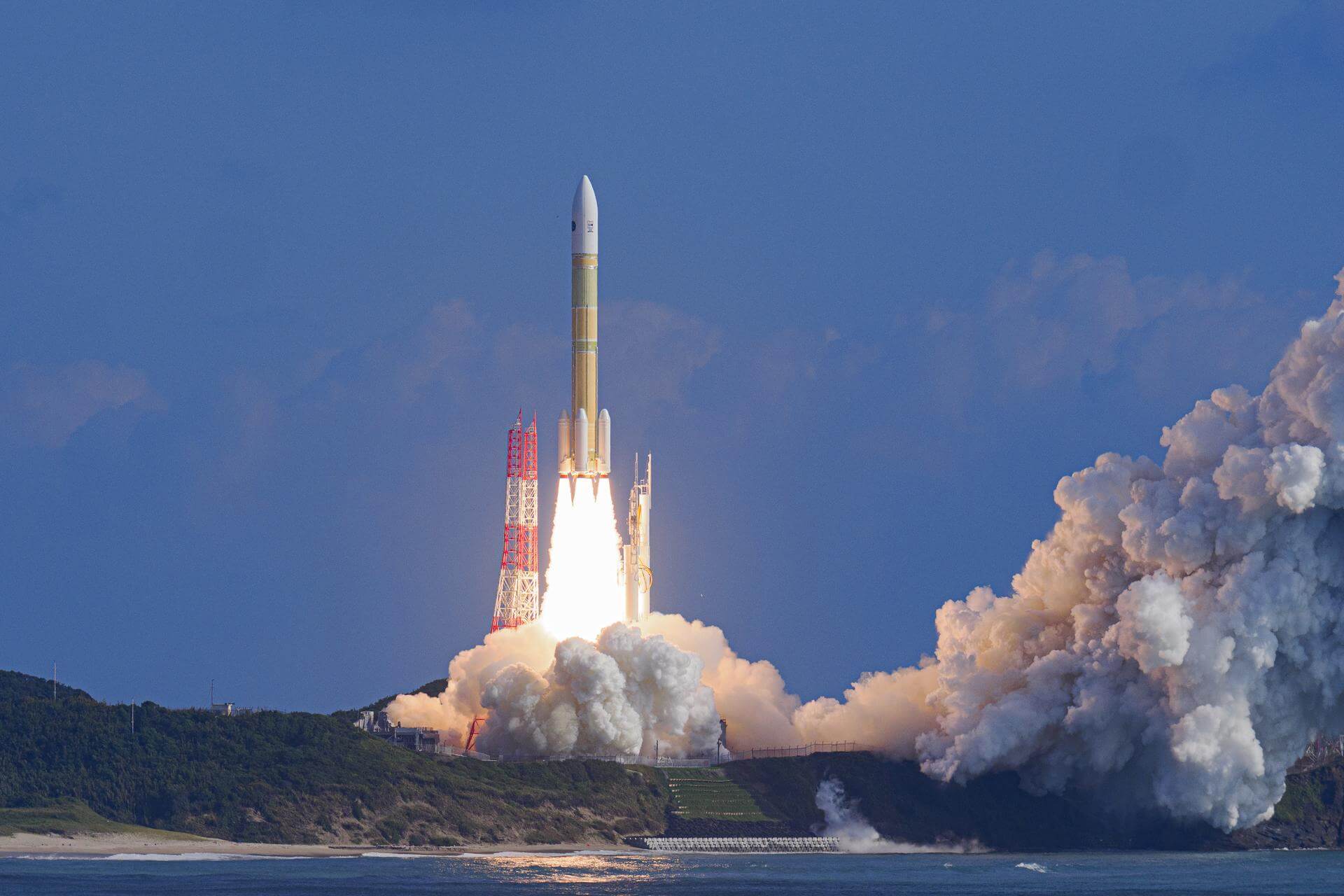
Soyuz 2.1b/Fregat-M • Soyuz
A batch of 36 satellites for the OneWeb satellite constellation, which is intended to provide global Internet broadband service for individual consumers. The constellation is planned to have around 648 microsatellites (of which 60 are spares), around 150 kg each, operating in Ku-band from low Earth orbit.
Long March 4C • Long March
ZY-1 02E is a Chinese Earth observation satellite. The primary objective is to acquire high-resolution (5 meter) panchromatic and multispectral imagery for land resource surveys, disaster monitoring, forestry and ecological monitoring.
Ariane 5 ECA+ • Ariane
The James Webb Space Telescope is a space telescope developed by NASA, ESA and CSA to succeed the Hubble Space Telescope as NASA's flagship astrophysics mission. Its primary mirror, the Optical Telescope Element, is composed of 18 hexagonal mirror segments which combine to create a 6.5 m diameter mirror, considerably larger than Hubble's 2.4 m mirror. This will allow JWST to provide improved infrared resolution and sensitivity over Hubble, and will enable a broad range of investigations across the fields of astronomy and cosmology, including observing some of the most distant events and objects in the universe, such as the formation of the first galaxies.
Long March 7A • Long March
Chinese experimental satellites. Details TBD.
H-IIA • H-II
Inmarsat-6 is the sixth generation of satellites for the London-based global mobile satellite communications operator Inmarsat. It consists of a dual mission to augment both L-band and Ka-band Global Xpress services. Airbus Defence and Space has been awarded a contract by Inmarsat to design and develop the first two Inmarsat-6 (I-6) mobile communications satellites, creating the most versatile mobile services satellites in its fleet. The two I-6 satellites are based on Airbus Defence and Space's Eurostar platform in its E3000e variant, which exclusively uses electric propulsion for orbit raising. The satellites take advantage of the reduction in mass that this electric propulsion technology enables for a dual payload mission, with an exceptionally large next generation digitally processed payload. I-6 F1 and F2 both carry a large 9 m aperture L-band antenna and nine multibeam Ka-band antennas, and feature a high level of flexibility and connectivity. A new generation modular digital processor provides full routing flexibility over up to 8000 channels and dynamic power allocation to over 200 spot beams in L-band. Ka-band spot beams are steerable over the full Earth disk, with flexible channel to beam allocation.
Falcon 9 • Falcon
24th commercial resupply services mission to the International Space Station operated by SpaceX. The flight will be conducted under the second Commercial Resupply Services contract with NASA. Cargo Dragon 2 brings supplies and payloads, including critical materials to directly support science and research investigations that occur onboard the orbiting laboratory.
Falcon 9 • Falcon
Türksat 5B is a geostationary communications satellite. It is tasked with providing broadband telecommunication services to customers across Turkey, the Middle East and large regions of Africa.
Falcon 9 • Falcon
A batch of 52 satellites for Starlink mega-constellation - SpaceX's project for space-based Internet communication system.
Kuaizhou 1A • Kuaizhou
Commercial navigation satellites for automobile navigation.
Long March 3B/E • Long March
Tianlian is a Chinese data tracking and relay communications satellite series.
Proton-M Briz-M • Proton / UR-500
The Ekspress-AMU 3 and Ekspress-AMU 7 are two communications satellite for russian domestic communication services. While the spacecraft themselves are built by russian RSCC (Kosmicheskiya Svyaz), the communication payloads are built by Thales Alenia Space. Both satellites are based on the Ekspress-1000 bus and feature 16 Ku-, 1 L- and 20 C-band transponders. They will be located at 96.5° and 145° East respectively.
New Shepard •
NS-19 is the third crewed New Shepard flight, carrying two honorary guests and four paying customers.
Long March 4B • Long March
The SJ 6 (Shi Jian 6) series consisted of pairs of technology satellites, which were reported to be used to probe the space environment, radiation and its effects, record space physical environment parameters, and conduct other related space experiments.
Falcon 9 • Falcon
Imaging X-ray Polarimetry Explorer (IXPE) is a space observatory tasked with measuring the polarization of cosmic X-rays. This data will help to learn more about objects that emit these X-rays, such as black holes and neutron stars.
Electron •
Payload consists of two BlackSky Gen-2 high-resolution multi-spectral Earth observation satellites.
Soyuz 2.1a • Soyuz
Soyuz MS-20 will carry Roscosmos cosmonaut Aleksandr Misurkin as well as two tourists, Japanese billionaire Yusaku Maezawa and his assistant Yozo Hirano, to the International Space Station.
Atlas V 551 • Atlas
Rideshare mission with the STPSat-6 satellite and six secondary payloads for the US Air Force. STPSat-6 carries the NNSA's Space and Atmospheric Burst Reporting System-3 (SABRS-3) payload and NASA's Laser Communications Relay Demonstration (LCRD) experiment.
Ceres-1 • Ceres-1
This mission carried five commercial small satellites into orbit. These include: a remote sensing satellite Tianjin University-1, two remote sensing satellites for Golden Bauhinia 1 (also known as Jinzijing 1) constellation; and experimental satellites Lize-1 and Baoyun.
Soyuz STB • Soyuz
Two satellites for Europe's Galileo navigation system. Galileo provides Europe with an alternative to the American GPS and Russian GLONASS constellations, but will be interoperable with both systems.
Falcon 9 • Falcon
A batch of 48 satellites for the Starlink mega-constellation - SpaceX's project for space-based Internet communication system - as well as 2 BlackSky Earth observation satellites as rideshare payloads.
Long March 3B/E • Long March
The FH 2 (Feng Huo 2) series are reportedly the second generation of chinese military comsats and data relay satellites. They provide both C-band and UHF communications. China Aerospace Science and Technology Corp. manufactured the satellites based on the DFH-4 Bus. FH-2D is also known as Chinasat-1D.
Soyuz 2.1b/Fregat • Soyuz
The Tundra or EKS (meaning Unified Space System) series of satellites is the next generation of Russian early warning satellites.
Kuaizhou 1A • Kuaizhou
Unknown Chinese satellite reported for technology development purposes.
Soyuz 2.1b • Soyuz
The UM (Uzlovoy Module) or NM (Node Module) is a node to be added to the Russian part of the ISS complex. It is also named Prichal. UM will be delivered by a modified Progress space tug, called Progress-M-UM. The UM will be docked to the nadir port of the MLM (Nauka) module, providing four ports to mount additional modules and one docking port for cargo and crew spacecrafts.
Falcon 9 • Falcon
Double Asteroid Redirection Test (DART) mission is the first-ever mission to demonstrate the capability to deflect an asteroid by colliding a spacecraft with it at high speed, a technique known as a kinetic impactor. DART is a planetary defense-driven test of one of the technologies for preventing the Earth impact of a hazardous asteroid: the kinetic impactor. DART's primary objective is to demonstrate a kinetic impact on a small asteroid. The binary near-Earth asteroid (65803) Didymos is the target for DART. While Didymos' primary body is approximately 800 meters across, its secondary body has a 150-meter size, which is more typical of the size of asteroids that could pose a more common hazard to Earth. The DART spacecraft will achieve the kinetic impact by deliberately crashing itself into the moonlet at a speed of approximately 6 km/s, with the aid of an onboard camera and sophisticated autonomous navigation software. The collision will change the speed of the moonlet in its orbit around the main body by a fraction of one percent, enough to be measured using telescopes on Earth.
Long March 4C • Long March
Gaofen (GF) is a series of Chinese civilian remote sensing satellites for the state-sponsored program China High-definition Earth Observation System (CHEOS). GF 3 features a multi-polarized C-band SAR at meter-level resolution, with designed lifespan of 8 years. The satellite is based on the CS-L3000B bus.
Astra Rocket 3 • Astra Rocket
Space Force test payload contracted through the Defense Innovation Unit’s Other Transaction Agreement with Astra Space.
Long March 4B • Long March
Gaofen is a series of civilian Earth observation satellites developed and launched for the China High-definition Earth Observation System (CHEOS), a state-sponsored programme aimed to develop a near-real time, all-weather, global surveillance network consisting of satellite, near-space (stratosphere) airships, and aerial observation platforms.
Electron •
Payload consists of two BlackSky Gen-2 high-resolution multi-spectral Earth observation satellites.
Vega • Vega
CERES (CapacitÉ de Renseignement Électromagnétique Spatiale) is a space-based signal intelligence (SIGNIT) system consisting of three satellites constellation.
Falcon 9 • Falcon
A batch of 53 satellites for Starlink mega-constellation - SpaceX's project for space-based Internet communication system.
Falcon 9 • Falcon
SpaceX Crew-3 is the third crewed operational flight of a Crew Dragon spacecraft to the International Space Station as part of NASA's Commercial Crew Program.
Epsilon • Epsilon
8 payloads will fly on this mission : "RApid Innovative payload demonstration SatellitE-2" (RAISE-2), DRUMS (Debris Removal Unprecedented Micro-Satellite), Hibari, Z-Sat, and four CubeSat (ASTERISC, ARICA, NANODRAGON, KOSEN-1).
Long March 2D • Long March
3 Chinese reconnaissance satellites.
Long March 6 • Long March
Satellite developed by the Chinese Academy of Sciences (CAS) for pursuing sustainable development. It is expected to provide advanced, open and shared data resources for monitoring and evaluating the sustainable development index representing the interaction between human and nature, in particular providing support for Sustainable Development Goals (SDGs) of the UN 2030 Agenda for Sustainable Development. The satellite has three payloads including thermal infrared, low light level and multispectral imagers, with 300 km wide data acquisition swath capability. It can achieve global coverage within 11 days.
Long March 2C/YZ-1S • Long March
Yaogan is a series of Chinese reconnaissance satellites. The visualization during the launch of Yaogan-32 Group 01 hints towards the two satellites being SIGINT satellites.
Soyuz 2.1a • Soyuz
The Progress MS-18 spacecraft will resupply the International Space Station.
Kuaizhou 1A • Kuaizhou
Jilin-1 is a series of Chinese commercial remote sensing satellites.
H-IIA • H-II
The Quasi-Zenith Satellite System (QZSS) is a three-satellite regional time transfer system and the satellite-based augmentation system for the GPS that would be receivable within Japan. The primary purpose of QZSS is to increase the availability of GPS in Japan's numerous urban canyons, where only satellites at very high elevation can be seen. A secondary function is performance enhancement, increasing the accuracy and reliability of GPS derived navigation solutions. QZS-1R is a replacement satellite for QZS-1 which was launched in 2010.
Ariane 5 ECA+ • Ariane
SES-17 is a Ka-band high-throughput geostationary communications satellite built by Thales Alenia Space designed to provide mobile internet services to airline passengers over the Americas and the Atlantic Ocean. Syracuse 4A is a French military communications satellite built by Thales Alenia Space.
Long March 3B/E • Long March
Chinese payload launching on trajectory consistent with geostationary transfer target orbit, official purpose declared as "validation of on orbit space debris reduction technologies".
Nuri • KSLV
Maiden flight of the KSLV-II "Nuri" launch vehicle, carrying a dummy Payload of 1500 kg to sun-synchronous orbit.
Atlas V 401 • Atlas
Lucy is the first mission to explore and study Trojan asteroids. The Trojans are a type of asteroids that orbit the Sun in two groups, in front of and behind Jupiter in its orbit around our star. Since these asteroids have been in such stable orbits for billions of years, they are of great interest as remnants of early Solar System. Lucy is a NASA mission led by NASA Goddard and Southwest Research Institute in Boulder, Colorado. Over the course of 12 years, Lucy will fly by seven different Trojan asteroids and also one main belt asteroid. The complex trajectory to visit all targets will include several Earth gravity assists.
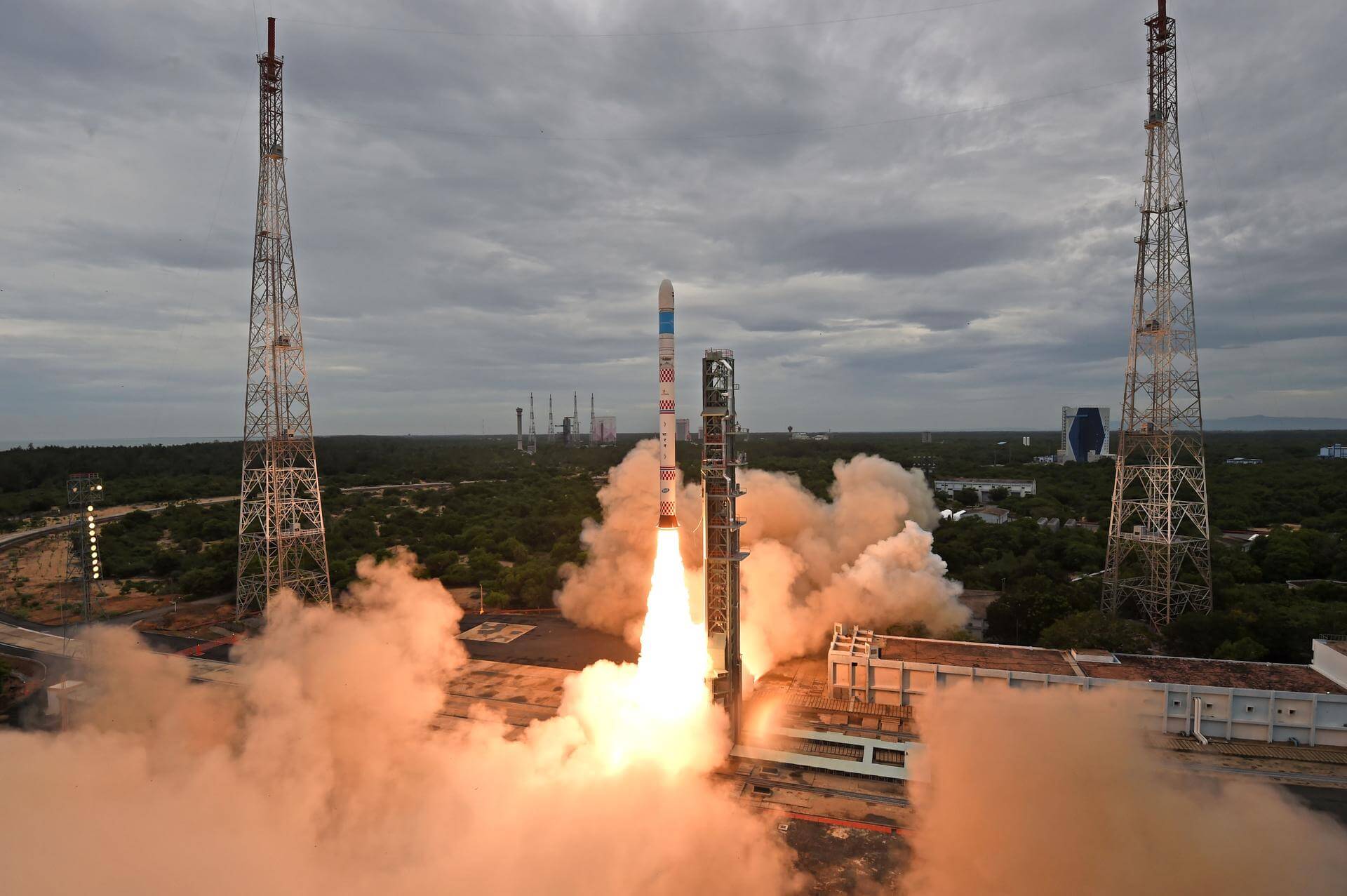
Long March 2F/G • Long March
Second crewed flight to the Chinese Tiangong space station carrying Zhai Zhigang, commander, Wang Yaping and Ye Guangfu, operators, on their second, second and first spaceflight respectively. Their mission duration onboard the TSS is 6 months, the longest so far in Chinese spaceflight.
Long March 2D • Long March
Xihe, also known as the Chinese Hα Solar Explorer (CHASE), is designed to test a newly developed satellite platform and conduct solar observations. The scientific payload of the satellite is an Hα imaging spectrograph (HIS), which can, for the first time, acquire full-disk spectroscopic solar observations in the Hα waveband. It will complement the observations by on-orbit solar spacecraft (such as SDO, IRIS, STEREO and PSP), as well as future solar missions of the Solar Orbiter and the Chinese Advanced Space-based Solar Observatory (ASO-S). Mission is named Xihe after a solar deity from Chinese mythology.
Soyuz 2.1b • Soyuz
A batch of 36 satellites for the OneWeb satellite constellation, which is intended to provide global Internet broadband service for individual consumers. The constellation is planned to have around 648 microsatellites (of which 60 are spares), around 150 kg each, operating in Ku-band from low Earth orbit.
New Shepard •
NS-18 is the second crewed New Shepard flight, carrying 4 paying customers.
Soyuz 2.1a • Soyuz
Soyuz mission launching from the Baikonur Cosmodrome in Kazakhstan and carrying Roscosmos cosmonaut Anton Shkaplerov as well as the Challenge movie crew (Russian film producer Klim Shipenko and actress Yulia Peresild) to the International Space Station.
Atlas V 401 • Atlas
Landsat 9 is a partnership between NASA and the U.S. Geological Survey to continue the Landsat program's critical role in monitoring, understanding and managing the land resources needed to sustain human life. Landsat 9, like Landsat 8, has a higher imaging capacity than past Landsats, allowing more valuable data to be added to the Landsat global land archive. Its operational orbit is a sun-synchronous orbit at an altitude of 705 km for a mission lifetime of at least 5 years.
Long March 3B/E • Long March
Classified test satellite which suffered an anomaly during launch. The launch vehicle has not been confirmed to be responsible for the failure.
Kuaizhou 1A • Kuaizhou
Jilin-1 is a series of Chinese commercial remote sensing satellites.
Long March 7 • Long March
Second cargo delivery mission to the Chinese large modular space station.
Hapith I •
The first Hapith I launch will be testing TiSPACE's hybrid rocket engine technology in preparation for the future Hapith V launch vehicle. Targeting 250 km altitude, the test launch campaign will also support of the development of the Whalers Way Orbital Launch Complex in South Australia, operated by Southern Launch.
Falcon 9 • Falcon
Inspiration4 is the world’s first all-commercial astronaut mission to orbit. Jared Isaacman, founder and CEO of Shift4 Payments, is donating the three seats alongside him aboard Dragon to individuals from the general public - Medical Officer Hayley Arceneaux, a physician assistant at St. Jude Children’s Research Hospital and pediatric cancer survivor; Mission Specialist Chris Sembroski, an Air Force veteran and aerospace data engineer; and Mission Pilot Dr. Sian Proctor, a geoscientist, entrepreneur, and trained pilot. The Inspiration4 crew received commercial astronaut training by SpaceX on the Falcon 9 launch vehicle and Dragon spacecraft, orbital mechanics, operating in microgravity, zero gravity, and other forms of stress testing. They will go through emergency preparedness training, spacesuit and spacecraft ingress and egress exercises, as well as partial and full mission simulations. The Crew Dragon spacecraft will remain in a 575 km high orbit for three days before reentering Earth's atmosphere for a soft water landing off the coast of Florida. During their multi-day journey in orbit, the Inspiration4 crew will conduct scientific research designed to advance human health on Earth and during future long-duration spaceflights. For this mission, Crew Dragon is configured to feature an observation dome in place of docking port to provide views to the crew.
Soyuz 2.1b/Fregat-M • Soyuz
A batch of 34 satellites for the OneWeb satellite constellation, which is intended to provide global Internet broadband service for individual consumers. The constellation is planned to have around 648 microsatellites (of which 60 are spares), around 150 kg each, operating in Ku-band from low Earth orbit.
Falcon 9 • Falcon
A batch of 51 satellites for Starlink mega-constellation - SpaceX's project for space-based Internet communication system.
Soyuz • Soyuz
The Russian Razbeg 1 is small military satellite optical reconnaissance satellite. It was built by NPP VNIIEM. It is likely the same satellite identified in earlier reports as Zvesda. The 250 kg satellite was reportedly inspired by the US American commercial Earth imaging satellites of the SkySat 1 series. It features a camera built by the Belarusian company OAO Peleng with a maximum ground resolution of 0.9 meters in panchromatic mode.
Long March 3B/E • Long March
Zhongxing-9B (ChinaSat 9B) is a Chinese communications satellite, that will replace the Zhongxing-9A satellite in orbit. The latter was launched in 2017, but the CZ-3B launch vehicle suffered a partial failure, and the satellite had to burn a large amount of fuel to reach its nominal orbit. ZX-9B will be used to retransmit television to the Chinese, as well as to provide television communications with Chinese islands, and ships sailing near the coast. The satellite will also be used to broadcast the 2022 Beijing Winter Olympics in 8K.
Long March 4C • Long March
Gaofen (GF) is a series of Chinese civilian remote sensing satellites for the state-sponsored program China High-definition Earth Observation System (CHEOS). GF 5 is configured with six types of payloads, including visible and short-wave infra hyper-spectral camera, spectral imager, greenhouse gas detector, atmospheric environment infrared detector at very high spectral resolution, differential absorption spectrometer for atmospheric trace gas, and multi-angle polarization detector, with designed lifespan of 8 years. The satellite is based on the SAST-5000B bus. The instruments are: * Advanced Hyperspectral Imager (AHSI) * Visual and Infrared Multispectral Sensor (VIMS) * Greenhouse-gases Monitoring Instrument (GMI) * Atmospheric Infrared Ultraspectral (AIUS) * Environment Monitoring Instrument (EMI) * Directional Polarization Camera (DPC)
Firefly Alpha •
First flight of the new Firefly Alpha small sat launcher developed by Firefly Aerospace. It will carry Firefly’s DREAM (Dedicated Research & Education Accelerator Mission), which includes various payloads like cubesats, personal items, pictures, DNA samples and more to inspire young people to pursue STEM education.
Falcon 9 • Falcon
SpaceX will launch the cargo variant of its Dragon 2 spacecraft on their 23rd commercial resupply services mission to the International Space Station. The flight will be conducted under the second Commercial Resupply Services contract with NASA. Dragon will be filled with supplies and payloads, including critical materials to directly support science and research investigations that occur onboard the orbiting laboratory.
Astra Rocket 3 • Astra Rocket
Space Force test payload contracted through the Defense Innovation Unit’s Other Transaction Agreement with Astra Space.
New Shepard •
Seventeenth flight of New Shepard. It will carry a second NASA lunar landing technology demonstration on the exterior of the booster, 18 commercial payloads inside the crew capsule, and an art installation on the exterior of the capsule.
Long March 3B/E • Long March
Alleged Chinese classified geosynchronous satellite. Payload identity uncertain but might be an early warning satellite.
Long March 2C/YZ-1S • Long March
"Ronghe Shiyan Weixing" (RSW) = "Integrated Experimental Satellite" are test satellites that will be used to develop a state-owned Chinese low-earth orbit constellation, Xingwang, consisting of several thousand satellites.
Soyuz 2.1b/Fregat-M • Soyuz
A batch of 34 satellites for the OneWeb satellite constellation, which is intended to provide global Internet broadband service for individual consumers. The constellation is planned to have around 648 microsatellites (of which 60 are spares), around 150 kg each, operating in Ku-band from low Earth orbit.
Long March 4B • Long March
TH 2 (Tianhui-2 = "Sky drawing") is a pair of Chinese cartography and Earth observation satellites.
Vega • Vega
Pléiades Neo is a constellation of four optical high-resolution Earth observation satellites built and operated by Airbus. It is a dual purpose constellation, serving both civilian and military purposes. Pléiades Neo 4 is the second satellite in the constellation which is to deliver imagery with spatial resolution of 30 cm. It is launched along with several rideshare payloads.
GSLV Mk II • GSLV
GISAT-1 is an Indian earth observation satellite to be launched in geostationary orbit. It is tasked with continuous observation of Indian sub-continent and quick monitoring of natural hazards and disaster. GISAT carries an imaging payload consisting of of multi-spectral, multi-resolution from 50 m to 1.5 km. It will provide pictures of the area of interest on near real time basis including border areas.
Antares 230+ • Antares
This is the 16th planned flight of the Orbital ATK's uncrewed resupply spacecraft Cygnus and its 15th flight to the International Space Station under the Commercial Resupply Services contract with NASA. This Cygnus spacecraft is named after American astronaut Ellison Onizuka who died in the destruction of the Space Shuttle Challenger.
Long March 3B/E • Long March
Chinasat 2E is a geostationary communications satellite.
Long March 6 • Long March
The KL-Beta A and B, satellites are test satellites for a global multimedia satellite system for the German company KLEO Connect and the Chinese company Shanghai Spacecom Satellite Technology. The satellites were built by CAS Microspace and feature a Ka-band communications payload. The prototype system also includes another satellite “GMS-T” built by OHB System of Germany.
Hyperbola-1 •
New generation experimental Earth imaging satellite for the Jilin-1 constellation. NOTE: Payload identity unconfirmed.
MOMO v1 • MOMO
Despite the MOMO unit's number, this is the seventh flight of the sounding rocket. Company aims to reach space for the third time.
Ariane 5 ECA+ • Ariane
Star One D2 is a 6.2 tons satellite built by Space Systems Loral for operator Star One, subsidiary of Brazilian Embratel. Its architecture is based on a SSL-1300 platform and equipped with C, X, Ku and Ka-band transceivers. It will provide communications services to Latin America for at least 15 years. Eutelsat Quantum is an experimental communications satellite carrying a payload able to be reconfigured by software. It is developed by ESA, Eutelsat and Airbus Defence and Space.
Electron •
A U.S. Air Force experimental spacecraft. It will demonstrate the use of a deployable sensor, where the sensor’s mass is a substantial fraction of the total mass of the spacecraft and provide a platform to test future space protection capabilities.
Long March 2D • Long March
TH 1 (Tianhui-1 = "Sky drawing") is a Chinese stereo-topographic mapping satellite operated by the People’s Liberation Army (PLA). The satellites are built by the Hangtian Dongfanghong Weixing Corporation and the China Aerospace Science and Technology Corporation and the Chinese Academy of Space Technology (CAST). The satellites operate on a 500 km circular sun synchronous orbit. Electrical power is provided by two deployable solar panels that is stored on onboard batteries. They are equipped with a three-dimensional survey camera and a CCD camera with a ground resolution of 5 meters, spectral region of 0.51 µm to 0.69 µm and with a camera angle of 25 degrees. Also on board is a multi-spectral camera with a ground resolution of 10 meters operating in four spectral bands of 0.43 µm to 0.52 µm, 0.52 µm to 0.61 µm, 0.61 µm to 0.69 µm, and 0.76 µm to 0.90 µm. The swath width of the cameras is 60 kilometers wide.
Proton-M • Proton / UR-500
Nauka (which means "Science" in Russian), also known as Multipurpose Laboratory Module (MLM), is a new module of the russian segment of the ISS. It will dock at Zvezda's nadir port, replacing the Pirs module occupying it since September 2001. The Nauka module is designed to be used for experiments, docking and cargo as well as serve as a crew work and rest area. It is equipped with full guidance and navigation control including engines and an attitude control system that can be used as a backup by the ISS. The Nauka module also brings the European Robotic Arm, for which a spare elbow joint was already launched in 2010, to the orbital laboratory.
New Shepard •
First crewed flight of Blue Origin's New Shepard rocket.
Long March 2C • Long March
NOTE: Payload identity not confirmed. The Yaogan-30 is a series of military remote sensing satellites which are launched in triplets. The satellites are spaced by 120° in their orbit.
SpaceShipTwo •
Powered flight of VSS Unity on the first fully crewed flight. Including the founder Sir Richard Branson.
Long March 6 • Long March
The Ningxin-1 satellites (also called Zhongzi) are a series of Chinese commercial remote sensing satellite owned by Ningxia Jingui Information Technology Co. Ltd. The satellites were built by DFH Satellite Co. Ltd of CAST. They have been reported to be a commercial operated global EM spectrum signal monitoring satellite system (SIGINT).
Long March 3C/E • Long March
Tianlian 1, also known as Tian Lian 1, TL-1, and CTDRS-1 is a Chinese data tracking and relay communications satellite series. Based on the DFH-3 satellite bus, it will provide communication coverage for manned Shenzhou missions, from Shenzhou 7 onwards. Functionally, it is similar to the United States Tracking and Data Relay Satellite System.
Long March 4C • Long March
The newer FY-3 series is an improved generation of polar-orbiting heliosynchronous weather satellites.
MOMO v1 • MOMO
Sixth flight of Interstellar Technologies MOMO rocket. First flight using the MOMO v1 design bringing various improvements over MOMO v0. It reached an apogee altitude of 99 km.
Long March 2D • Long March
Jilin-1 satellites are a series of Chinese commercial remote sensing satellite for high definition video within the Jilin-1 constellation designed and owned by the Chang Guang Satellite Technology Corporation.
Soyuz 2.1b/Fregat-M • Soyuz
A batch of 36 satellites for the OneWeb satellite constellation, which is intended to provide global Internet broadband service for individual consumers. The constellation is planned to have around 648 microsatellites (of which 60 are spares), around 150 kg each, operating in Ku-band from low Earth orbit.
Falcon 9 • Falcon
Transporter 2 mission is a dedicated rideshare flight to a sun-synchronous orbit with dozens of small microsatellites and nanosatellites for commercial and government customers.
LauncherOne •
The mission includes three cubesats for US Department of Defense which are launched as a part of the DoS Space Test Program (STP); the Netherland's first military satellite, a cubesat called BRIK II; and two optical satellites, STORK-4 and STORK-5, for SatRevolution's STORK constellation. The mission name, "Tubular Bells, Part One", references the first music album released by Virgin Records label in the 1970s. The label was established by Virgin Orbit CEO Richard Branson.
Soyuz 2.1a • Soyuz
The Progress MS-17 spacecraft will resupply the International Space Station.
Soyuz 2.1b • Soyuz
The Russian Pion-NKS (14F139) satellites are the naval component of the next generation ELINT satellite system Liana. As a replacement for both the passive ELINT US-PM and the active radar US-A, they carry both ELINT sensors as well as an active radar.
Long March 2C • Long March
The Yaogan-30 is a series of military remote sensing satellites which are launched in triplets. The satellites are spaced by 120° in their orbit.
Falcon 9 • Falcon
GPS-IIIA (Global Positioning System) is the first evolution stage of the third generation of the GPS satellites. It consists of the first ten (known as "tranche") of GPS III satellites.
Long March 2F/G • Long March
First crewed flight to the Chinese large modular space station.
Minotaur I • Minotaur
Classified payload for the U.S. National Reconnaissance Office.
Pegasus XL • Pegasus
Payload for the US Space Force’s Tactically Responsive Launch program. It is a space domain awareness satellite that was procured under the Space Force's responsive launch program. The spacecraft was built in under a year and the launch provider was given three weeks of notice for the launch.
Simorgh •
According to U.S. Space Command, Iran suffered a rocket launch failure early on June 12th. While there are no details available as to which rocket was used, what the payload was or how exactly the launch had failed, OSINT efforts suggest that the launcher used was the Simorgh rocket. This makes it a fourth consecutive failure of the Simorgh launch vehicle.
Long March 2D • Long March
0.5 m resolution Earth observation satellite for Twenty First Century Aerospace Technology Company Ltd.
Falcon 9 • Falcon
SXM-8 is a large high power broadcasting satellite for SiriusXM's digital audio radio service (DARS). Space Systems/Loral (SS/L) got in July 2016 the contract to build the two satellites based on their SSL-1300 bus - SXM-7 and SXM-8. Satellite design operates in the S-band spectrum. Each satellite will generate more than 20-kW of power and will have a large unfurlable antenna reflector, which enables broadcast to radios without the need for large dish-type antennas on the ground. SXM-8 is meant to replace the XM-4 satellite. SXM-7 was meant to replace the XM-3, but suffered a failure in orbit 6 weeks after its launch.
Falcon 9 • Falcon
SpaceX will launch the second cargo variant of its Dragon 2 spacecraft on their 22nd commercial resupply services mission to the International Space Station. The flight will be conducted under the second Commercial Resupply Services contract with NASA. Dragon will be filled with supplies and payloads, including critical materials to directly support science and research investigations that occur onboard the orbiting laboratory.
Long March 3B • Long March
China's geostationary meteorological satellite program FY-4 (Feng Yun 4) is the second generation of chinese geostationary meteorological satellites.
Long March 7 • Long March
First cargo delivery mission to the Chinese large modular space station.
Soyuz 2.1b/Fregat-M • Soyuz
A batch of 36 satellites for the OneWeb satellite constellation, which is intended to provide global Internet broadband service for individual consumers. The constellation is planned to have around 648 microsatellites (of which 60 are spares), around 150 kg each, operating in Ku-band from low Earth orbit.
Falcon 9 • Falcon
A batch of 60 satellites for Starlink mega-constellation - SpaceX's project for space-based Internet communication system.
SpaceShipTwo •
Powered test flight of VSS Unity carrying technology experiments for NASA's Flight Opportunities Program.
Long March 4B • Long March
Haiyang (Chinese: "Ocean"), abbreviated HY, is a marine remote sensing satellite series planned by China.
Atlas V 421 • Atlas
Fifth geosynchronous satellite of the Space Based Infrared System program (SBIRS), providing capabilities for early missile warning and missile defense. SBIRS GEO-5 is the first satellite using Lockheed Martin's LM2100 combat bus.
Falcon 9 • Falcon
A batch of 52 satellites for Starlink mega-constellation - SpaceX's project for space-based Internet communication system. Two rideshare satellites are also on this flight: a Capella radar observation spacecraft and a small payload from the California-based smallsat manufacturer Tyvak.
Electron •
This was the 20th launch of Electron rocket. It carried two Earth imaging microsatellites for BlackSky's constellation which were lost due to a launcher failure after second stage ignition.
Falcon 9 • Falcon
A batch of 60 satellites for Starlink mega-constellation - SpaceX's project for space-based Internet communication system.
Long March 2C • Long March
The Yaogan-30 is a series of military remote sensing satellites which are launched in triplets. The satellites are spaced by 120° in their orbit.
Starship Prototype • Starship
The SN15 Starship prototype will perform a test flight similar to SN8 to SN11. It will launch up to an altitude of 10 km or 33,000 ft and do a belly flop maneuver followed by a controlled descent to the landing pad.
Falcon 9 • Falcon
A batch of 60 satellites for Starlink mega-constellation - SpaceX's project for space-based Internet communication system.
Long March 4C • Long March
Officially described as an optical remote-sensing satellite built by SAST.
Falcon 9 • Falcon
A batch of 60 satellites for Starlink mega-constellation - SpaceX's project for space-based Internet communication system.
Long March 5B • Long March
Tianhe (which translates as "Heavenly Harmony") is the core module and backbone of the Chinese space station, designed to provide the main living quarters and control centre for the station crew.
Vega • Vega
Pléiades Neo is a constellation of four optical high-resolution Earth observation satellites built and operated by Airbus. It is a dual purpose constellation, serving both civilian and military purposes. Pléiades Neo 3 is the first satellite in the constellation which is to deliver imagery with spatial resolution of 30 cm. It is launched along with several rideshare payloads.
Long March 6 • Long March
This launch delivered 9 commercial satellites into low Earth orbit. Qilu-1 and Qilu-4, as well as most other satellites on this mission, are Earth observation spacecraft. One other satellite on this mission is the scientific research and technology verification satellite NEO 1 with the purpose of observing small space bodies, as well as testing the technology to use deployable net for catching small objects in orbit.
Delta IV Heavy • Delta
Classified payload for the U.S. National Reconnaissance Office.
Soyuz 2.1b/Fregat-M • Soyuz
A batch of 36 satellites for the OneWeb satellite constellation, which is intended to provide global Internet broadband service for individual consumers. The constellation is planned to have around 648 microsatellites (of which 60 are spares), around 150 kg each, operating in Ku-band from low Earth orbit.
Falcon 9 • Falcon
SpaceX Crew-2 is the second crewed operational flight of a Crew Dragon spacecraft to the International Space Station as part of NASA's Commercial Crew Program. It used the same Falcon 9 first stage as the Crew-1 mission and the same Crew Dragon capsule as the Demo-2 mission (Endeavour).
New Shepard •
Fifteenth flight of Blue Origin's New Shepard rocket. During the mission, astronaut operational exercises will be conducted in preparation for human space flight. The primary operations will entail Blue Origin personnel standing in as astronauts entering into the capsule prior to launch. These astronauts will climb the launch tower, get into their seats, buckle their harnesses, and conduct a communications check from their seat with CAPCOM, the Capsule Communicator. The tower operations team will prepare the capsule cabin for launch and then briefly close the capsule hatch. The astronauts will then exit the capsule prior to launch. Post-landing, the astronauts will get inside the capsule to rehearse hatch opening, and exiting the capsule at the landing site. Inside the capsule during the flight will be Mannequin Skywalker, along with more than 25,000 postcards on behalf of Club for the Future, Blue Origin’s nonprofit organization
Soyuz 2.1a • Soyuz
Soyuz MS-18 begins expedition 65 by carrying Roscosmos cosmonauts Oleg Novitsky, Pyotr Dubrov and NASA astronaut Mark Vande Hei to the International Space Station aboard the Soyuz spacecraft from the Baikonur Cosmodrome in Kazakhstan. After launching from the Baikonur Cosmodrome in Kazakhstan, they will rendezvous to the station where they will remain for their 6 month stay.
Long March 4B • Long March
Mission details available on detail page.
Falcon 9 • Falcon
A batch of 60 satellites for Starlink mega-constellation - SpaceX's project for space-based Internet communication system.
Long March 4C • Long March
Gaofen is a series of civilian Earth observation satellites developed and launched for the China High-definition Earth Observation System (CHEOS), a state-sponsored programme aimed to develop a near-real time, all-weather, global surveillance network consisting of satellite, near-space (stratosphere) airships, and aerial observation platforms.
Starship Prototype • Starship
The SN11 Starship prototype performed a test flight similar to SN8, SN9 and SN10. It launched up to an altitude of 10 km or 33,000 ft and did a belly flop maneuver followed by a controlled descent, but got destroyed during the landing maneuver.
Soyuz 2.1b/Fregat-M • Soyuz
A batch of 36 satellites for the OneWeb satellite constellation, which is intended to provide global Internet broadband service for individual consumers. The constellation is planned to have around 648 microsatellites (of which 60 are spares), around 150 kg each, operating in Ku-band from low Earth orbit.
Falcon 9 • Falcon
A batch of 60 satellites for Starlink mega-constellation - SpaceX's project for space-based Internet communication system.
Electron •
The Electron rocket will carry seven satellites to low Earth orbit: one Earth-observation satellite for BlackSky, two Internet-Of-Things (IoT) nanosatellites for companies Fleet Space and Myriota, a technology demonstration satellite for the University of New South Wales (UNSW) Canberra Space, a weather satellite pathfinder technology demonstration from Care Weather technologies, a technology demonstrator for the U.S. Army’s Space and Missile Defense Command as well as Rocket Lab’s in-house designed and built Photon Pathstone spacecraft which will operate on orbit as a risk reduction demonstration to build spacecraft heritage ahead of Rocket Lab’s mission to the Moon for NASA later this year.
Soyuz 2.1a/Fregat-M • Soyuz
CAS500-1 is the first of two South Korean Earth observation satellites. These spacecraft feature the AEISS-C imaging system with a ground resolution of 0.5 m in panchromatic mode and 2 m in color mode. More than a dozen other satellites are included as secondary payloads, among them being the first spacecraft by the Catalan Space Agency.
Falcon 9 • Falcon
A batch of 60 satellites for Starlink mega-constellation - SpaceX's project for space-based Internet communication system.
Long March 4C • Long March
Mission details available on detail page.
Long March 7A • Long March
Unknown Chinese "technological validation" satellite; rumored to be new optical observation satellite in GEO.
Falcon 9 • Falcon
A batch of 60 satellites for Starlink mega-constellation - SpaceX's project for space-based Internet communication system.
Falcon 9 • Falcon
A batch of 60 satellites for Starlink mega-constellation - SpaceX's project for space-based Internet communication system.
Starship Prototype • Starship
The SN10 Starship performed a test flight similar to SN8 and SN9. It launched up to an altitude of 10 km or 33,000 ft, did a belly flop maneuver followed by a controlled descent to the landing pad. Despite successfully performing the landing flip maneuver with its three Raptor engines, its vertical velocity was too high on landing, damaging its structure and resulting in an explosive destruction a few minutes after touchdown.
Soyuz 2.1b/Fregat-M • Soyuz
Arktika-M ("Arctic-M") is a series of Earh observation satellites which will gather meteorological and hydrological data on polar region. Arktika-M satellites will also provide communication services for the region.
PSLV-DL • PSLV
Amazonia 1 is a Brazilian optical Earth observation satellite of the National Institute for Space Research (INPE). This satellite will further strengthen the existing structure by providing remote sensing data to users for monitoring deforestation in the Amazon region and analysis of diversified agriculture across the Brazilian territory. The 18 co-passenger satellites include four from IN-SPACe (three UNITYsats from consortium of three Indian academic institutes and One Satish Dhawan Sat from Space Kidz India) and 14 from NSIL.
Long March 4C • Long March
Mission details available on detail page.
Antares 230+ • Antares
This is the 15th planned flight of the Orbital ATK's uncrewed resupply spacecraft Cygnus and its 14th flight to the International Space Station under the Commercial Resupply Services contract with NASA. This Cygnus spacecraft carries the name of American mathematician Katherine Johnson, whose calculations of orbital mechanics as a NASA employee were critical to the success of the first and subsequent U.S. crewed spaceflights.
Falcon 9 • Falcon
A batch of 60 satellites for Starlink mega-constellation - SpaceX's project for space-based Internet communication system.
Soyuz 2.1a • Soyuz
The Progress MS-16 Spacecraft will resupply the International Space Station.
Long March 3B/E • Long March
Alleged Chinese classified geosynchronous satellite. Payload identity uncertain.
Falcon 9 • Falcon
A batch of 60 satellites for Starlink mega-constellation - SpaceX's project for space-based Internet communication system.
Soyuz 2.1b • Soyuz
Lotos-S1 spacecraft is a part of the Liana constellation, designed for orbital electronic intelligence.
Starship Prototype • Starship
The SN9 Starship performed a first flight similar to the one of SN8. It launched up to an altitude of 10 km or 33,000 ft, did a belly flop maneuver and a controlled descent to the landing pad where the landing flip maneuver was unsuccessful and resulted in the destruction of the prototype on impact.
Hyperbola-1 •
Mission details available on detail page.
Long March 4C • Long March
Mission details available on detail page.
Falcon 9 • Falcon
Transporter 1 mission is a dedicated rideshare flight to a sun-synchronous orbit with dozens of small microsatellites and nanosatellites for commercial and government customers.
Falcon 9 • Falcon
A batch of 60 satellites for Starlink mega-constellation - SpaceX's project for space-based Internet communication system.
Electron •
Dedicated mission for a single communication microsatellite that will enable specific frequencies to support future services from orbit. The launch will be Rocket Lab’s 18th Electron mission.
Long March 3B/E • Long March
Tiantong-1-03 is the third satellite in a series of Chinese geostationary communication satellites.
LauncherOne •
This is Virgin Orbit's second attempt to launch the LauncherOne rocket. It also carries cubesats which were contracted by NASA through Venture Class Launch Services contract.
New Shepard •
For this mission, the New Shepard crew capsule will be outfitted with upgrades for the astronaut experience as the program nears human space flight. The upgrades include improvements to environmental features such as acoustics and temperature regulation inside the capsule, crew display panels, and speakers with a microphone and push-to-talk button at each seat. The mission will also test a number of astronaut communication and safety alert systems. The capsule will be outfitted with six seats, including one occupied by Mannequin Skywalker.
Falcon 9 • Falcon
Türksat 5A is the first of two Turkish next generation communications satellites, which will be operated by Türksat for commercial and military purposes.
Soyuz STA • Soyuz
The CSO-2 (Composante Spatiale Optique-2) satellite is the second of three new-generation high-resolution optical imaging satellites for the French military, replacing the Helios 2 spy satellite series.
Long March 4C • Long March
Mission details available on detail page.
Long March 8 • Long March
XJY-7 is an undisclosed Chinese government payload for the first launch of Long March 8
Falcon 9 • Falcon
Classified payload for NRO.
Soyuz 2.1b/Fregat-M • Soyuz
A batch of 36 satellites for the OneWeb satellite constellation, which is intended to provide global Internet broadband service for individual consumers. The constellation is planned to have around 648 microsatellites (of which 60 are spares), around 150 kg each, operating in Ku-band from low Earth orbit.
PSLV-XL • PSLV
CMS-01, formerly also known as GSAT-12R, is an Indian geostationary telecommunications satellite. It's designed to last for 7 years and will provide services in Extended-C band across Indian mainland, Andaman-Nicobar & Lakshadweep Islands.
Astra Rocket 3 • Astra Rocket
Astra will attempt a second test flight of Rocket 3.0 following an unsuccessful first flight
Electron •
StriX-α is a demonstration mission for Japanese company Synspective which plans to deploy a constellation of synthetic aperture radar satellites. For this mission, Rocket Lab will utilize a custom expanded fairing to encompass Synspective’s wide-body satellite – the first use of the expanded fairing options that Rocket Lab recently introduced.
Angara A5/Briz-M • Angara
This is the second test flight of the Angara-A5 launch vehicle. It carries mass simulator payload which is to be delivered to geostationary orbit.
Falcon 9 • Falcon
SXM-7 is a large high power broadcasting satellite for SiriusXM's digital audio radio service (DARS). Space Systems/Loral (SS/L) got in July 2016 the contract to build the two satellites based on their SSL-1300 bus - SXM-7 and SXM-8. Both operate in the S-band spectrum. Each satellite will generate more than 20-kW of power and will have a large unfurlable antenna reflector, which enables broadcast to radios without the need for large dish-type antennas on the ground. SXM-7 is meant to replace the XM-3 satellite.
SpaceShipTwo •
First attempted spaceflight from New Mexico, aborted due to computer malfunction, engine ignited and automatically turned off.
Delta IV Heavy • Delta
Classified payload for NRO.
Starship Prototype • Starship
The SN8 Starship prototype was destroyed when attempting to land after a first flight to an altitude of 12.5 km or 41,000 ft.
Long March 11 • Long March
GECAM (Gravitational Wave High-energy Electromagnetic Counterpart All-sky Monitor) is a constellation of two small X-ray and gamma-ray all-sky observatories to search for gamma-ray counterparts to gravitational wave events. Each satellite features a dome-shaped array of 25 Gamma-ray detectors (GRD) and 8 Charged particle detectors (CPD). Together the satellites will provide a FOV of 100% all-sky. The sensitivity of the detectors is ~2E-8 erg/cm2/s. They will provide a localization of ~1°. The detectors are sensible in the energy band from 6 keV to 5 MeV. Besides detecting the radiation from gravitatinal wave events, the satellites will also be contributing in detectiong Ultra-long GRBs, X-ray Flashes, X-ray-rich GRBs, Magnetars and Terrestrial Gamma-ray Flashes.
Falcon 9 • Falcon
SpaceX will launch the first cargo variant of its Dragon 2 spacecraft on their 21st commercial resupply services mission to the International Space Station. The flight will be conducted under the second Commercial Resupply Services contract with NASA. Dragon will be filled with supplies and payloads, including critical materials to directly support more than 250 science and research investigations that occur onboard the orbiting laboratory.
Long March 3B/E • Long March
Gaofen is a series of civilian Earth observation satellites developed and launched for the China High-definition Earth Observation System (CHEOS), a state-sponsored programme aimed to develop a near-real time, all-weather, global surveillance network consisting of satellite, near-space (stratosphere) airships, and aerial observation platforms.
Soyuz 2.1b/Fregat-M • Soyuz
Gonets-M are an upgraded version of Gonets satellites, derived from military communications system Strela-3. Gonets-M constellation is tasked with monitoring ecological and industrial objects, providing communication and data transmission services, covering also the remote areas like the Far North region.
Soyuz STA • Soyuz
Falcon Eye 2 is a high-resolution Earth-imaging satellite for the United Arab Emirates. Built by Airbus Defense and Space with an optical imaging payload from Thales Alenia Space, Falcon Eye is the second of two surveillance satellites ordered by the UAE's military.
H-IIA • H-II
JDRS-1 is a Japanese Data Relay Satellite.
Falcon 9 • Falcon
A batch of 60 satellites for Starlink mega-constellation - SpaceX's project for space-based Internet communication system.
Long March 5 • Long March
Chang'e 5 is China's robotic lunar sample return mission, which is set to bring back at least 2 kg of lunar soils and rock samples. The probe will perform a soft landing on the Moon, then rendezvous and dock with the return module in lunar orbit and fly back to Earth.
Falcon 9 • Falcon
The Sentinel-6 Michael Freilich and Sentinel-6B make up the Sentinel-6 mission, also known as Jason Continuity of Service (Jason-CS), which is a partnership between NASA, NOAA, ESA, and EUMETSAT. This mission continues the long-term global sea surface height data record begun by first Jason satellites in 1992. Named after former NASA Earth Science Division Director Michael Freilich, Sentinel-6 Michail Freilich will provide altimeter data necessary for ocean climate monitoring, ocean modelling and numerical ocean prediction, weather forecasting, marine meteorology, coastal altimetry and modelling. A secondary objective of the mission is to collect high-resolution vertical profiles of temperature, using the Global Navigation Satellite System (GNSS) Radio-Occultation sounding technique, to assess temperature changes in the troposphere and stratosphere and to support numerical weather prediction. Sentinel-6 Michael Freilich is to operate in a highly-inclined circular orbit at an altitude of 1336 km, with an operational mission lasting 5 years. Near-identical Sentinel-6B is planned to follow-up shortly after.
Electron •
"Return to Sender" will loft 30 satellites to a sun-synchronous orbit at 500 km altitude for a range of customers, including TriSept, Unseenlabs, Swarm, Te Pūnaha Ātea - Auckland Space Institute, and global gaming software company Valve. The satellites span a range of operations, from TriSept’s tech demonstration of new tether systems designed to accelerate spacecraft reentry and reduce orbital debris, through to the next generation of maritime surveillance satellites for Unseenlabs, as well as communications satellites for Swarm. The mission will also deploy New Zealand’s first student-built satellite, the APSS-1 satellite for Te Pūnaha Ātea - Auckland Space Institute at The University of Auckland. The DRAGRACER mission will test the effectiveness of new tether technologies designed to accelerate spacecraft reentry and reduce orbital debris at the conclusion of space missions. TriSept has completed the integration of a pair of qualified Millennium Space Systems 6U small satellites, one featuring the tether drag device and one without. The controlled spacecraft should deorbit in approximately 45 days, while the second spacecraft is expected to remain in orbit for seven to nine years. BRO-2 and BRO-3 are the second and third satellites in French company Unseenlabs’ planned constellation of about 20 satellites dedicated to maritime surveillance. Swarm will launch the latest 24 1/4U SpaceBEE satellites to continue building out its planned constellation of 150 satellites to provide affordable satellite communications services to IoT devices in remote regions around the world. The student-built Waka Āmiorangi Aotearoa APSS-1 satellite is designed to monitor electrical activity in Earth’s upper atmosphere to test whether ionospheric disturbances can predict earthquakes. Extra payload on this flight is a 150 mm 3D printed Half-Life Gnome Chompski. Created for Valve Software's co-founder Gabe Newell by design studio Weta Workshop, it serves as an homage to the innovation and creativity of gamers worldwide, and also aims to test and qualify a novel 3D printing technique that could be employed for future spacecraft components. Gnome will remain attached to the Kick Stage and will burn up on reentry. Besides payloads, this flight will also serve as a test of Electron's reusability. Rocket Lab will attempt to bring Electron’s first stage back to Earth under a parachute system for a controlled water landing before collection by a recovery vessel.
Vega • Vega
SEOSAT-Ingenio is a high-resolution optical imaging mission of Spain - the flagship mission of the Spanish space strategic plan. Its mission is devoted to ensure an even coverage of the areas of national interest, providing a large operational capability in the capture of high-resolution multi-spectral land optical images for numerous user groups, as well as supporting and optimizing the development in Spain of teledetection-based applications in Spain. The overall mission objective is to provide information for applications in cartography, land use, urban management, water management, environmental monitoring, risk management and security. TARANIS (Tool for the Analysis of RAdiation from lightNIngand Sprites), the Celtic god of thunder and lightning, is the first satellite designed to observe luminous, radiative and electromagnetic phenomena occurring at altitudes of 20 to 100 km over thunderstorms. Discovered 20 years ago, such transient luminous events (TLEs) such as red sprites, blue jets, elves, sprite halos, etc. remain shrouded in mystery. They are sometimes accompanied by terrestrial gamma-ray flashes (TGFs). The TARANIS microsatellite will fly over thousands of TLEs and TGFs for at least four years and will be capable of detecting these events and recording their luminous and radiative signatures at high resolution, as well as the electromagnetic perturbations they set off in Earth’s upper atmosphere. The payload includes numerous sensors to observe the TLEs and to perform in-situ measurements of perturbations caused on the local plasma (fields, waves and particles).
Falcon 9 • Falcon
SpaceX Crew-1 is the first crewed operational flight of a Crew Dragon spacecraft to the International Space Station as part of NASA's Commercial Crew Program.
Atlas V 531 • Atlas
Classified payload for the U.S. National Reconnaissance Office.
Long March 3B/E • Long March
Designed by the CAST Institute (China Academy of Space Technology), a subsidiary of the Chinese aerospace group CASC and specialized in spacecraft design, the Tiantong-1 02 satellite will be operated by China Satellite Communications Co. Ltd, another CASC subsidiary which owns about ten communication satellites such as the ChinaStar and APStar. Tiantong-1 02 is the second satellite of China's first mobile communication network. It uses a Chinese DFH-4 satellite platform, and, according to its manufacturer CAST, has the highest payload mass utilization rate compared to other satellites of the same family. The project was launched in 2010 following the 2008 earthquake in Sichuan, where almost all ground communication networks were paralyzed. China had no mobile communication satellites at the time, so it had to lease services from foreign countries, such as Inmarsat in Europe, for its rescue teams.
PSLV-DL • PSLV
EOS-1 (previously known as RISAT-2BR2) is an imaging mission of ISRO using an active SAR (Synthetic Aperture Radar) imager to provide continuity of service for RISAT-2. The objective of the RISAT mission is to use the all-weather as well as the day-and-night SAR observation capability in applications such as agriculture, forestry, soil moisture, geology, sea ice, coastal monitoring, object identification, and flood monitoring, but also for military surveillance. Flight also carries 9 rideshare payloads, including Lithuanian NanoAvionics R2 satellite - pathfinder for their M6P cubesat platform, 4 KSM satellites of Kleos Space for a maritime geolocation constellation, and 4 Lemur satellites for Spire.
Ceres-1 • Ceres-1
Tianqi (also transcribed Tiange) is a series of small Chinese experimental LEO comsats by Guodian Gaoke for IoT (Internet of Things) communications, which are also carrying a camera for educational purposes. Guodian Gaoke plans to operate an IoT constellation. The "Apocalypse Constellation" provides users with much-needed data collection and transmission services for terrestrial network coverage blind areas, which are widely used in marine, environmental protection, meteorological, forestry, geological, emergency, rescue and smart city industries to enhance China's global data network coverage and application capabilities are of strategic importance.
Long March 6 • Long March
First batch of remote sensing satellites for Satellogic's constellation.
Falcon 9 • Falcon
GPS-IIIA (Global Positioning System) is the first evolution stage of the third generation of the GPS satellites. It consists of the first ten (known as "tranche") of GPS III satellites.
Electron •
"In Focus" is a rideshare mission carrying 10 Earth observation satellites for Planet and Canon Electronics.
Long March 2C • Long March
The Yaogan 30-01-01 to 30-01-03 (Remote Sensing Satellite-30-01-01 to 30-01-03) satellites, were launched by CZ-2C rocket from China's Xichang space center on 29 September 2017. The purpose is not confirmed, although the news reports hint towards a SIGINT mission, especially to detect ships by their radio emissions. They are also known as CX 5 by the manufacturer. The satellites are spaced by 120° in their orbit.
Soyuz 2.1b/Fregat • Soyuz
Glonass-K are the third generation of satellite design for GLONASS satellite navigation system. GLONASS is a Russian space-based navigation system comparable to the similar GPS and Galileo systems. This generation improves on accuracy, power consumption and design life. Each satellite is unpressurized and weighs 935 kg, and has an operational lifetime of 10 years.
Falcon 9 • Falcon
A batch of 60 satellites for Starlink mega-constellation - SpaceX's project for space-based Internet communication system.
Falcon 9 • Falcon
A batch of 60 satellites for Starlink mega-constellation - SpaceX's project for space-based Internet communication system.
Soyuz 2.1a • Soyuz
Soyuz MS-17 begins expedition 63 by carrying Roscosmos cosmonauts Sergey Ryzhikov, Sergey Kud-Sverchkov and NASA astronaut Kathleen Rubins to the International Space Station aboard the Soyuz spacecraft from the Baikonur Cosmodrome in Kazakhstan. After launching from the Baikonur Cosmodrome in Kazakhstan, they will rendezvous to the station where they will remain for their 6 month stay.
New Shepard •
This will be the 13th New Shepard mission and the 7th consecutive flight for this particular vehicle (a record), demonstrating its operational reusability. New Shepard will fly 12 commercial payloads to space and back on this mission, including the Deorbit, Descent, and Landing Sensor Demonstration with NASA’s Space Technology Mission Directorate under a Tipping Point partnership. This is the first payload to fly mounted on the exterior of a New Shepard booster rather than inside the capsule, opening the door to a wide range of future high-altitude sensing, sampling, and exposure payloads.
Long March 3B/E • Long March
Gaofen is a series of civilian Earth observation satellites developed and launched for the China High-definition Earth Observation System (CHEOS), a state-sponsored programme aimed to develop a near-real time, all-weather, global surveillance network consisting of satellite, near-space (stratosphere) airships, and aerial observation platforms.
Falcon 9 • Falcon
A batch of 60 satellites for Starlink mega-constellation - SpaceX's project for space-based Internet communication system.
Antares 230+ • Antares
This is the 15th planned flight of the Orbital ATK's uncrewed resupply spacecraft Cygnus and its 14th flight to the International Space Station under the Commercial Resupply Services contract with NASA. This Cygnus spacecraft carries the name of NASA astronaut Kalpana Chawla, who was the first female astronaut of Indian descent.
Soyuz 2.1b/Fregat-M • Soyuz
Gonets-M are an upgraded version of Gonets satellites, derived from military communications system Strela-3. Gonets-M constellation is tasked with monitoring ecological and industrial objects, providing communication and data transmission services, covering also the remote areas like the Far North region. This launch also carries 22 small satellites as a rideshare payloads. These are cubesats for commercial companies such as Spire and Kepler Communications, as well as cubesats for various international universities.
Long March 4B • Long March
Huanjing (abbreviated as HJ) is a constellation of environmental monitoring satellites. The HJ-2A and HJ-2B are 16-meter optical satellites which will provide 16-meter multispectral, 48-meter hyperspectral and infrared image data.
Long March 4B • Long March
Haiyang (Chinese: "Ocean"), abbreviated HY, is a marine remote sensing satellite series planned by China.
Long March 11 • Long March
Earth observation satellites for the Jilin-1 commercial Earth observation satellites constellation.
Kuaizhou 1A • Kuaizhou
Jilin-1 is a series of Chinese commercial remote sensing satellites.
Astra Rocket 3 • Astra Rocket
This is the first orbital attempt of Astra Space small satellite launch vehicle. Rocket carries no payload for this flight.
Long March 4B • Long March
Gaofen is a series of civilian Earth observation satellites developed and launched for the China High-definition Earth Observation System (CHEOS), a state-sponsored programme aimed to develop a near-real time, all-weather, global surveillance network consisting of satellite, near-space (stratosphere) airships, and aerial observation platforms.
Long March 2F/G • Long March
The payload is an experimental reusable spacecraft. It is rumored to be a prototype of a reusable spaceplane (similar to Boeing X-37B vehicle). The spacecraft stayed in orbit for two days and returned to Earth on September 6. Though the landing site was not disclosed, the spacecraft is presumed to have landed at an airbase near Lop Nor nuclear test site.
Starship Prototype • Starship
The Starship SN6 prototype sucessfully performed a 150m hop similar to the one successfully performed by its predecessor SN5.
Falcon 9 • Falcon
A batch of 60 satellites for Starlink mega-constellation - SpaceX's project for space-based Internet communication system.
Vega • Vega
The Vega POC (Proof Of Concept) flight will be the first mission of the SSMS (Small Spacecraft Mission Service), a modular carbon fiber dispenser, a program initiated by ESA in 2016, with the contribution of the European Commission. For all the European partners involved, its purpose is to address the burgeoning institutional and commercial small spacecraft market with a new rideshare concept. Payload includes dozens of satellites: Athena, ION CubeSat Carrier, ESAIL, NEMO-HD, GHGSat C1, six Flock-v cubesats, several Lemur-2 cubesats, twelve SpaceBEE nanosats, FSSCat A & B, RTAF-Sat, DIDO 3, IGOSat, PICASSO, PINO, PIXL, QARMAN, SIMBA, TRISAT, Casaa-Sat, TTU-100, and more.
Electron •
This return to flight mission is dedicated for Capella Space, an information services company providing Earth observation data on demand. Capella’s payload, ‘Sequoia’, is a single 100 kg class microsatellite which will be the first publicly available satellite in the company’s commercial Synthetic Aperture Radar (SAR) constellation. By positioning the satellite to a 45-degree inclination, Capella Space will maximize coverage over important areas such as the Middle East, Korea, Japan, Europe, South East Asia, Africa, and the U.S. The mission name is a nod to Capella’s SAR technology that provides high quality images of the Earth day or night, and in any weather conditions, as well as a nod to the infamous advertisement campaign for “I Can’t Believe It’s Not Butter”. Capella’s space-based radar can detect sub-0.5 meter changes on the surface of the Earth, providing insights and data that can be used for security, agricultural and infrastructure monitoring, as well as disaster response and recovery.
Falcon 9 • Falcon
The SAOCOM 1B spacecraft is the second of the two SAOCOM constellation satellites. It is tasked with hydrology and land observation, and will also operate jointly with the Italian COSMO-SkyMed constellation in X-band to provide frequent information relevant for emergency management. Two rideshare payloads are present - Tyvak-0172 and PlanetiQ’s GNOMES-1.
Long March 2D • Long March
Gaofen is a series of civilian Earth observation satellites developed and launched for the China High-definition Earth Observation System (CHEOS), a state-sponsored programme aimed to develop a near-real time, all-weather, global surveillance network consisting of satellite, near-space (stratosphere) airships, and aerial observation platforms.
Falcon 9 • Falcon
A batch of 58 satellites for Starlink mega-constellation - SpaceX's project for space-based Internet communication system. This launch will also carry 3 SkySat Earth-imaging satellites as a rideshare.
Ariane 5 ECA+ • Ariane
Galaxy-30 is a geostationary communications satellite for Intelsat. Satellite is built by Northrop Grumman Innovation Systems (NGIS) and is planned to provide video distribution and broadcast services to customers in North America. Galaxy 30 satellite is launched in tandem with MEV-2 vehicle. MEV-2, which stands for Mission Extension Vehicle-2, is the second servicing mission by NGIS. MEV-2 will rendezvous and dock with the Intelsat 1002 satellite in early 2021. Then, MEV-2 will use its own thrusters and fuel supply to control the satellite’s orbit, thereby extending its useful lifetime. Another passenger of the flight is the BSAT-4b satellite for the Japanese operator BSAT. BSAT-4b will serve as a back-up for BSAT-4a satellite, launched in 2017. BSAT-4b will provide Direct-to-Home television services and is expected to operate for at least 15 years.
Falcon 9 • Falcon
A batch of 57 satellites for Starlink mega-constellation - SpaceX's project for space-based Internet communication system. This launch will also carry two BlackSky Earth-imaging satellites as a rideshare.
Long March 2D • Long March
Gaofen is a series of civilian Earth observation satellites developed and launched for the China High-definition Earth Observation System (CHEOS), a state-sponsored programme aimed to develop a near-real time, all-weather, global surveillance network consisting of satellite, near-space (stratosphere) airships, and aerial observation platforms.
Starship Prototype • Starship
The Starship SN5 first flight was a 150m 'hop' from SpaceX's South Texas Launch Site in Boca Chica Village.
Proton-M Briz-M • Proton / UR-500
Ekspress-80 and Ekspress 103 are communications satellites for Russian domestic communication services owned by RSCC (Kosmicheskiya Svyaz). Express 80 will be positioned at 80° East, and will be fitted with 16 C-band and 20 Ku-band transponders to cover Russia, as well as two L-band transponders offering global coverage. Express 103 will be positioned at 103° East, and will be fitted with 16 C-band and 20 Ku-band transponders to cover Russia and Southeast Asia, as well as one L-band transponder for global coverage. Both have a design life of 15 years.
Atlas V 541 • Atlas
Atop this ULA Atlas V rocket will be Perseverance, a car-sized rover which will explore an ancient river delta on Mars. Armed with a suite of six scientific instruments, Perseverance will primarily hunt for clues to the planet's distant past, and hopefully uncover signs of ancient life and habitability. The rover also carries an experiment that'll convert carbon dioxide into oxygen, a box-sized helicopter named Ingenuity that'll demonstrate powered flight on Mars, and a system that enables the rover to leave behind samples for later retrieval and return to Earth during NASA and ESA's ambitious sample return mission later this decade.
Long March 4B • Long March
Ziyuan is a series of remote sensing satellites in Sun-synchronous orbit around Earth. Ziyuan 3-02 is a Chinese Earth observation satellite, a high-resolution imaging satellite operated by the Ministry of Land and Resources of the People's Republic of China.
Soyuz 2.1a • Soyuz
The Progress resupply vehicle is an automated, unpiloted version of the Soyuz spacecraft that is used to bring supplies and fuel to the International Space Station.
Long March 5 • Long March
Tianwen-1 ("questions to heaven") Mars mission includes a Martian orbiter and a lander/rover duo. This will be China's first mission to Mars. The spacecraft will reach Mars in February 2021. Lander will remain attached to the orbiter for two to three months before attempting its landing. The chosen landing area is Utopia Planitia, a huge basin formed by a large impact far back in Mars' history. The rover is expected to be in operation for about 90 Martian sols. The Tianwen-1 orbiter will provide a relay communication link to the rover while performing its own scientific observations for one Martian year. The orbiter will operate in a polar orbit in order to map Mars' morphology and geological structure while also using the Mars-Orbiting Subsurface Exploration Radar instrument to investigate soil characteristics and water-ice distribution. It will also measure the ionosphere and the electromagnetic and gravitational fields, the new paper reported. The rover will have 13 instruments detecting things such as topography, soil, environment, atmosphere, water ice, physical field and internal structure. It will investigate the surface soil characteristics and water-ice distribution with its own Subsurface Exploration Radar. It will also analyze surface material composition and characteristics of the Martian climate and environment on the surface.
Falcon 9 • Falcon
ANASIS-II is South Korea's first dedicated military satellite.
H-IIA • H-II
Hope Mars Mission, also known as Al-Amal, is UAE's first interplanetary space probe. It's an orbiter which will study Martian atmosphere and climate with the help of 3 science instruments: Emirates Exploration imager (EXI), Emirates Mars Ultraviolet Spectrometer (EMUS), and Emirates Mars Infrared Spectrometer (EMIR). These instruments were designed and built in collaboration with University of Colorado, University of California and Arizona State University. Hope is planned to arrive to Mars in February 2021 and has an expected lifetime of 2 years.
Minotaur IV • Minotaur
Classified payload for the U.S. National Reconnaissance Office.
Kuaizhou 11 • Kuaizhou
First flight of the new solid launcher developed by ExPace, subsidiary of CASIC. It will carry 2 communication satellites on this launch.
Long March 3B/E • Long March
APStar-6D is a commercial communications satellite for APT Satellite Company Ltd under an end-to-end contract signed with China Great Wall Industry Corp. (CGWIC) for satellite production and launch services. It will deliver VSAT, video distribution, Direct-to-home television and cellular backhaul to the Asia-Pacific Region.
Shavit-2 • Shavit
Ofek is a series of Israeli reconnaissance satellites.
Long March 2D • Long March
Chuangxin is a series of experimental small satellites developed by China Academy of Science.
Electron •
‘Pics Or It Didn’t Happen’ is the 13th mission for Rocket Lab. It was planned to deploy seven imaging small satellites to a 500km circular low Earth orbit for a range of customers including Spaceflight Inc.’s customer Canon Electronics, as well as Planet and In-Space Missions.
Long March 4B • Long March
Gaofen is a series of civilian Earth observation satellites developed and launched for the China High-definition Earth Observation System (CHEOS), a state-sponsored programme aimed to develop a near-real time, all-weather, global surveillance network consisting of satellite, near-space (stratosphere) airships, and aerial observation platforms.
Falcon 9 • Falcon
GPS-IIIA (Global Positioning System) is the first evolution stage of the third generation of the GPS satellites. It consists of the first ten (known as "tranche") of GPS III satellites.
SpaceShipTwo •
Free glide test flight of VSS Unity.
Long March 3B • Long March
This satellite is a part of the geostationary component of the 3rd phase of the Chinese Beidou (Compass) satellite navigation system. It features a phased array antenna for navigation signals and a laser retroreflector and additionally deployable S/L-band and C-band antennas.
Long March 2D • Long March
Gaofen is a series of civilian Earth observation satellites developed and launched for the China High-definition Earth Observation System (CHEOS), a state-sponsored programme aimed to develop a near-real time, all-weather, global surveillance network consisting of satellite, near-space (stratosphere) airships, and aerial observation platforms.
MOMO v0 • MOMO
Interstellar Technologies will launch the 'MOMO' observation rocket on its fifth mission.
Falcon 9 • Falcon
A batch of 58 satellites for Starlink mega-constellation - SpaceX's project for space-based Internet communication system. This launch will also carry three SkySat Earth-imaging satellites as a rideshare for Planet.
Electron •
This rideshare mission carries small satellites for NASA, University of New South Wales and for NRO. The mission has been named "Don't Stop Me Now" in recognition of Rocket Lab board member and avid Queen fan Scott Smith, who recently passed away.
Long March 2C • Long March
Haiyang is a series of Chinese marine remote sensing satellites. Haiyang 1C is the follow-up of the Haiyang 1A and 1B satellites. It is intended for ocean monitoring and will be providing data on the temperature and dynamics of coastal waters and global oceans in China.
Falcon 9 • Falcon
A batch of 60 satellites for Starlink mega-constellation - SpaceX's project for space-based Internet communication system.
Long March 2D • Long March
Gaofen is a series of civilian Earth observation satellites developed and launched for the China High-definition Earth Observation System (CHEOS), a state-sponsored programme aimed to develop a near-real time, all-weather, global surveillance network consisting of satellite, near-space (stratosphere) airships, and aerial observation platforms.
Falcon 9 • Falcon
A new era of human spaceflight is set to begin as American astronauts once again launch on an American rocket from American soil. The Demo-2 mission is the second test flight of Crew Dragon, and the first flight with crew onboard. It will carry NASA astronauts Robert Behnken and Douglas Hurley to the International Space Station for an extended stay (the specific mission duration will be determined once on station based on the readiness of the next commercial crew launch). They will perform tests on Crew Dragon in addition to conducting research and other tasks with the space station crew. As the final flight test for SpaceX, this mission will validate the company’s crew transportation system, including the launch pad, rocket, spacecraft, and operational capabilities. This also will be the first time NASA astronauts will test the spacecraft systems in orbit. The Demo-2 mission will be the final major step before NASA’s Commercial Crew Program certifies Crew Dragon for operational, long-duration missions to the space station. Current Mission Status: After a successful ride to orbit and stay at the International Space Station, the Dragon Spacecraft successfully made its way back to Earth. Capsule successfully landed in the Gulf of Mexico waters on 3rd August 2020 at 18:48 UTC.
Long March 11 • Long March
XJS-G and XJS-H are experimental small satellites which will be used for Earth observation.
LauncherOne •
Payload-free test flight of the LauncherOne vehicle.
Soyuz 2.1b/Fregat • Soyuz
The Tundra or EKS (meaning Unified Space System) series of satellites is the next generation of Russian early warning satellites.
H-IIB • H-II
The last H-II Transfer Vehicle "Kounotori" will be launched on an H-IIB 304 launch vehicle, carrying 6,200 kg (13,669 lbs) of supplies and science experiments to be conducted by astronauts aboard the International Space Station. Kounotori 9 will be the last original HTV spacecaft : its successor scheduled to launch in February 2022 will be the first of the new HTV-X version.
Atlas V 501 • Atlas
It is the sixth flight of the X-37B program. United States Air Force Orbital Test Vehicle is built by Boeing. It's an unmanned 5000 kg, 8.8 m-long reusable mini-spaceplane capable of autonomous re-entry and landing.
Kuaizhou 1A • Kuaizhou
Xingyun-2 01 and 02 are the first two satellites of the planned low Earth orbit constellation being built by Xingyun Satellite company, whichi is a subsidiary of CASIC. These satellites will be used to provide Internet of Things (IoT) communications services. Xingyun constellation is planned to consist of 156 satellites in total.
Long March 5B • Long March
This is the maiden flight of Long March 5B rocket, which is to be used for delivering modules for China's new space station. This launch is also the first test flight for China's new generation crewed spacecraft.
SpaceShipTwo •
Free glide test flight of VSS Unity.
Soyuz 2.1a • Soyuz
The Progress resupply vehicle is an automated, unpiloted version of the Soyuz spacecraft that is used to bring supplies and fuel to the International Space Station.
Falcon 9 • Falcon
A batch of 60 satellites for Starlink mega-constellation - SpaceX's project for space-based Internet communication system.
Qased •
This is the first launch of the Qased launch vehicle, which is reported to have placed a military satellite called Noor into 425-km orbit.
Long March 3B • Long March
Nusantara Dua is a high throughput communications satellite built by CAST for Indonesian satellite operator PT Pasifik Satelit Nusantara. It will replace the Palapa D satellite. Nusantara Dua will provide broadband internet and broadcasting access to users in Indonesia, as well as some regions of Asia-Pacific and Australia.
Soyuz 2.1a • Soyuz
Soyuz MS-16 begins expedition 62 by carrying Roscosmos cosmonauts Anatoli Ivanishin, Ivan Vagner and NASA astronaut Chris Cassidy to the International Space Station aboard the Soyuz spacecraft from the Baikonur Cosmodrome in Kazakhstan. After launching from the Baikonur Cosmodrome in Kazakhstan, they will rendezvous to the station where they will remain for their 6 month stay.
Atlas V 551 • Atlas
This is the sixth and final satellite in the Advanced Extremely High Frequency (AEHF) system, which is a series of communications satellites operated by the United States Air Force Space Command. It provides global, survivable, protected communications capabilities for strategic command and tactical warfighters operating on ground, sea and air platforms.
Long March 2C • Long March
The Yaogan 30-01-01 to 30-01-03 (Remote Sensing Satellite-30-01-01 to 30-01-03) satellites, were launched by CZ-2C rocket from China's Xichang space center on 29 September 2017. The purpose is not confirmed, although the news reports hint towards a SIGINT mission, especially to detect ships by their radio emissions. They are also known as CX 5 by the manufacturer. The satellites are spaced by 120° in their orbit.
Soyuz 2.1b/Fregat-M • Soyuz
A batch of 34 satellites for the OneWeb satellite constellation, which is intended to provide global Internet broadband service for individual consumers. The constellation is planned to have around 648 microsatellites (of which 60 are spares), around 150 kg each, operating in Ku-band from low Earth orbit. Eventually it can be expanded to include extra 1260 satellites, for a total of 1908.
Falcon 9 • Falcon
A batch of 60 satellites for Starlink mega-constellation - SpaceX's project for space-based Internet communication system.
Soyuz 2.1b/Fregat-M • Soyuz
Glonass-M, also known as Uragan-M, are the second generation of Uragan satellite design used for GLONASS satellite navigation system. GLONASS is a Russian space-based navigation system comparable to the similar GPS and Galileo systems. This generation improves on accuracy, power consumption and design life. Each satellite weighs 1415 kg, is equipped with 12 L-band antennas, and has an operational lifetime of 7 years.
Long March 7A • Long March
This is the first flight of the Long March 7A which is a new configuration of the Long March 7 launch vehicle. The difference is that 7A variant includes an additional third stage, allowing the rocket to perform GTO launches. This is also the first mission out of Wenchang cosmodrome in 2020.
Long March 3B • Long March
This satellite is a part of the geostationary component of the 3rd phase of the Chinese Beidou (Compass) satellite navigation system. It features a phased array antenna for navigation signals and a laser retroreflector and additionally deployable S/L-band and C-band antennas.
Falcon 9 • Falcon
SpaceX launched the Dragon spacecraft on their 20th operational cargo delivery mission to the International Space Station. The flight was conducted under the Commercial Resupply Services contract with NASA.
Soyuz 2.1a/Fregat-M • Soyuz
Meridian is a series of communications satellite for military and civilian use.
Long March 2D • Long March
These are four experimental satellites which will be used mainly to test some Earth observation technologies.
Ariane 5 ECA+ • Ariane
JCSAT-17 is a Japanese communication satellite of SKY Perfect JSAT Corporation. Its payloads incorporate S-band, C-band and Ku-band transponders, which will provide satellite communication services. The S-band and C-band transponders will serve NTT DOCOMO, Inc., the largest telecommunications company in Japan, for its flexible mobile communications services in Japan and the surrounding region under IRU contract (Indefeasible Right of Use). SKY Perfect JSAT will support NTT DOCOMO’s satellite communication services. JCSAT-17 also includes a flexible processor that will allow SJC to redirect capacity to concentrate on disaster relief efforts or other high-volume events. The GEO-KOMPSAT-2 program is a national program of the Korean government to develop and operate two civilian geostationary satellites sharing the same satellite bus: GEO-KOMPSAT-2A for meteorological and space weather monitoring missions; and GEO-KOMPSAT-2B for Earth environment monitoring and ocean monitoring missions. The GEO-KOMPSAT 2 program also ensures the succession for the COMS program (Communication, Ocean and Meteorological Satellite). The satellite carries two main payloads: GOCI II (Geostationary Ocean Color Imager II), provided by Airbus Defence and Space; and the GEMS (Geostationary Environment Monitoring Spectrometer), provided by Ball Aerospace & Technologies.
Falcon 9 • Falcon
A batch of 60 satellites for Starlink mega-constellation - SpaceX's project for space-based Internet communication system.
Antares 230+ • Antares
This is the 14th planned flight of the Orbital ATK's uncrewed resupply spacecraft Cygnus and its 13th flight to the International Space Station under the Commercial Resupply Services contract with NASA. Spacecraft carries the name of Robert Henry Lawrence Jr., honouring USA's first black astronaut.
Atlas V 411 • Atlas
Solar Orbiter is a joint ESA/NASA mission dedicated to solar and heliospheric physics. It will be used to examine how the Sun creates and controls the heliosphere, the vast bubble of charged particles blown by the solar wind into the interstellar medium. The spacecraft will combine in situ and remote sensing observations to gain new information about the solar wind, the heliospheric magnetic field, solar energetic particles, transient interplanetary disturbances and the Sun's magnetic field. Instruments include: * Solar Wind Analyser (SWA) * Energetic Particle Detector (EPD) * Magnetometer (MAG) * Radio and Plasma Wave analyser (RPW) * Polarimetric and Helioseismic Imager (PHI) * Extreme Ultraviolet Imager (EUI) * Spectral Imaging of the Coronal Environment (SPICE) * Spectrometer Telescope for Imaging X-rays (STIX) * Coronagraph (Metis) While mission is not intended to get as close to the Sun as Parker Solar Probe, it's designed to coordinate observations and has different set of instruments. Main mission starts after one and only Earth flyby in November 2021, and lasts until Dec 2026 when it enters extended phase. During the mission, Solar Orbiter will get through numerous Venus gravity assists, and its trajectory will be highly inclined allowing direct observations of Sun's poles.
Simorgh •
Zafar-1 is a small Earth observation satellite with reported ground resolution of 22.5 m. This is also a third attempt for Simorgh rocket to conduct a successful launch.
H-IIA • H-II
Information Gathering Satellite (IGS) is a Japanese governmental spy satellite program. IGS Optical 7, as the name suggests, is an optical reconnaissance satellite. Japan began development of IGS in the late 1990s, following North Korea’s attempted satellite launch in 1998. Although the North Korean launch failed to reach orbit, the rocket carrying it crossed Japan during its ascent, sparking fears that North Korean missiles would be able to target the islands. With IGS, Japan aimed to develop an independent reconnaissance capability to monitor future threats. The constellation can also be used for disaster monitoring and other civilian applications by the Japanese government.
Soyuz 2.1b/Fregat-M • Soyuz
A batch of 34 satellites for the OneWeb satellite constellation, which is intended to provide global Internet broadband service for individual consumers. The constellation is planned to have around 648 microsatellites (of which 60 are spares), around 150 kg each, operating in Ku-band from low Earth orbit. Eventually it can be expanded to include extra 1260 satellites, for a total of 1908.
Electron •
This is a dedicated launch for the National Reconnaissance Office (NRO). The contract was awarded under Rapid Acquisition of a Small Rocket (RASR) program.
Falcon 9 • Falcon
Second operational Starlink payload of 2020 and third overall. The Falcon 9 launch vehicle will carry a batch of 60 Starlink satellites that will be insterted in a Low Earth Orbit (LEO) at an altitude of 290 km (180 mi) and an inclination of 53°. They will then split into three orbital planes and raise their orbits to reach an operational altitude of 550 km (342 mi). The Starlink LEO constellation aims to provide worldwide affordable satellite internet access. 182 satellites (120 operational) have been deployed so far, the goal scheduled for the mid-2020s being 12,000 satellites in orbit, with a possible later extension to 42,000. The booster for this launch will be B1051, a Block 5 generation core which previously flew on SpaceX's Demonstration Mission 1 (first Crew Dragon test flight) and launched the Canadian Space Agency's RADARSAT Constellation.
Falcon 9 • Falcon
When the Falcon 9 Block 5 rocket reaches Max-Q (maximum dynamic forces), the launch abort system of the Crew Dragon spacecraft will be triggered. This will fire up its SuperDraco engines and propel the spacecraft and its theoretical passengers away from the launch vehicle before landing back safely in the Atlantic Ocean. The goal of this test is to demonstrate the capacity of the spacecraft to ensure a safe return to the ground for the astronauts in the event of a launch vehicle failure. The booster for this launch will be B1046, a thrice-flown core which was the first of the Block 5 generation. It will not attempt to land and is expected to be destroyed by the SuperDracos and aerodynamic loads.
Ariane 5 ECA • Ariane
Eutelsat Konnect is an all-electric, Ka-band geostationary communications satellite built by Thales Alenia Space for Eutelsat. It will provide broadband services to users in Africa and Europe. The baseline mission of the satellite is to provide 75 Gbps of capacity across a network of 65 spotbeams that together provide quasi-complete coverage of Sub-Saharan Africa. The satellite will address direct-to-user consumer and enterprise broadband services using dishes from approximately 75 cm. It will also be used for community networks connected to Wi-Fi hotspots, mobile phone backhauling and rural connectivity. Eutelsat Konnect is the first to use Thales Alenia Space’s all-electric Spacebus NEO platform, developed under the Neosat Partnership Project conducted by the European and French space agencies (ESA and CNES). More robust, more modular, more powerful, more innovative, more flexible, this platform is perfectly adapted to operators' expectations in the evolving telecommunication market, and particlularly well positioned for very demanding VHTS missions. Eutelsat Konnect will allow the in-orbit validation of the complete end-to-end system of the new Spacebus Neo product line, including the fully-electric orbit-raising phase GSAT-30 is a telecommunications satellite designed and manufactured by ISRO. To be positioned at a longitude of 83° East, it will provide high-quality television, telecommunications and broadcasting services over Indian mainland and Islands. GSAT-30 is configured on ISRO’s enhanced I-3K platform to provide communications services from geostationary orbit in C-and Ku-band for a lifetime greater than 15 years. By operating GSAT-30, ISRO will once again foster the use of space to help bridge the digital divide in the Indian subcontinent as part of its ambitious space program. These objectives are to develop India by focusing on all types of space applications, including navigation, Earth observation, telecommunications and broadcasts of educational programs, while pursuing science research and planetary exploration.
Kuaizhou 1A • Kuaizhou
Yinhe 1 is technology demonstration mission for the planned 144 satellite global 5G communications constellation which is to be built by Chinese Galaxy Space company.
Long March 2D • Long March
Mission details available on detail page.
Long March 3B • Long March
TJS-5 is a geostationary communications satellite. It offers satellite communication, television and broadcasting services, while also verifying high-throughput communications technology.
Falcon 9 • Falcon
A batch of 60 satellites for Starlink mega-constellation - SpaceX's project for space-based Internet communication system.
Long March 5 • Long March
Shijian 20 is an experimental geostationary communications satellite. This is also a return-to-flight launch for Long March 5 after a July 2017 failure.
Rokot/Briz-KM • Rokot
Gonets-M are an upgraded version of Gonets satellites, derived from military communications system Strela-3. Gonets-M constellation is tasked with monitoring ecological and industrial objects, providing communication and data transmission services, covering also the remote areas like the Far North region. Gonets-M satellites share the ride with the Blits-M microsatellite, which is a geodesic satellite tasked with determining precise orbit parameters for GLONASS satellites.
Proton-M • Proton / UR-500
Elektro-L is a series of meteorological satellites developed for the Russian Federal Space Agency by NPO Lavochkin. They are designed to capture real-time images of clouds and the Earth’s underlying surface, heliogeophysical measurements, collection and translating hydrometeorological and service data.
Atlas V N22 • Atlas
This is the first test flight of Starliner spacecraft to the International Space Station. Although Atlas V and Centaur upper stage successfully put Starliner into planned trajectory, the spacecraft was unable to perform a nominal orbital insertion. Preliminary analysis indicate that Mission Elapsed Time (MET) system error led to Starliner burning more fuel than expected. Spacecraft is healthy and in stable orbit, but won't be able to reach and dock with ISS. Landing at White Sands Facility is planned on Dec 22.
Long March 4B • Long March
On April 24, 2015, China and Brazil have signed the agreement for the construction of CBERS-4A. It's a third satellite in the continuity to the CBERS program, and a sixth CBERS satellite to be constructed. The CBERS satellites enhance and complement the existing remote sensing systems in an effort to improve our knowledge about the Earth environment and resources.
Soyuz STB • Soyuz
The COSMO-SkyMed Second Generation satellite (CSG-1) is an Earth observation spacecraft featuring state-of-the-art technologies and engineering solutions, further bolstering Italian leadership in this sector. It's one out of two satellites to replace the first generation COSMO-SkyMed system. This second-generation system, including its ground segment, will set a new performance standard for space-based radar observation systems in terms of precision, image quality and the flexibility of user services. It is a dual (civil/military) system, designed to address the requirements of both commercial and government customers, as well as the scientific community. The COSMO-SkyMed Second Generation satellites are equipped with synthetic aperture radar (SAR), capable of observations under any weather or light conditions, day or night. The Characterising Exoplanet Satellite (CHEOPS) is an ESA mission implemented in partnership – in particular with Switzerland. CHEOPS is the first mission dedicated to studying bright, nearby stars that already are known to host exoplanets in order to make high-precision observations of the planet's size as it passes in front of its host star. The spacecraft will focus on planets in the super-Earth to Neptune size range, with its data enabling the bulk density of the planets to be derived – a first characterization step towards understanding these alien worlds. Flight also includes 3 auxiliary payloads: OPS-SAT, EyeSat, ANGELS. OPS-SAT is the world’s first free-for-use, in-orbit test bed for new software, applications and techniques in satellite control. It enables new software to be tested in orbit. In the first year of operation, OPS-SAT will host over 100 in-flight experiments submitted from many ESA Member States. EyeSat is a 3U CubeSat designed to study the zodiacal light and image the Milky Way. It's fitted with an instrument called IRIS, which is a small space telescope. ANGELS is a 12U CubeSat, and is the French industry’s first nanosatellite. The satellite will be fitted with a miniaturized ARGOS Néo instrument, which is 10-times smaller than the equivalent previous-generation device. The instrument collects and determines the position of low-power signals and messages sent by the 20,000 ARGOS beacons now in service worldwide.
Falcon 9 • Falcon
JCSAT-18/KACIFIC-1 is a joint high-throughput communications satellite for Sky Perfect JSAT Corp. of Japan and a Singapore telecommunications company Kacific Broadband Satellites. Satellite will provide mobile telephone, data and internet services throughout the Asia-Pacific region. The JCSAT-18 payload will provide Ku-band coverage and improve mobile and broadband services for SKY Perfect JSAT Corporation customers in the Asia-Pacific region, including the far eastern part of Russia. The satellite features technologies in the power subsystem to achieve highest efficiencies, and it also features command and data handling technologies to provide a more secure spacecraft. The KACIFIC-1 payload is designed to deliver uncontended broadband throughput via 56 Ka-band narrow beams, each having a capacity up to 1.25 Gbps, with the highest signal power ever achieved in the region. The beams are selectively tailored to cover precise pockets of demand in a geographically dispersed footprint of 20 Pacific and South East Asian nations.
Long March 3B/YZ-1 • Long March
These two satellites will be used to provide global navigation coverage as part of the Chinese Beidou (Compass) satellite navigation system.
New Shepard •
The 12th flight of New Shepard will contain commercial payloads and postcards from the nonprofit organisation 'Club for the Future'.
PSLV-QL • PSLV
Satellite imaging mission of ISRO using an active SAR (Synthetic Aperture Radar) imager to provide continuity of service for RISAT-2. Mission also carries several small satellites for international customers.
Soyuz 2.1b/Fregat-M • Soyuz
Glonass-M, also known as Uragan-M, are the second generation of Uragan satellite design used for GLONASS satellite navigation system. GLONASS is a Russian space-based navigation system comparable to the similar GPS and Galileo systems. This generation improves on accuracy, power consumption and design life. Each satellite weighs 1415 kg, is equipped with 12 L-band antennas, and has an operational lifetime of 7 years.
Kuaizhou 1A • Kuaizhou
Mission details available on detail page.
Kuaizhou 1A • Kuaizhou
Jilin-1 is a series of Chinese commercial remote sensing satellites.
Soyuz 2.1a • Soyuz
The Progress resupply vehicle is an automated, unpiloted version of the Soyuz spacecraft that is used to bring supplies and fuel to the International Space Station. Progress MS-13 will deliver close to 2,480 kilograms of supplies to the ISS, including around 420 kilograms of water in the containers of the Rodnik system, around 50 kilograms of pressurized oxygen in tanks, around 650 kilograms of propellant for refueling and around 1,350 kilograms of dry cargo, such as food rations, hardware for life-support and flight control systems, hygiene and medical supplies. In addition, the crew was also scheduled to receive a new tread for the treadmill.
Electron •
This is the Rocket Lab's 10th flight. It carries several small satellites for international commercial customers. This is also the first flight to feature an upgraded first stage of the Electron rocket, which is now equipped with new hardware and sensors. After completing its mission, Electron's first stage will perform a guided atmospheric re-entry, gathering data necessary for the development of Rocket Lab's reusability program.
Falcon 9 • Falcon
SpaceX launched the Dragon spacecraft on their 19th operational cargo delivery mission to the International Space Station. The flight was conducted under the Commercial Resupply Services contract with NASA. Dragon was filled with approximately 5,700 pounds of supplies and payloads, including critical materials to directly support more than 250 science and research investigations that occur onboard the orbiting laboratory.
Long March 4C • Long March
Gaofen is a series of civilian Earth observation satellites developed and launched for the China High-definition Earth Observation System (CHEOS), a state-sponsored programme aimed to develop a near-real time, all-weather, global surveillance network consisting of satellite, near-space (stratosphere) airships, and aerial observation platforms.
PSLV-XL • PSLV
Cartosat-3 is an advanced remote sensing satellite with high resolution imaging capability developed by ISRO. It's designed as a follow-on to the Cartosat-2 series. Many new technologies/elements were developed for it like highly agile structural platform, payload platform, higher rate data handling and transmission systems, advanced onboard computer and new power electronics, dual gimbal antenna, etc. This mission also carries 13 rideshare payloads, including 12 SuperDove cubesats and a technology demonstration Meshbed cubesat.
Ariane 5 ECA • Ariane
TIBA-1 is a geostationary communications satellite for the Government of Egypt developed jointly by Thales Alenia Space (TAS) and Airbus. TAS, the leading partner, designed and built the communications payload, featuring a dual mission in Ka-band for secure and broadband communications. Airbus Defence and Space supplied the Eurostar E3000 platform and assembled and tested the spacecraft. Designed to remain in service in orbit for more than 15 years, TIBA-1 will have a launch mass of 5600 kg and an electric power capability of higher than 9 kW. Inmarsat-5 F5 (Global Xpress-5 or GX-5) is Inmarsat's very high throughput satellite (V-HTS), which will offer services covering the Middle East, Europe and the Indian sub-continent. The payload will be fully integrated into Inmarsat’s current Global Express high-speed network. Inmarsat-5 F5 satellite is based on Thales Alenia Space’s upgraded Spacebus 4000 B2 platform and will be fitted with 72 Ka-band beams. With a specified design life of 16 years, it will weigh 4007 kg at launch and will offer payload power of about 6.8 kW.
Soyuz 2.1v • Soyuz
This is a military inspector satellite, capable of monitoring other satellites in orbit. Its payload also allows for Earth observation activities.
Long March 3B/YZ-1 • Long March
These two satellites will be used to provide global navigation coverage as part of the Chinese Beidou (Compass) satellite navigation system.
Kuaizhou 1A • Kuaizhou
Mission details available on detail page.
Long March 6 • Long March
Ningxia 1 is a constellation of remote sensing satellites developed by Dongfanghong Satellite Co., Ltd.
Kuaizhou 1A • Kuaizhou
Jilin-1 is a series of Chinese commercial remote sensing satellites.
Falcon 9 • Falcon
A batch of 60 satellites for Starlink mega-constellation - SpaceX's project for space-based Internet communication system. Since the demo launch of Starlink satellites, SpaceX has increased spectrum capacity for the end-user through upgrades in design that maximize the use of both Ka and Ku bands. Additionally, components of each satellite are 100% destructible and will quickly burn up in Earth’s atmosphere at the end of their life cycle.
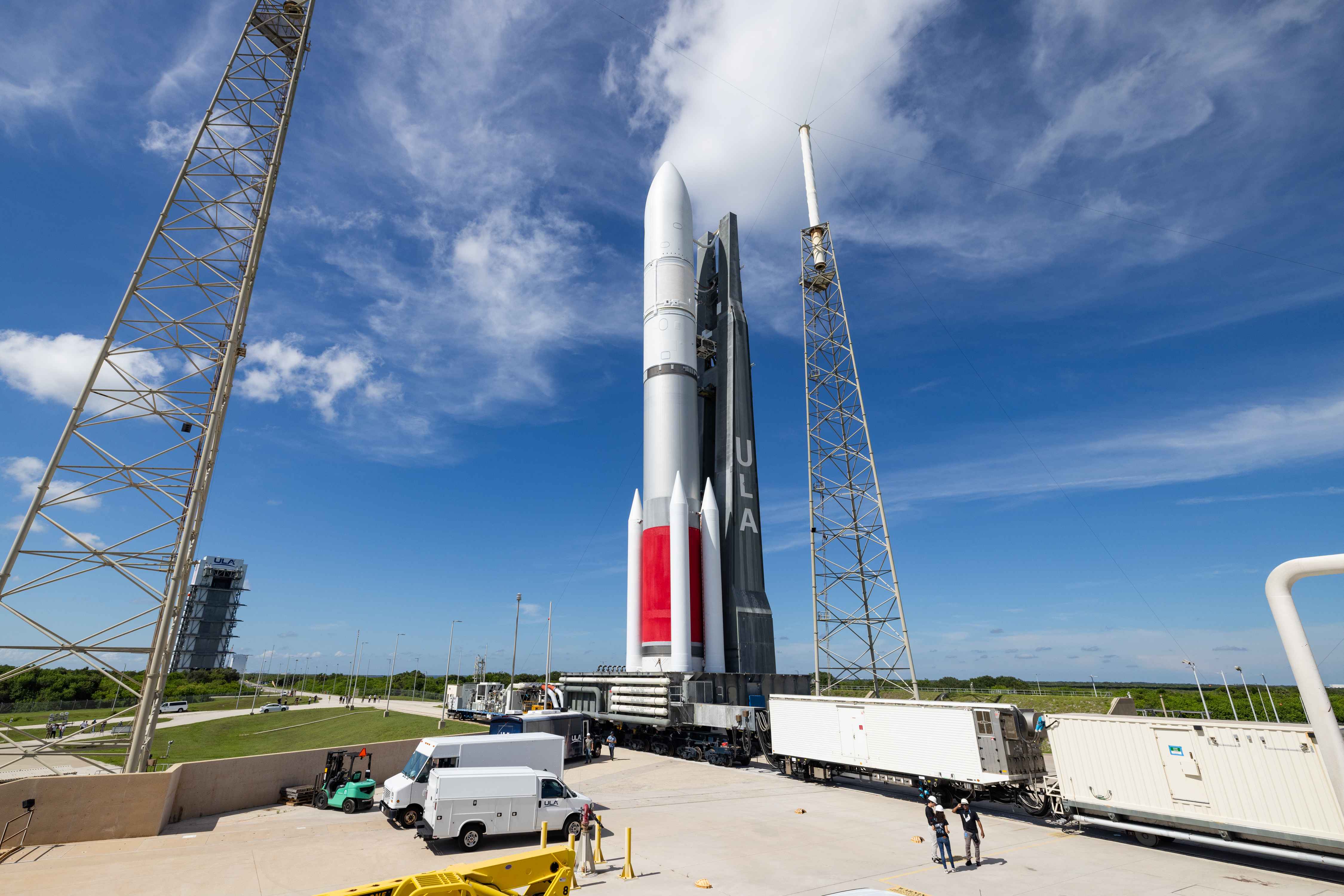
Long March 3B/E • Long March
Beidou is a Chinese satellite navigation system. Beidou-3 IGSO-3 is another addition to the part of the constellation consisting of satellites in an inclined geosynchronous orbit,
Long March 4B • Long March
Gaofen is a series of civilian Earth observation satellites developed and launched for the China High-definition Earth Observation System (CHEOS), a state-sponsored programme aimed to develop a near-real time, all-weather, global surveillance network consisting of satellite, near-space (stratosphere) airships, and aerial observation platforms.
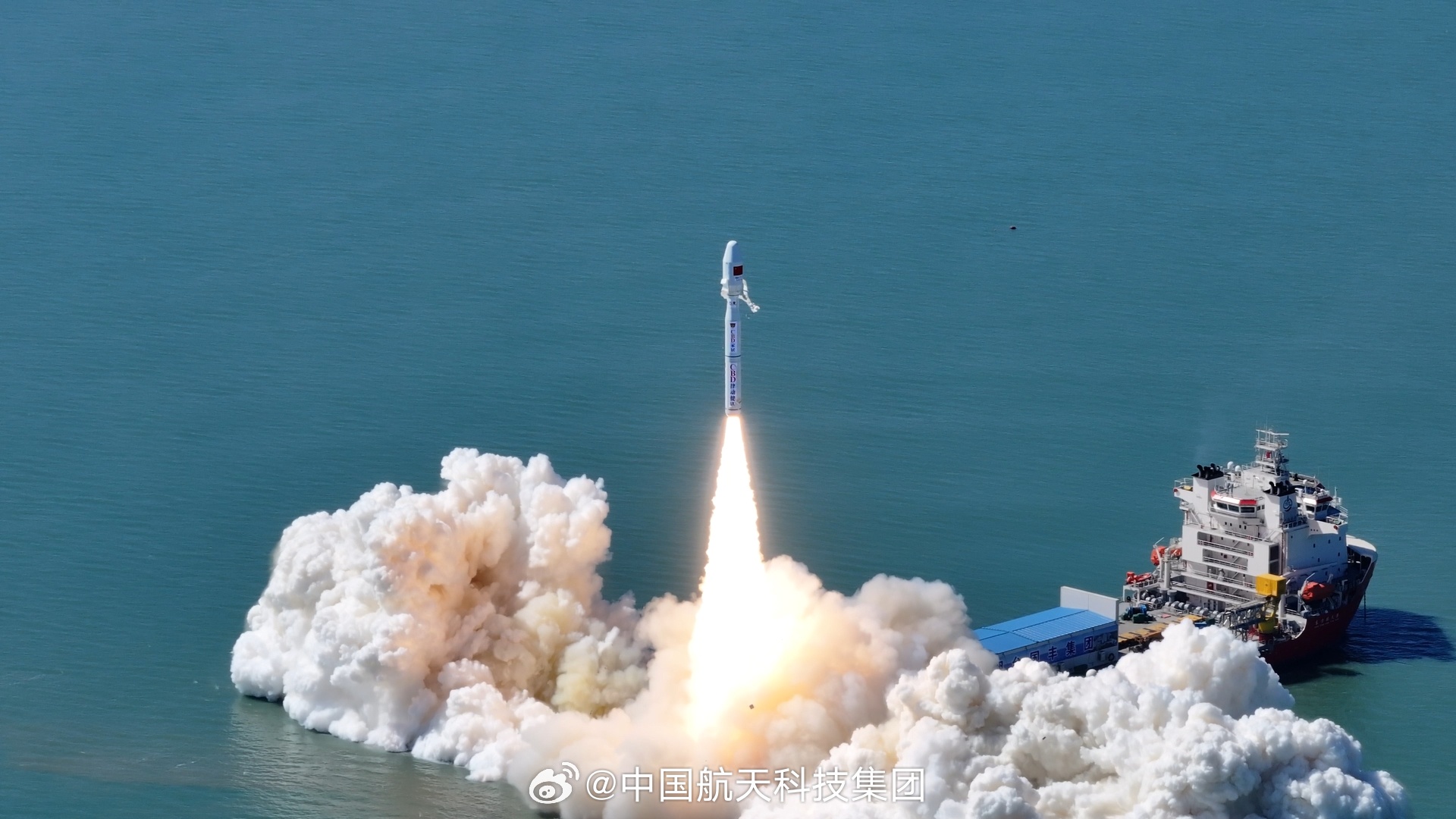
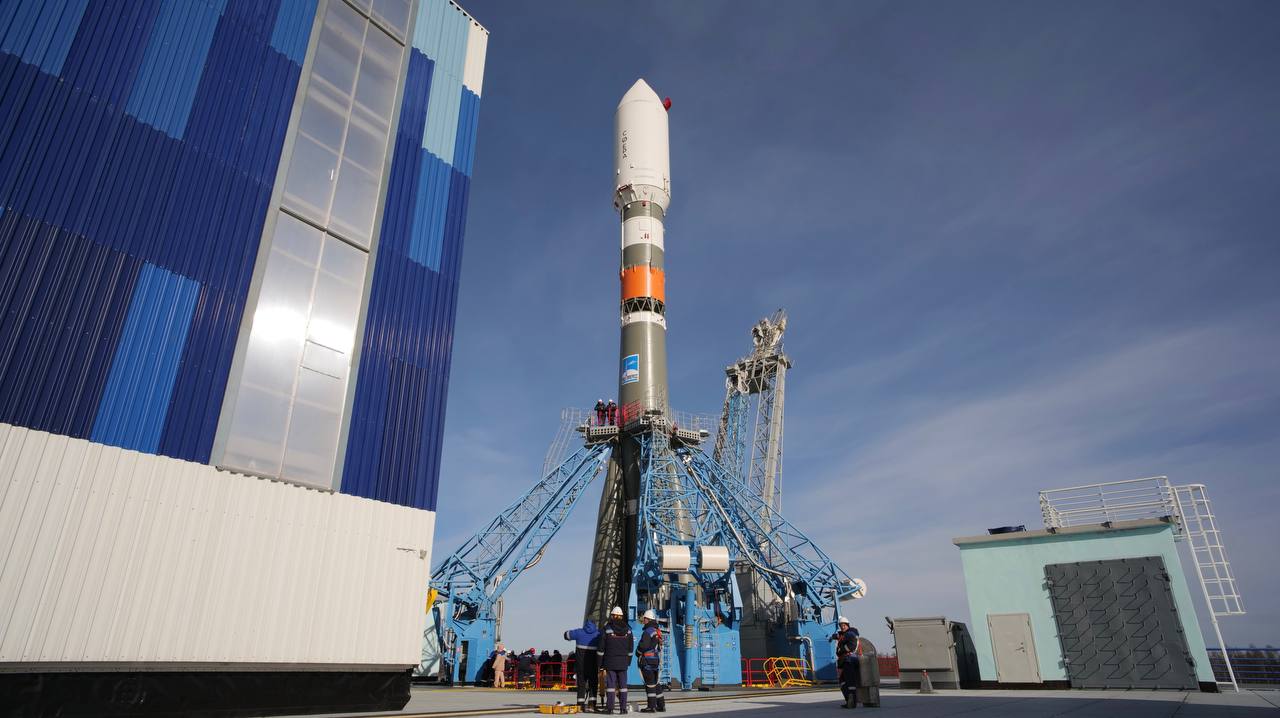
Antares 230+ • Antares
This is the 13th planned flight of the Orbital ATK's uncrewed resupply spacecraft Cygnus and its 12th flight to the International Space Station under the Commercial Resupply Services contract with NASA.
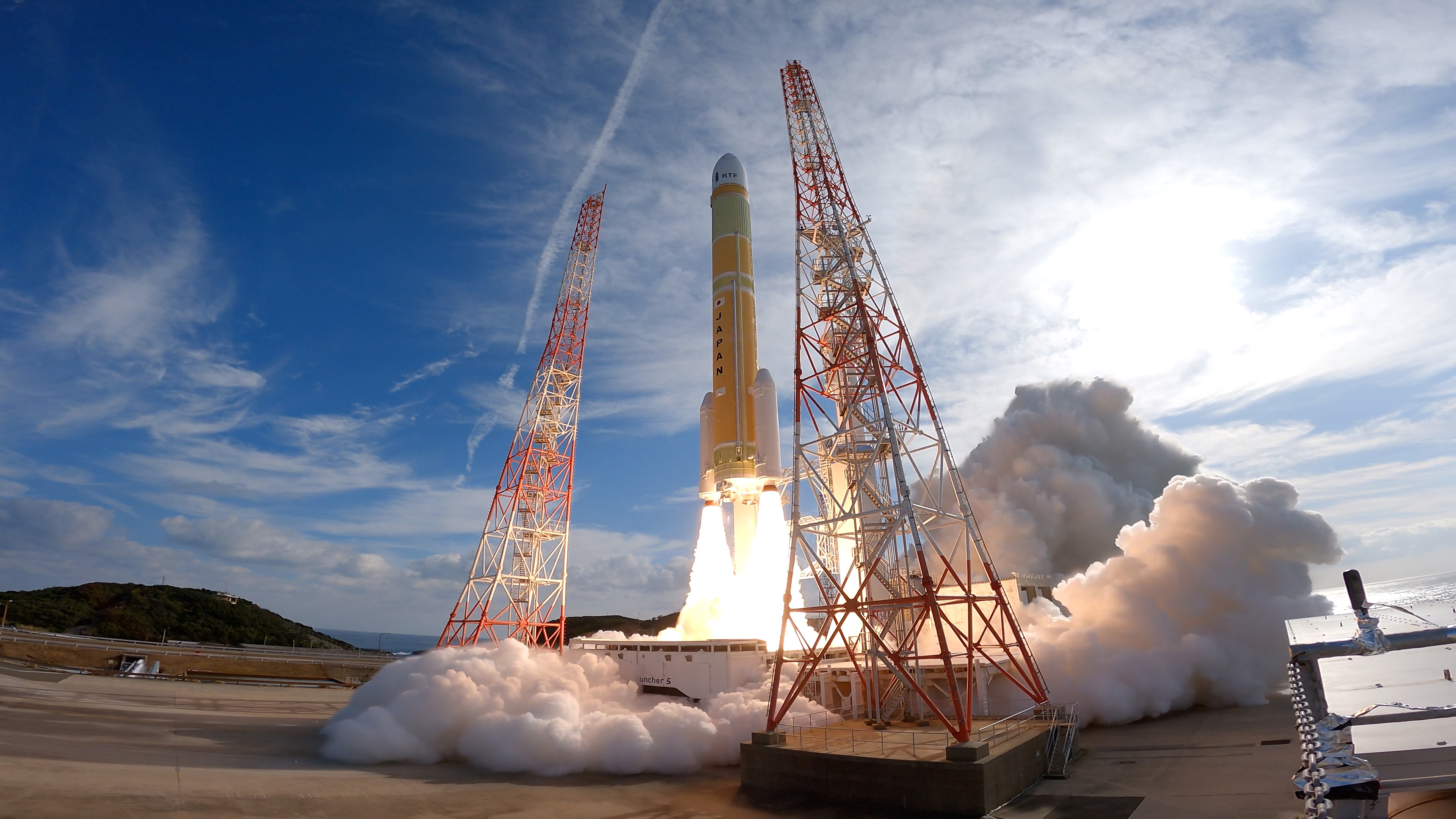
SARGE •
The 4th launch of EXOS Aerospace's reusable launch vehicle.
Long March 3B/E • Long March
TJS-4 is a geosynchronous satellite which is used for multi-band and high-rate satellite communication technology verification.
Electron •
Encapsulated in Electron's fairing will be a single spacecraft for Astro Digital, a California-based satellite manufacturer and operator. The Landmapper-BC remote sensing satellite features a broad coverage multispectral imaging system with a resolution of 22 meters per pixel. Eventually, Astro Digital plans to extend the Landmapper-BC constellation to capture daily, multispectral imagery of the world’s arable land. The mission is named 'As The Crow Flies' in a nod to Astro Digital's Corvus Platform, which provides flexible and cost-effective solutions across a wide range of applications and mission profiles on bus variants ranging from 6U and 16U CubeSats to ESPA Class. Corvus is also a widely-distributed genus of birds which includes crows.
Pegasus XL • Pegasus
Ionospheric Connection Explorer (ICON) is a NASA mission to study Earth's thermosphere and ionosphere and the connection between space weather and weather on our planet. Mission is planned to last for two years.
Proton-M Briz-M • Proton / UR-500
Eutelsat 5 West B will replace the Ku-band capacity of Eutelsat 5 West A (formerly Stellat 5) satellite, a key digital infrastructure addressing predominantly French, Italian and Algerian broadcast markets. Eutelsat 5 West B will provide business continuity and improved quality for these services via a Ku-band payload. The satellite is built on Orbital ATKs GEOStar-2e bus and carries 35 equivalent 36 MHz Ku-band transponders connected to three service areas. Switchable transponders will also increase commercial flexibility. Co-passenger on this flight will be provided Northrop Grumman Innovation Systems. MEV-1 (Mission Extension Vehicle-1) incorporates flight-proven technologies the company has used in its commercial satellite and space logistics businesses. After successfully completing a series of in-orbit tests, the MEV-1 will begin its mission extension service for Intelsat-901 satellite in the graveyard orbit. MEV-1 will relocate the satellite scheduled for the mission extension service, which is planned for a five-year period, after which Intelsat 901 will be place back into graveyard orbit. Intelsat will also have the option to service multiple satellites using the same MEV. MEV-1 is based on the company’s GEOStar-3 spacecraft bus platform. Controlled by the company’s satellite operations team, the MEV-1 uses a reliable, low-risk docking system that attaches to existing features on a customer’s satellite. The MEV-1 provides life-extending services by taking over the propulsion and attitude control functions. The vehicle has a 15-year design life with the ability to perform numerous dockings and undockings during its life span.
Long March 4C • Long March
Gaofen is a series of civilian Earth observation satellites developed and launched for the China High-definition Earth Observation System (CHEOS), a state-sponsored programme aimed to develop a near-real time, all-weather, global surveillance network consisting of satellite, near-space (stratosphere) airships, and aerial observation platforms. Gaofen-10R is a replacement satellite for the one lost in a 2016 failed launch.
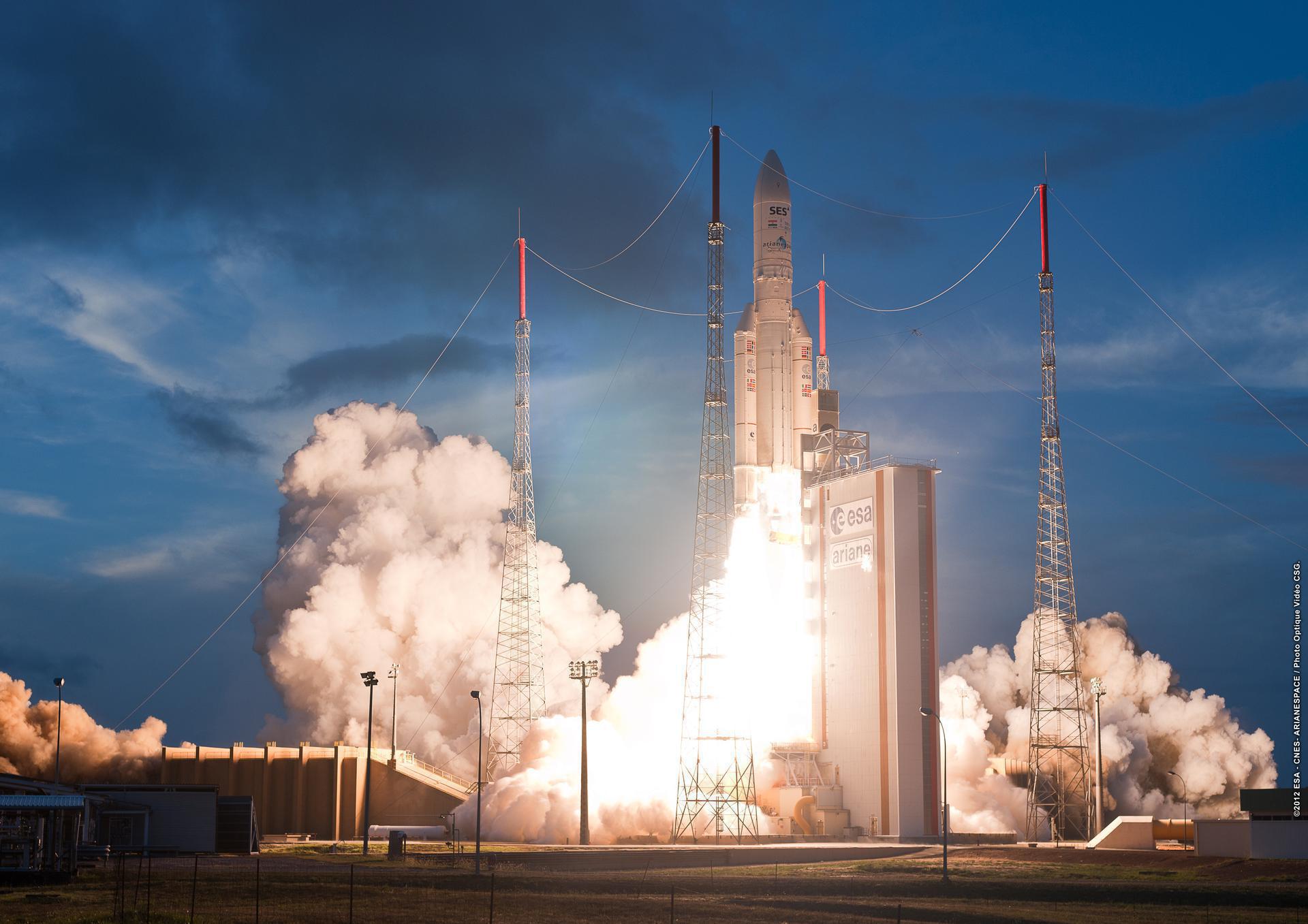
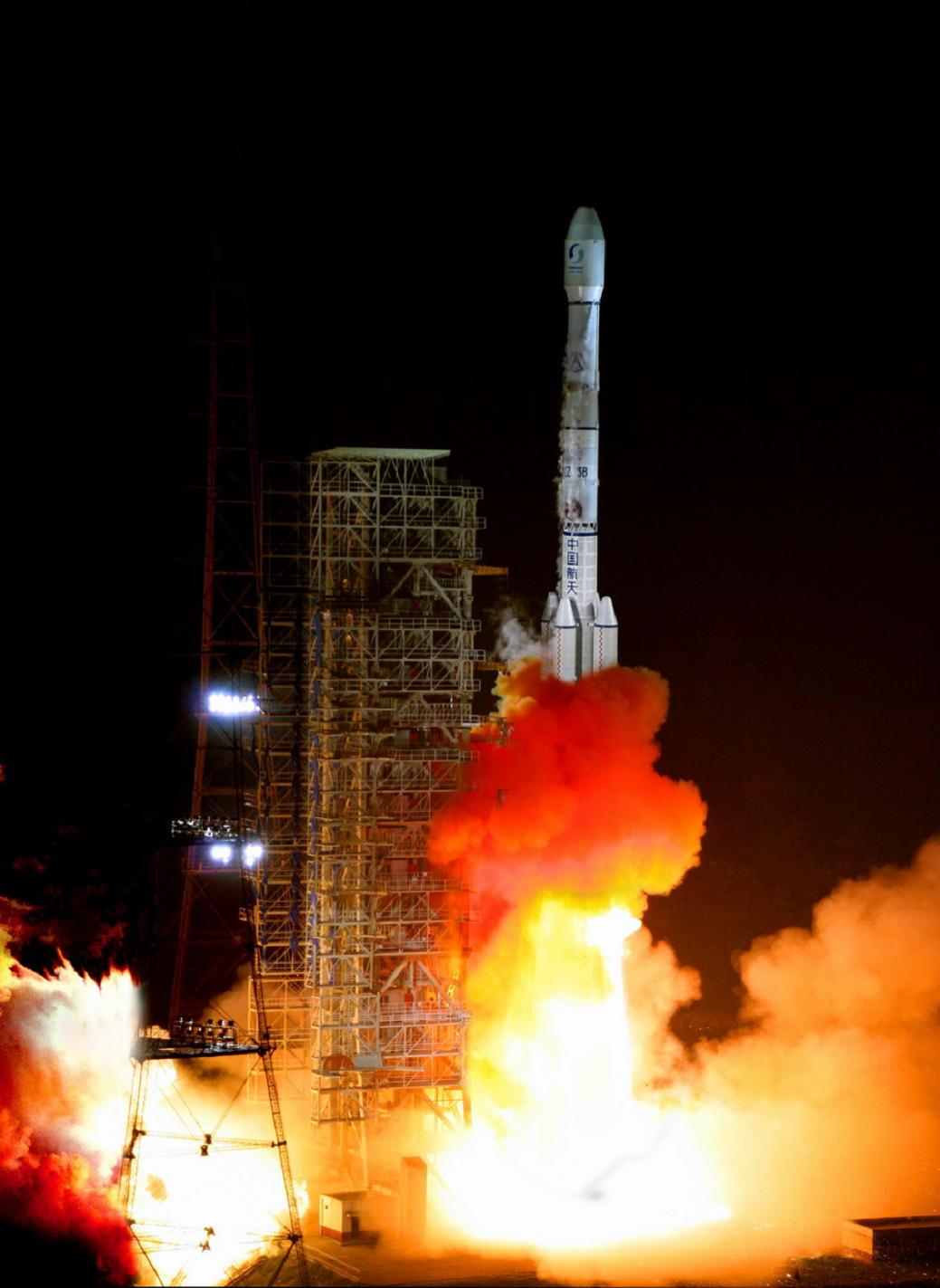
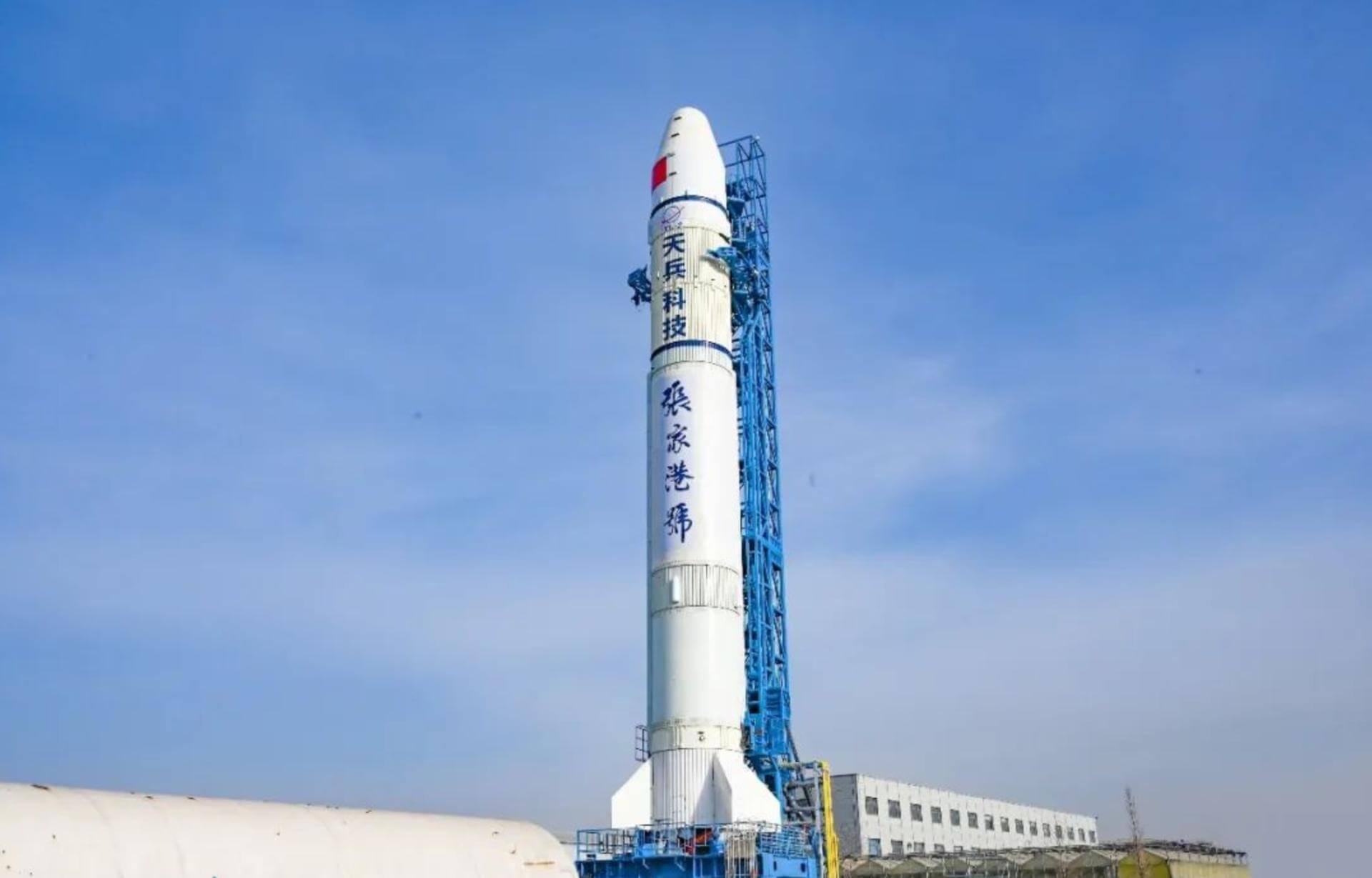
Soyuz 2.1b/Fregat • Soyuz
The Tundra or EKS (meaning Unified Space System) series of satellites is the next generation of Russian early warning satellites.
Soyuz •
Soyuz MS-15 begins expedition 61 by carrying NASA astronaut Jessica Meir, Roscosmos cosmonaut Oleg Skripochka and United Arab Emirates’ Hazzaa Ali Almansoori, a Roscosmos spaceflight participant and first Emirati in space that will spend only 8 days aboard ISS before returning to Earth aboard a Soyuz MS-12.
Long March 2D • Long March
The Yunhai-1 satellite is designed for detecting environmental elements in the atmosphere and ocean, the space environment, disaster prevention and reduction, and scientific experimentation. It is made by the Shanghai Institute of Spaceflight Technology.
H-IIB • H-II
Uncrewed cargo resupply mission to International Space Station.
Long March 3B/YZ-1 • Long March
These two satellites will be used to provide global navigation coverage as part of the Chinese Beidou (Compass) satellite navigation system.
Long March 11 • Long March
Mission details available on detail page.
Long March 4B • Long March
Mission details available on detail page.
Kuaizhou 1A • Kuaizhou
Developed by the DFH Satellite Co., the microgravity experimental satellite KX-09 (supposedly Kuxue-09) will conduct studies in microgravity. Established in August 2001, DFH Satellite Co., Ltd. is mainly engaged in system R&D, design, integration and in-orbit service of small satellites. It is subordinated to China Academy of Space Technology (CAST) and wholly owned by the listed company China Spacesat Co., Ltd. Xiaoxiang 1-07 (TY 1-07) is a small satellite developed by SpaceTY, possibly a CubeSat-2U. As one of the first commercial aerospace companies in China, “Spacety†specializes in developing commercial micro/nanosatellites. The company aims to provide short-cycle, low-cost and one-stop services to scientists, research institutes, and commercial companies, for science experiments and technology demonstrations.
Rokot/Briz-KM • Rokot
Geo-IK-2 is a Russian geodesy mission to deliver precise three-dimensional maps of the Earth’s surface and gravitational data for use in scientific studies and military applications. Using GLONASS for accurate positioning data, the 1400kg satellite will operate in a 1000km polar orbit.
Starship Prototype • Starship
SpaceX's latest prototype rocket design, Starhopper, has successfully performed a 150m hop on Tuesday August 27, 2019 at 22:02 UTC.
Delta IV M+(4,2) • Delta
GPS-IIIA (Global Positioning System) is the first evolution stage of the third generation of the GPS satellites. It consists of the first ten (known as "tranche") of GPS III satellites.
Soyuz 2.1a • Soyuz
Uncrewed Soyuz MS spacecraft to bring cargo to the space station. This demo flight tests a modified motion and navigation control system, as well as mating to Soyuz-2.1a rocket. The results will be used in development of an uncrewed cargo vehicle, based on Soyuz spacecraft.
Electron •
Mission carries a satellite for the future UNSEENLABS maritime tracking constellation, a BlackSky Global-4 Earth observation satellite, and two experimental satellites for United States Air Force Space Command.
Long March 3B/E • Long March
Zhongxing-18 (Chinasat-18) is a Chinese communications satellite based upon a DFH-4E bus. The Chinasat-18 provides Ku commercial communications services with 30 Ku-band transponders, Ka broadband communication services with 14 Ka-band MSS spot user beams and exploring Ka-band broadcasting services with 2 Ka BSS-band transponders within the service coverage areas.
Smart Dragon 1 • Smart Dragon
First launch of the new solid-fueled rocket by Chinarocket Co., Ltd., which is a commercial subsidiary of CASC. On this launch Smart Dragon 1 will also carry payloads for four private companies.
Atlas V 551 • Atlas
This is the fifth satellite in the Advanced Extremely High Frequency (AEHF) system, which is a series of communications satellites operated by the United States Air Force Space Command. It provides global, survivable, protected communications capabilities for strategic command and tactical warfighters operating on ground, sea and air platforms.
Falcon 9 • Falcon
Amos-17 is a multi-band high-throughput satellite which will operate from 17°E, offering Ka-band, Ku-band, and C-Band services to users in Africa, the Middle East and Europe.
Ariane 5 ECA+ • Ariane
EDRS-C is one of the two EDRS (European Data Relay System) satellites. EDRS is the European constellation of two geostationary data relay satellites that will relay information and data between satellites, spacecraft, unmanned aerial vehicles, and ground stations. Broadband communications payload called HYLAS 3 is placed on EDRS-C satellite, and is to complement HYLAS 1 and HYLAS 2 satellites already in orbit.
Proton-M Briz-M • Proton / UR-500
The fourth and final of four Blagovest communication satellites. It is a high throughput communications satellite used for high speed internet services, TV, radio broadcasting and voice/video networking.
Soyuz 2.1a • Soyuz
The Progress resupply vehicle is an automated, unpiloted version of the Soyuz spacecraft that is used to bring supplies and fuel to the International Space Station.
Soyuz 2.1a/Fregat-M • Soyuz
The Meridian series of communications satellites is reported to be the replacement for all the Molniya-1T, the Molniya-3 and Molniya-3K satellite series and possibly also for the communication component of the Parus. They are launched into highly eccentric Molniya-orbits. Meridian is the highly eccentric orbit (HEO) component of the Integrated Satellite Communications System (ISSS), where they work in conjunction with the geostationary Raduga-1M (Globus-M) satellites. The bus structure is reportedly pressurized, possibly based on the Uragan-M bus. Meridian satellites carry three transponders operating in different frequency bands.
MOMO v0 • MOMO
The Momo-4 rocket will carry a research device developed by Kochi University of Technology and release a paper plane in space as part of an experiment proposed by Castem Co., a precision parts manufacturer based in Fukuyama, Hiroshima Prefecture, that provided some of the funding for the project.
Long March 2C • Long March
Yaogan is a series of Chinese reconnaissance satellites.
Starship Prototype • Starship
The Starhopper test article performed an untethered hop to an altitude of 20m.
Falcon 9 • Falcon
SpaceX launched the Dragon spacecraft on their 18th operational cargo delivery mission to the International Space Station. The flight was conducted under the Commercial Resupply Services contract with NASA.
Hyperbola-1 •
This is the first flight of a small solid fuel rocket designed by iSpace, also known as Beijing Interstellar Glory Space Technology Ltd. It will carry several payloads for commercial customers to LEO.
LVM-3 (GSLV Mk III) • GSLV
Chandrayaan-2 is India's second mission to the Moon. It consists of an orbiter, lander and rover. After reaching the 100 km lunar orbit, the lander housing the rover will separate from the orbiter. After a controlled descent, the lander will perform a soft landing on the lunar surface at a specified site and deploy the rover. Six-wheeled rover weighs around 20 kg and will operate on solar power. It will move around the landing site, performing lunar surface chemical analysis and relaying data back to Earth through the orbiter. The lander will be collecting data on Moon-quakes, thermal properties of the lunar surface, the density and variation of lunar surface plasma. The orbiter will be mapping lunar surface. Altogether, Chandrayaan-2 mission will collect scientific information on lunar topography, mineralogy, elemental abundance, lunar exosphere and signatures of hydroxyl and water-ice.
Soyuz •
Soyuz MS-13 begins expedition 60 by carrying NASA astronaut Andrew Morgan, Luca Parmitano of ESA (European Space Agency) and Alexander Skvortsov of the Russian space agency Roscosmos launch to the International Space Station aboard the Soyuz spacecraft from the Baikonur Cosmodrome in Kazakhstan.
Proton-M • Proton / UR-500
Spektr-RG is a joint Russian-German observatory-class mission. It is intented to study the interplanetary magnetic field, galaxies and black holes.
Vega • Vega
Falcon Eye 1 is a high-resolution Earth-imaging satellite for the United Arab Emirates. Built by Airbus Defense and Space with an optical imaging payload from Thales Alenia Space, Falcon Eye 1 is the first of two surveillance satellites ordered by the UAE’s military.
Soyuz 2.1v • Soyuz
Four satellites in the interests of the Ministry of Defense of Russia.
Soyuz 2.1b/Fregat • Soyuz
This is the fourth spacecraft in the Russian Meteor-M series of remote sensing satellites. Weighing about 2750 kg, it is intended to gather hydrometeorological data from sun-synchronous orbit. This includes monitoring ozone layer and radiation levels in the near-Earth space, as well as monitoring ocean surface temperatures and ice conditions.
Orion Abort Test Booster •
Ascent Abort-2 (AA-2) is a scheduled test of the Launch Abort System (LAS) of NASA's Orion spacecraft.
SARGE •
The 3rd launch of EXOS Aerospace's reusable launch vehicle. Failed during ascent due to what appears to be a gimbal issue. Sarge 1 glided steering its parachute and landed safely on the ground after dumping fuel.
Electron •
Rideshare mission for Spaceflight. Electron will launch seven spacecraft, including a commercial Earth-observing microsatellite for BlackSky, two CubeSats for U.S. Special Operations Command, a pair of tiny prototype data relay nodes for Swarm Technologies, a student-built payload from Australia called ACRUX-1, and a satellite whose identity and owner remain a secret. The mission is named "Make it Rain" in a nod to the high volume of rainfall in Seattle, where Spaceflight is headquartered, as well in New Zealand where Launch Complex 1 is located.
Falcon Heavy • Falcon
The STP-2 payload is composed of 25 small spacecraft. Included is COSMIC-2 constellation to provide radio occultation data, along with 8 cubesat nanosatellites. Other payloads include LightSail carried by the Prox-1 nanosatellite, Oculus-ASR nanosatellite, GPIM and the Deep Space Atomic Clock.
Long March 3B/E • Long March
These two satellites will be used to provide global navigation coverage as part of the Chinese Beidou (Compass) satellite navigation system.
Ariane 5 ECA • Ariane
Eutelsat 7C is based on an all-electric propulsion version of the SSL-1300 satellite platform. Equipped with 44 operational Ku-band transponders, the new satellite will be copositioned with Eutelsat 7B, releasing Eutelsat 7A to another orbital location. This improved two-satellite constellation will enable Eutelsat to optimise resources across both satellites, with enhanced coverage flexibility and connectivity set to take the 7° East neighbourhood to a new level. By almost doubling capacity over Sub-Saharan Africa, from 22 to 42 transponders, it will also make room for several hundred additional digital channels to support the region’s fast expanding TV market. Eutelsat 7C will also be equipped with a beam providing enhanced capacity for government services over Europe, the Middle East and Central Asia, and a beam that can be steered to cover any region visible from 7° East. AT&T T-16 is based on Astrium’s Eurostar-3000 platform. The satellite has a payload comprising of high power transponders in Ku-band and transponders in Ka-band. It will operate from 100.85° West.
Falcon 9 • Falcon
The Radarsat Constellation Mission is a follow-on project to RADARSAT-2 currently developed by MDA. The constellation will consist of a fleet of three spacecraft, and be both complementary and a follow-on to the upcoming deployment of the RADARSAT-2 mission. The primary purpose of the RCM is to provide C-Band data continuity for RADARSAT-2 users, as well as adding a new series of applications enabled through the constellation approach. The main uses of RCM are expected to be in the areas of: maritime surveillance (ship detection, ice monitoring, and oil spill detection), disaster management, ecosystem monitoring. The primary areas of interest are the landmass of Canada and its surrounding Arctic, Pacific and Atlantic maritime areas. The images and derived information are required to be provided to Canadian government users at frequent area coverage rates. Contrary to the earlier RadarSat missions, the imagery will not be available commercially. The spacecraft Payload will consist of a Synthetic Aperture Radar (SAR) sensor integrated with an Automated Identification System (AIS). The SAR Payload concept is a 2-panel deployable SAR antenna of length approximately 7 meters.
Long March 11 • Long March
The first sea launch of Long March 11 rocket. It carries 7 satellites, which include a new high-resolution Earth observation satellite Jilin-1 and several test satellites, verifying such technologies as sea surface wind measuring and satellite interlink communication.
Proton-M Briz-M • Proton / UR-500
Yamal-601 is a geostationary communications satellite for Gazprom Space Systems.
Soyuz 2.1b/Fregat-M • Soyuz
Glonass-M, also known as Uragan-M, are the second generation of Uragan satellite design used for GLONASS satellite navigation system. GLONASS is a Russian space-based navigation system comparable to the similar GPS and Galileo systems. This generation improves on accuracy, power consumption and design life. Each satellite weighs 1415 kg, is equipped with 12 L-band antennas, and has an operational lifetime of 7 years.
Falcon 9 • Falcon
An initial batch of 60 satellites meant to test Starlink mega-constellation - SpaceX's project for space-based Internet communication system.
Long March 4C • Long March
Yaogan is a series of Chinese reconnaissance satellites.
PSLV • PSLV
Satellite imaging mission of ISRO using an active SAR (Synthetic Aperture Radar) imager to provide continuity of service for RISAT-2.
Long March 3C • Long March
Navigation satellite for China's BeiDou navigation satellite constellation.
Electron •
The mission has been procured by the DoD Space Test Program in partnership with Defense Innovation Unit (DIU) as part of its Rapid Agile Launch Initiative .The payload consists of three satellites, SPARC-1, Falcon ODE and Harbinger, that will deployed in a precise sequence. The Space Plug and Play Architecture Research CubeSat-1 (SPARC-1) mission, sponsored by the Air Force Research Laboratory Space Vehicles Directorate (AFRL/RV), is a joint Swedish-United States experiment to explore technology developments in avionics miniaturization, software defined radio systems, and space situational awareness (SSA). The Falcon Orbital Debris Experiment (Falcon ODE), sponsored by the United States Air Force Academy, will evaluate ground-based tracking of space objects. Harbinger, a commercial small satellite built by York Space Systems and sponsored by the U.S Army, will demonstrate the ability of an experimental commercial system to meet DoD space capability requirements.
MOMO v0 • MOMO
Flight duration : 515 seconds. Maximum altitude : 113.4 km. Downrange : 37 km from the launch site. This was the first successful attempt following two consecutive failures for the previous MOMO series, and has provided valuable telemetry data for further development within IST.
Falcon 9 • Falcon
SpaceX launched the Dragon spacecraft on their 17th operational cargo delivery mission to the International Space Station. The flight was conducted under the Commercial Resupply Services contract with NASA.
New Shepard •
New Shepard flight 11 will fly 38 microgravity research payloads to space.
Long March 4B • Long March
At 22:52 UTC on April 29, 2019, China used a Long March 4B rocket from the Taiyuan Satellite Launch Center to successfully launch two Tianhui-2-01 satellites. The satellites will be used for scientific experiments, land resource survey, geographic survey and mapping.
Long March 3B/E • Long March
The satellite is a part of the Chinese Beidou (Compass) satellite navigation system.
Antares 230 • Antares
This is the 12th planned flight of the Orbital ATK's uncrewed resupply spacecraft Cygnus and its 11th flight to the International Space Station under the Commercial Resupply Services contract with NASA. Northrop Grumman named the vehicle after Apollo 1 astronaut Roger Chaffee.
Falcon Heavy • Falcon
Arabsat-6A is a Saudi Arabian communications satellite to be positioned at 30.5°East orbital slot. Arabsat-6A was built by Lockheed Martin for Arabsat and will deliver TV, internet and mobile phone services to the Middle East, Africa and Europe.
Soyuz STB • Soyuz
The O3b Satellite Constellation is designed for telecommunications and data backhaul from remote locations.
Soyuz 2.1a • Soyuz
The Progress resupply vehicle is an automated, unpiloted version of the Soyuz spacecraft that is used to bring supplies and fuel to the International Space Station.
PSLV-QL • PSLV
The main payload is an electronic intelligence satellite EMISAT for India's Defence Research and Development Organization. This launch will also be the first flight of PSLV-QL, which is a version of PSLV rocket with four strap-on boosters. The fourth stage of the rocket will serve as an experimental platform for in-orbit experiments and will carry a small payload developed by Indian Institute of Space Science and Technology. The stage is equipped with solar panels and is expected to remain active for at least six months.
Long March 3B/E • Long March
Tianlian is a Chinese data tracking and relay communications satellite series.
Electron •
Radio Frequency Risk Reduction Deployment Demonstration (R3D2) is a mission for Defense Advanced Research Projects Agency (DARPA). It will test a prototype reflect array antenna which is intended to improve radio communications in small spacecraft.
OS-M1 •
This is the first flight of the OS-M1 rocket. It carries a remote sensing satellite developed by a ZeroG Lab.
Vega • Vega
PRISMA (PRecursore IperSpettrale della Missione Applicativa) is a medium-resolution hyperspectral imaging mission of the Italian Space Agency ASI. The mission can provide a unique contribution to the observations of natural resources and in the study of key environmental processes
Delta IV M+(5,4) • Delta
WGS-10 is the tenth and final satellite in Wideband Global Satcom constellation. These are high-capacity military communications satellites providing vital service for tactical forces who rely on WGS for connectivity to the Defence Information Systems Network (DISN).
Soyuz •
Soyuz MS-12 begins expedition 59 by carrying Roscosmos cosmonaut Aleksey Ovchinin, NASA astronauts Christina Hammock Koch and Nick Hague to the International Space Station. After launching from the Baikonur Cosmodrome in Kazakhstan, they will rendezvous to the station where they will remain for their 6 month stay.
Long March 3B/E • Long March
Zhongxing 6C is a high-throughput Ka-band communications satellite. It will be positioned at 130° East orbital slot.
SARGE •
The SARGE rocket carried several small research payloads and was intended to reach a peak altitude of 80 kilometers. It only reached a peak altitude of about 20 kilometers before gliding back to a landing about 1.2 kilometers from the launch pad.
Falcon 9 • Falcon
This is the first test flight of Crew Dragon 2 to the International Space Station marking a huge milestone towards the Commercial Crew program.
Soyuz STB • Soyuz
OneWeb satellite constellation is intended to provide global Internet broadband service for individual consumers. The constellation is planned to have around 720 microsatellites, around 150 kg each, operating in Ku-band from low Earth orbit. Eventually it can be expanded to include extra 1260 satellites, for a total of 1980.
SpaceShipTwo •
Powered test flight of VSS Unity. Carried a third crew member in the passenger cabin for the first time.
Falcon 9 • Falcon
Spaceflight’s first mission beyond Lower Earth Orbit (LEO) and its first combined launch with SSL. Consists out lunar lander called Beresheet (Hebrew for in the beginning) and AFRL’s S5 satellite.
Soyuz 2.1b/Fregat-M • Soyuz
EgyptSat-A (MisrSat A) is Egypt's third Earth remote-sounding satellite. The satellite is jointly built by Egypt's National Authority for Remote Sensing and Space Sciences together with RKK Energiya in Russia. The imaging payload was developed by OAO Peleng and NIRUP Geoinformatsionnye Sistemy in Belarus. The satellite is an improved version of EgyptSat 2 and is also based on RKK Energiya's 559GK bus, which inherits technologies from their USP platform. The satellite features SPD-70 electric engines using Xenon. It features an improved opto-electronic system and onboard control system, high-speed on-board radio link and solar cells with increased efficiency.
Ariane 5 ECA • Ariane
Hellas Sat 4/SaudiGeoSat 1 is a geostationary communications satellite to be used jointly by Hellas Sat and KACST. It will provide advanced telecommunications capabilities, including television, internet, telephone and secure military communications to customers in the Middle East, Africa and Europe. Another passenger of the launch is an Indian communications satellite GSAT-31.
Safir 1B • Nodong
Doosti (farsi for "friendship") is a microsatellite developed and built by the Remote Sensing Laboratory of Iranian Space Agency.
PSLV-DL • PSLV
Microsat-R is a remote sensing satellite . This launch will also test the use of the fourth stage (PS4) as an orbital platform for carrying out experiments. It will carry a student payload Kalamsat.
New Shepard •
New Shepard flight 10 will feature 9 NASA-sponsored payloads via the NASA Flight opportunity program.
Long March 11 • Long March
Launch carried four remote sensing satellites for Chinese private companies.
Delta IV Heavy • Delta
Classified payload for the U.S. National Reconnaissance Office.
Epsilon • Epsilon
A rideshare mission to launch experimental microsats and cubesats. Main payload is RAPIS-1 (RAPid Innovative payload demonstration Satellite 1), which will test several new technologies in space.
Simorgh •
Payam is a civilian remote sensing satellited developed by Amirkabir University of Technology. It was supposed to be used for Earth imaging to assist agriculture and environment management.
Falcon 9 • Falcon
SpaceX's Falcon 9 rocket will deliver 10 satellites to low Earth orbit for Iridium, a global leader in mobile voice and data satellite communications. This is the eighth set of 10 satellites in a series of 75 total satellites that SpaceX will launch for Iridium's next generation global satellite constellation, Iridium NEXT.
Long March 3B • Long March
Chinasat 2D is a geostationary communications satellite.
Long March 2D/YZ-3 • Long March
Hongyan-1 is the first demonstration satellite for Hongyan, which is a planned constellation consisting of 320 satellites in low Earth orbit. Yunhai-2 is a constellation of Chinese military meteorological satellites. Reportedly the satellites use Global Navigation Satellite System (GNSS) Radio Occultation (GNSS-RO) to collect atmospheric data for weather prediction and for ionosphere, climate, and gravity research.
Soyuz 2.1a/Fregat-M • Soyuz
Kanopus-V is a series of Russian Earth observation satellites. They are used for real-time monitoring of natural and man-made emergencies, detecting forest fires, monitoring of land and water resources.
Long March 3C • Long March
TJS 3 (Tongxin Jishu Shiyan) is a Chinese geostationary communications technology test satellite.
Falcon 9 • Falcon
GPS-IIIA (Global Positioning System) is the first evolution stage of the third generation of the GPS satellites. It consists of the first ten (known as "tranche") of GPS III satellites. This program will improve position, navigation, and timing services for the warfighter and civil users worldwide and provide advanced anti-jam capabilities yielding superior system security, accuracy and reliability.
Long March 11 • Long March
Hongyun is planned constellation of 156 low Earth orbit communications satellites by China Aerospace Science and Industry Corp (CASIC). Hongyun-1 is a technology demonstration satellite.
Proton-M Briz-M • Proton / UR-500
The third of four Blagovest communication satellites. It is a high throughput communications satellite used for high speed internet services, TV, radio broadcasting and voice/video networking.
Soyuz STA • Soyuz
The CSO-1 (Composante Spatiale Optique-1) satellite is the first of three new-generation high-resolution optical imaging satellites for the French military, replacing the Helios 2 spy satellite series.
GSLV Mk II • GSLV
GSAT-7A is a geostationary communications satellite for the Indian Air Force (IAF).
Electron •
NASA's signed a Venture Class Launch Services contract with Rocket Lab to launch 10 cubesats as a part of CubeSat Launch Initiative Educational Launch of Nanosatellites (ELaNa) program. Cubesats are: ALBus / CeREs / CHOMPTT / Da Vinci / ISX / NMTSat / RSat-P / Shields 1 / STF 1 / CubeSail A / CubeSail B /TOMSat EagleScout / TOMSat R3 / SHFT 1
SpaceShipTwo •
Powered test flight of VSS Unity. Reached outer space for the first time according to the US definition of the space border.
Long March 3B/E • Long March
Chang'e 4 is a Chinese lunar exploration mission, incorporating a robotic lander and rover. Chang'e 4 will be China's second lunar lander and rover. The spacecraft is named after the Chinese Moon goddess. This will be the first mission to attempt soft landing on the far side of the Moon.
Long March 2D • Long March
SaudiSat 5A and 5B are Earth observation satellites developed by KACST (King Abdulaziz City for Science & Technology). They share the launch with several microsatellites for private Chinese companies.
Falcon 9 • Falcon
SpaceX launched the Dragon spacecraft on their 16th operational cargo delivery mission to the International Space Station. The flight was conducted under the Commercial Resupply Services contract with NASA.
Ariane 5 ECA • Ariane
GSAT-11 is an Indian geostationary communications satellite. It is based n the new I-6K Bus and carry 40 transponders in the Ku-band and Ka-band frequencies. GEO-KOMPSAT 2A is a South Korean geostationary meteorological satellite developed by KARI. The satellite will be used for weather and space weather observation.
Falcon 9 • Falcon
Dedicated rideshare launching payloads into sun-synchronous orbit. Payloads include ORS-6, EU:CROPIS, STPSat-5, BlackSky Global-1 to -4, HawkEye Pathfinder 1-3, Iceye, NEXTSat-1, 2 SkySats, Centauri II, and a Flock of Doves.
Soyuz •
Soyuz MS-11 begins expedition 58 by carrying Roscosmos cosmonaut Oleg Kononenko, CSA astronaut David Saint-Jacques and NASA astronaut Anne McClain to the International Space Station. After launching from the Baikonur Cosmodrome in Kazakhstan, they will rendezvous to the station where they will remain for their 6 month stay.
Rokot/Briz-KM • Rokot
Rodnik is a series of military communications satellites.
PSLV • PSLV
HysIS (Hyperspectral Imaging Spectrometer) is a small Indian earth observation satellite developed by ISRO. The primary goal of HysIS is to study the earth’s surface in visible, near infrared and shortwave infrared regions of the electromagnetic spectrum. It is launched along with 30 small satellites and cubesats for international companies.
KSLV 2 TLV • KSLV
Suborbital test flight, reaching a maximum altitude of 209 km and a 151-second burn time
Vega • Vega
A second Earth observation satellite for the Kingdom of Morocco. It was developed by Thales Alenia Space and Airbus. Satellite will be in particular used for mapping and land surveying activities, regional development, agricultural monitoring, the prevention and management of natural disasters, monitoring changes in the environment and desertification, as well as border and coastal surveillance.
Long March 2D • Long March
Shiyan 6 is the main payload of the launch and is reported to be used for "space environment measurements and related technical tests". It was launched along with 4 small satellites, among which are a China's first privately designed low Earth orbit communications satellite Jiading-1 and China's first software-based satellite Tianzhi-1.
Long March 3B/YZ-1 • Long March
These two satellites will be used to provide global navigation coverage as part of the Chinese Beidou (Compass) satellite navigation system.
Antares 230 • Antares
This is the eleventh planned flight of the Orbital ATK's uncrewed resupply spacecraft Cygnus and its tenth flight to the International Space Station under the Commercial Resupply Services contract with NASA.
Soyuz •
The Progress resupply vehicle is an automated, unpiloted version of the Soyuz spacecraft that is used to bring supplies and fuel to the International Space Station.
Falcon 9 • Falcon
Es'hail 2 is a communications satellite operated by a Quatar based company. The satellite will operate at 26 degrees East longitude along a geostationary orbit to provide direct-to-home television services in the Middle East and North Africa region.
LVM-3 (GSLV Mk III) • GSLV
GSAT-29 is a geostationary communications satellite developed by ISRO. GSAT-29 carries Ka x Ku multi-beam and optical communication payloads.
Electron •
Electron's first commercial launch will feature two Lemur-2 cubesats for Spire Global, a single cubesat for GeoOptics, a NABEO drag sail demonstrator for High Performance Space Structure Systems, an IRVINE01 cubesat from the Irvine CubeSat STEM Program, and two Proxima cubesats from Fleet Space Technologies.
Soyuz STB • Soyuz
MetOp is a series of three polar orbiting meteorological satellites developed by the European Space Agency (ESA).
Soyuz 2.1b/Fregat-M • Soyuz
Glonass-M, also known as Uragan-M, are the second generation of Uragan satellite design used for GLONASS satellite navigation system. GLONASS is a Russian space-based navigation system comparable to the similar GPS and Galileo systems. This generation improves on accuracy, power consumption and design life. Each satellite weighs 1415 kg, is equipped with 12 L-band antennas, and has an operational lifetime of 7 years.
Long March 3B • Long March
This satellite is a part of the geostationary component of the 3rd phase of the Chinese Beidou (Compass) satellite navigation system. It features a phased array antenna for navigation signals and a laser retroreflector and additionally deployable S/L-band and C-band antennas.
H-IIA • H-II
KhalifaSat is an Earth observation satellite for UAE. KhalifaSat will provide high-resolution imagery of Earth to be used for various purposes, including urban planning, change monitoring, area classification, monitoring environmental change and aiding relief efforts for natural disasters. GOSAT 2 (Greenhouse gases Observing SATellite 2) is a Japanese satellite dedicated to greenhouse gas measurement from space. It's a follow on to the GOSAT mission and includes such improvements as an ability to gather more precise data and monitor carbon monoxide concentrations.
Long March 2C • Long March
CFOSAT (China-France Oceanography SATellite) is a joint mission of the Chinese (CNSA) and French (CNES) space agencies with the goal to monitor the ocean surface winds and waves and to provide information on related ocean and atmospheric science and applications. The primary objective of CFOSAT is to monitor on a global scale the wind and waves at the ocean surface.
Zhuque-1 • Zhuque
The satellite is operated by China Central Television (CCTV) and is intended to carry out scientific expermients and perform Earth observation. Weilai-1 is expected to operate in sun-synchronous orbit for two years.
Soyuz 2.1b • Soyuz
Lotos-S1 spacecraft is a part of the Liana constellation, designed for orbital electronic intelligence.
Long March 4B • Long March
Haiyang is a series of Chinese marine remote sensing satellites. Haiyang 2B is a follow up to Haiyang 2A satellite. It is intended for monitoring the dynamic ocean environnement with microwave sensors to detect sea surface wind field, sea surface height and sea surface temperature.
Ariane 5 ECA • Ariane
BepiColombo is a joint mission of the ESA and the JAXA to the planet Mercury. The mission comprises two satellites to be launched together: the Mercury Planetary Orbiter (MPO) and the Mercury Magnetospheric Orbiter (MMO). The mission will perform a comprehensive study of Mercury, including its magnetic field, magnetosphere, interior structure and surface.
Atlas V 551 • Atlas
This is the fourth satellite in the Advanced Extremely High Frequency (AEHF) system, which is a series of communications satellites operated by the United States Air Force Space Command. It provides global, survivable, protected communications capabilities for strategic command and tactical warfighters operating on ground, sea and air platforms.
Long March 3B/YZ-1 • Long March
These two satellites will be used to provide global navigation coverage as part of the Chinese Beidou (Compass) satellite navigation system.
Soyuz •
Soyuz MS-10 was expected to begin expedition 57 by carrying Roscosmos cosmonaut Alexey Ovchinin and NASA astronaut Nick Hague to the International Space Station. However a launch failure occurred resulting in a loss of vehicle during flight, both crew members returned to Earth nominally.
Long March 2C/YZ-1S • Long March
Yaogan is a series of Chinese reconnaissance satellites.
Falcon 9 • Falcon
The SAOCOM 1A spacecraft is the first of the two SAOCOM constellation satellites. It is tasked with hydrology and land observaion, and will also operate jointly with the Italian COSMO-SkyMed constellation in X-band to provide frequent information relevant for emergency management.
Kuaizhou 1A • Kuaizhou
CentiSpace-1-S1 is an experimental satellite to test navigation and and positioning enhancement system being developed by Beijing Future Navigation Technology Co., Ltd.
Ariane 5 ECA • Ariane
Azercosmos-2/Intelsat-38 is a geostationary telecommunications satellite. As the name suggests, satellite will be used jointly by Azercosmos and Intelsat. Horizons-3e, also known as IS-H3e, is a high throughput geostationary communications satellite ordered by Horizons Satellite, a joint venture of Intelsat and SKY Perfect JSAT Group. The spacecraft is designed and manufactured by Boeing on the Boeing-702MP platform.
H-IIB • H-II
Uncrewed cargo resupply mission to International Space Station.
Long March 3B/YZ-1 • Long March
These two satellites will be used to provide global navigation coverage as part of the Chinese Beidou (Compass) satellite navigation system.
PSLV • PSLV
The NovaSAR-S spacecraft carries a radar imaging instrument, and the mission was developed in partnership between the British government and the British satellite manufacturer SSTL. The SSTL-S1 satellite, also built by SSTL, is a high-resolution optical Earth observation satellite identical to three DMC3/TripleSat reconnaissance craft launched in 2015. Beijing-based 21AT will lease imaging capacity on the SSTL-S1 satellite. There are also several secondary payloads.
Delta II • Delta
ICESat-2 (Ice, Cloud, and land Elevation Satellite 2) is a NASA Earth observation mission for measuring ice sheet elevation and sea ice freeboard, as well as land topography and vegetation characteristics.
Falcon 9 • Falcon
Telstar 18 VANTAGE, or Telstar 18V, is a communications satellite built by Space Systems Loral for the canadian satellite operator Telesat. The satellite is to provide coverage to the Asia Pacific region.
Long March 2C • Long March
Haiyang is a series of Chinese marine remote sensing satellites. Haiyang 1C is the follow-up of the Haiyang 1A and 1B satellites. It is intended for ocean monitoring and will be providing data on the temperature and dynamics of coastal waters and global oceans in China.
SARGE •
First test launch of the SARGE reusable sounding rocket.
Long March 3B/YZ-1 • Long March
These two satellites will be used to provide global navigation coverage as part of the Chinese Beidou (Compass) satellite navigation system.
Vega • Vega
ADM-Aeolus was an Earth observation satellite built by Airbus Defense and Space for ESA. Its goal was to directly observe wind profiles from space on a global scale and provide data that could improve weather forecasting and advance understanding of atmospherics dynamics and climate. The Aeolus satellite weighed around 1366 kg and flew in a low sun-synchronous orbit at about 400 km altitude. It was desorbited and reentered the Earth's atmosphere on July 28, 2023 at approximately 19:00 UTC.
Delta IV Heavy • Delta
Flying into the Sun’s atmosphere (or corona) for the first time. Coming closer to the Sun than any previous spacecraft, Parker Solar Probe will employ a combination of in situ measurements and imaging to achieve the mission’s primary scientific goal: to understand how the Sun’s corona is heated and how the solar wind is accelerated.
Falcon 9 • Falcon
Telkom-4, also known as Merah Putih, is an Indonesian geostationary communications satellite. It will replace the aging Telkom-1 satellite.
Long March 4B • Long March
The Gaofen-11 satellite is believed to be a Earth-imaging satellite that Chinese state media claims, "can be used for land survey, urban planning, road network design, agriculture, and disaster relief".
Long March 3B/YZ-1 • Long March
These two satellites will be used to provide global navigation coverage as part of the Chinese Beidou (Compass) satellite navigation system.
SpaceShipTwo •
Powered test flight of VSS Unity.
Falcon 9 • Falcon
SpaceX’s Falcon 9 rocket will deliver 10 satellites to low Earth orbit for Iridium, a global leader in mobile voice and data satellite communications. This is the seventh set of 10 satellites in a series of 75 total satellites that SpaceX will launch for Iridium’s next generation global satellite constellation, Iridium® NEXT.
Ariane 5 ES • Ariane
The Galileo constellation is ESA's satellite navigation system and is expected to be completed by 2020. Galileo will provide Europe with an alternative to the American GPS and Russian GLONASS constellations, but will be interoperable with both systems.
Falcon 9 • Falcon
Telstar 19 VANTAGE, or Telstar 19V, is a communications satellite built by Space Systems Loral for the canadian satellite operator Telesat. The satellite is to be placed into 63° West orbital slot, where it will provide coverage for North And South America.
New Shepard •
The third commercial flight for Blue Origin. NS-9 carried various payloads on a sub-orbital flight. It also tested the capsule escape rockets at high altitude.
Soyuz 2.1a • Soyuz
The Progress resupply vehicle is an automated, unpiloted version of the Soyuz spacecraft that is used to bring supplies and fuel to the International Space Station.