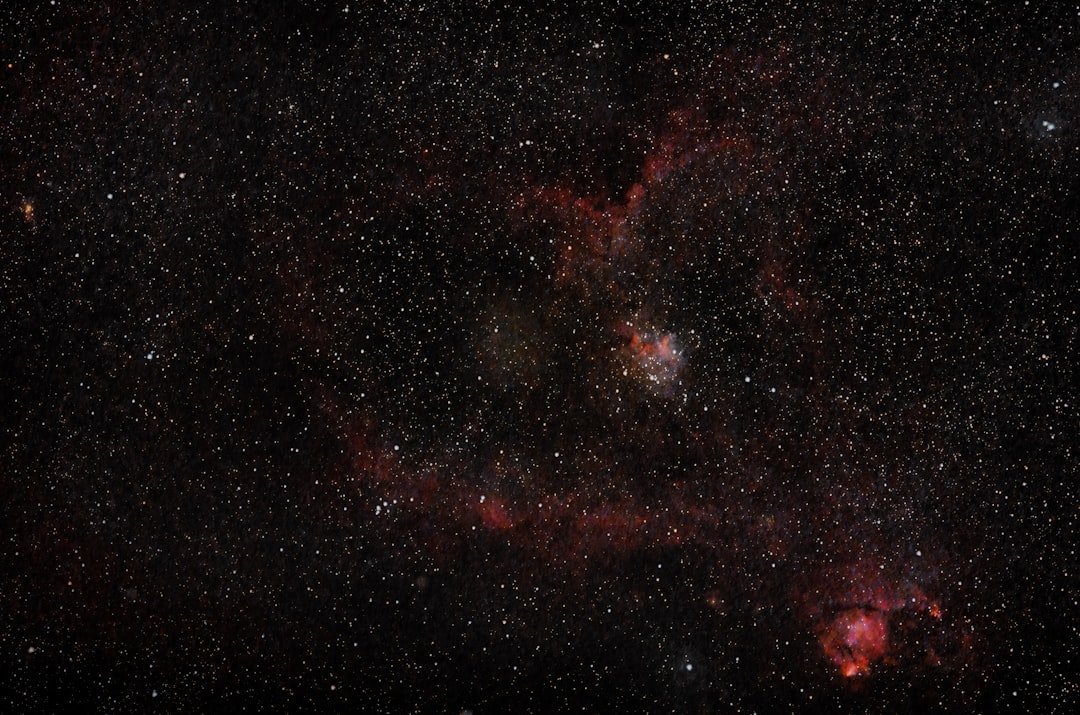
In the vast cosmic nursery of the Westerlund 2 star cluster, where dust veils secrets from prying eyes, the James Webb Space Telescope (JWST) has pierced the gloom. Released on December 19, 2025, this stunning infrared image from NASA, the European Space Agency (ESA), and the Canadian Space Agency reveals elusive brown dwarfs—celestial misfits that blur the line between planets and stars. Nestled 20,000 light-years away in the constellation Carina, amid the swirling Gum 29 nebula, Westerlund 2 pulses with the raw energy of stellar birth. But what JWST uncovered isn't just a pretty picture; it's a window into the universe's shadowy underbelly, where failed stars lurk in the haze.
Peering Through Cosmic Dust
Imagine trying to spot fireflies in a fog-shrouded forest. That's the challenge astronomers face when studying star-forming regions like Westerlund 2, a compact powerhouse spanning 6 to 13 light-years and home to about 3,000 stars. Formed roughly 2 million years ago, this cluster boasts some of the Milky Way's hottest, brightest, and most massive stars. Their intense radiation and powerful winds act like invisible sculptors, carving ridges and pillars from the surrounding gas and dust—features that leap out in JWST's infrared glow.
What sets JWST apart is its arsenal of infrared instruments: the Near-Infrared Camera and Mid-Infrared Instrument. These tools slice through obscuring clouds that block visible light, exposing hidden details. In this image, scientists spotted brown dwarfs for the first time in Westerlund 2, along with intricate gas structures that previous telescopes missed. As ESA officials put it, infrared tech is revolutionizing our grasp of star formation, turning dusty enigmas into crystal-clear revelations.
The Enigma of Brown Dwarfs
Brown dwarfs aren't quite stars, nor are they planets. These sub-stellar objects pack 13 to 80 times Jupiter's mass but lack the heft to ignite sustained hydrogen fusion—the nuclear fire that powers true stars. "Brown dwarfs are stellar objects that are born like stars but fail to gather enough matter to reach the masses needed [for fusion]," notes a Space.com report. In Westerlund 2, they thrive in the cluster's dense, dusty cradle, a perfect nursery for such cosmic oddballs.
JWST's infrared prowess shines here, excels at detecting these cool, dim bodies in environments where visible light falters. This isn't the telescope's first rodeo—similar feats illuminated brown dwarfs in the Flame Nebula. By spotting them in Westerlund 2, researchers gain clues about the fuzzy boundaries of star formation, where a budding star might fizzle out instead of flaring to life.
A Leap Beyond Hubble
Flash back to 2015, when the Hubble Space Telescope marked its 25th anniversary with a visible and near-infrared portrait of Westerlund 2. Hubble's view was striking, highlighting dust pillars shaped by stellar winds. Yet it skimmed the surface, unable to delve into the mid-infrared depths where cooler objects hide.
Enter JWST, orbiting from the stable L2 Lagrange point 1.5 million kilometers from Earth since its 2021 launch. Its advanced imaging reveals far more: additional structures, hidden objects, and those elusive brown dwarfs. This isn't just an upgrade; it's a paradigm shift, exposing how massive stars propel galactic evolution through supernovae and winds. As scientists compare the two telescopes, JWST's edge in dusty realms becomes undeniable, painting a fuller picture of cosmic chaos.
Broader Horizons and Future Glimpses
Discovered in 1961, Westerlund 2 has long been a benchmark for massive star formation in our galaxy. JWST's latest image joins a parade of high-resolution releases, from the Westerlund 1 supercluster in 2024 to NGC 602 later that year. It's part of the Extended Westerlund 2 Observing Campaign (EWOCS), led by researchers like V. Almendros-Abad, M. Guarcello, and K. Monsch. Their analysis underscores brown dwarfs' role in decoding star-planet divides, with ties to exoplanet studies and solar system analogs.
This work dovetails with JWST's grand mission: probing the universe from the Big Bang's afterglow to life-friendly solar systems. Collaborations with observatories like Chandra's X-ray eyes add layers, while ongoing EWOCS efforts promise precise counts and masses of these failed stars. In dense clusters like this, brown dwarfs offer insights into the Milky Way's turbulent youth, where massive stars bully their surroundings into shape.
As JWST continues its vigilant watch—echoing triumphs like the 2022 SMACS 0723 deep field, which unveiled thousands of galaxies in a sliver of sky—the Westerlund 2 image reminds us of the telescope's magic. It transforms veiled mysteries into vivid stories, hinting at more discoveries on the horizon. In the dance of dust and light, failed stars may not shine, but they illuminate the universe's deepest secrets, one infrared snapshot at a time.


